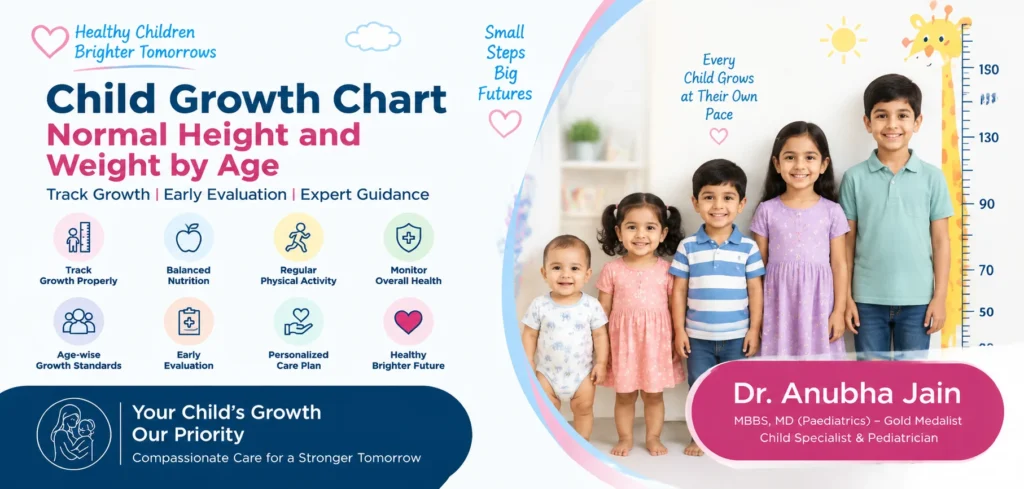
Normal Height and Weight for Children: Growth Charts by Age
A Child Growth Chart helps parents understand whether their child’s height and weight are progressing appropriately for their age.
Parents often ask questions such as “Is my child’s height normal?”, “What should my child weigh?” and “Why is my child growing more slowly than other children?”
Children grow at different rates. Height and weight should not be judged only by comparing one child with another. Pediatricians evaluate growth using measurements taken over time, age-appropriate growth charts and the child’s medical history.
Understanding growth patterns can help parents recognize normal variation and identify when further evaluation may be useful.
Quick Answer: How Do Child Growth Charts Work?
A child growth chart compares a child’s height, length, weight or related measurements with reference data from children of the same age and sex.
The child’s position on the chart is considered together with previous measurements and the overall pattern of growth.
A single measurement does not necessarily indicate whether a child is healthy or has a growth problem.
What Is a Child Growth Chart?
There is no single ideal height or weight that applies to every child.
Normal growth varies according to:
- Age
- Sex
- Genetics and family height
- Nutrition
- Physical health
- Developmental stage
- Puberty timing
A healthy child may be shorter or lighter than another child of the same age while still following an appropriate growth pattern.
Doctors use growth charts to understand how a child’s measurements compare with reference values and whether growth is progressing consistently over time.
For concerns about height, weight or growth trends, parents can explore Child Growth Consultation in Varanasi .
Understanding Growth Charts for Children
Growth charts are tools used by pediatricians to monitor growth throughout childhood.
Depending on age, the measurements may include:
- Length or height
- Weight
- Head circumference in younger children
- Weight-for-length or BMI-for-age where appropriate
- Changes in growth over time
Growth charts use percentile curves or other reference indicators to describe a child’s measurements.
A percentile is not a school-style score. For example, a child on the 25th height percentile is not necessarily less healthy than one on the 75th.
The pattern of growth, the clinical context and changes across measurements matter.
A consistent pattern can be reassuring, but a significant change in growth trajectory may require medical evaluation.
Do Boys and Girls Use the Same Growth Chart?
Growth charts commonly use age- and sex-specific references because growth patterns differ across childhood and adolescence.
The pediatrician selects an appropriate reference for the child’s age and clinical circumstances.
Normal Height and Weight Chart for Children by Age
Growth changes considerably between infancy and adolescence. The following sections explain what doctors commonly monitor at different ages.
These descriptions do not replace actual age-specific growth chart measurements. A clinician should use appropriate growth references when interpreting a child’s measurements.
Infants (0–12 Months)
During the first year, babies grow rapidly. Regular follow-up helps monitor their progress.
Pediatricians may review:
- Weight gain
- Length increase
- Head circumference
- Feeding patterns
- Developmental milestones
Unexpected slowing of weight gain or other growth concerns should be discussed with a healthcare professional.
Toddlers (1–3 Years)
Toddlers generally grow more slowly than infants. Their appetite and feeding habits may also change.
- Balanced nutrition
- Weight gain over time
- Height progression
- Physical activity
- Developmental progress
Parents should focus on the child’s overall growth trend rather than comparisons with other toddlers.
Preschool Children (3–5 Years)
Growth is generally steadier during the preschool years.
- Height progression
- Weight changes
- Eating habits
- Physical activity
- General health
A noticeable slowdown in height gain or unexpected weight changes may need further evaluation.
School-Age Children (5–12 Years)
School-age children usually experience ongoing growth, but patterns vary with individual development.
- Height gain over time
- Appropriate weight trends
- Nutrition
- Physical activity
- Overall health
Changes in growth trajectory should be considered along with medical history.
Adolescents (12+ Years)
Puberty affects height, weight and body composition. Growth spurts can begin at different ages.
- Puberty timing
- Hormonal changes
- Nutrition
- Family growth patterns
- Growth velocity
Early or delayed puberty, or an unexpected change in growth, may warrant pediatric assessment.
For a broader explanation of movement, communication, social and developmental skills, read Growth Milestones in Children .
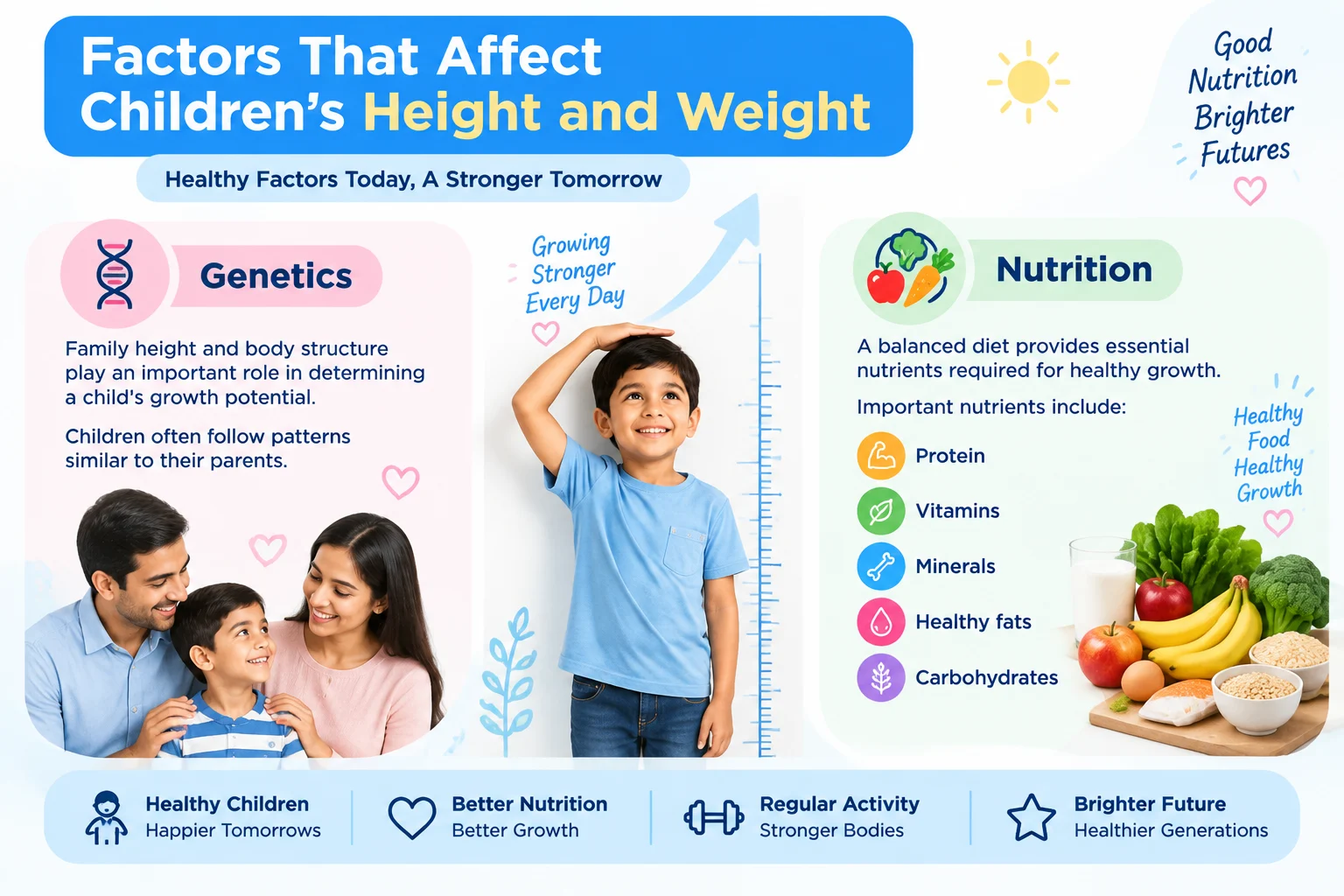
Factors That Affect Children’s Height and Weight
Genetics
Family height and inherited characteristics influence a child’s growth potential.
Children may follow growth patterns that are consistent with their parents’ heights. However, genetics is not the only factor affecting growth.
Nutrition
Balanced nutrition provides energy and nutrients needed for normal development.
Important nutrients include:
- Protein
- Vitamins
- Minerals
- Healthy fats
- Carbohydrates
Poor dietary intake, restricted eating or persistent feeding difficulties may affect a child’s weight gain and growth.
Learn more through Healthy Diet Plan for Children .
Parents seeking individualized feeding guidance can also visit Pediatric Nutrition in Varanasi .
Physical Activity
Regular age-appropriate activity supports:
- Muscle development
- Bone health
- Physical fitness
- Healthy daily routines
Sleep
Adequate sleep supports overall health, development and normal childhood routines.
Children need age-appropriate sleep duration and consistent sleep habits.
Hormones and Health Conditions
Growth is also influenced by hormonal regulation and general health. Certain chronic illnesses or endocrine conditions can affect growth.
If a child’s height is not increasing as expected, read Why Is My Child Not Growing Taller? for additional information about possible causes.
How Do Pediatricians Check Child Growth?
A pediatrician in Varanasi evaluates a child’s growth through multiple measurements and clinical findings rather than one number.
Height or Length Measurement
Age-appropriate measurements are recorded and compared over time to understand growth progression.
Weight Assessment
Weight is evaluated alongside age, length or height and relevant medical information.
Growth Chart Interpretation
Measurements are plotted on an appropriate growth chart to assess percentiles and growth trends.
Medical and Family History
The pediatrician may review:
- Previous illnesses
- Diet and feeding habits
- Family height history
- Development
- Puberty when age-appropriate
- Previous measurements
Physical Examination
An examination may help identify signs suggesting nutritional, hormonal or other medical concerns.
Testing is selected according to the clinical findings. Not every child needs blood tests or scans for a growth concern.
For an individual assessment of growth patterns, explore Growth Consultation in Varanasi .
When Should Parents Be Concerned About Height or Weight?
Parents should arrange pediatric evaluation when they notice:
- Growth appears slower than before
- Height gain becomes unexpectedly slow
- Poor or inadequate weight gain
- Persistent feeding problems
- Unexplained weight loss
- Changes in growth with other symptoms
- Persistent concerns about development
Early evaluation may help determine whether the issue involves normal growth variation, nutrition or another health condition.
For additional information, read Height Issues in Children .
Persistent or unexplained weight loss, significant weakness or other serious symptoms should not be ignored.
Can Nutrition Improve Child Growth?
Appropriate nutrition supports normal growth, but it does not determine a child’s final height on its own.
Height is influenced by genetics, hormones, nutrition, general health and developmental stage.
A balanced diet can help children achieve their natural growth potential.
Parents should avoid unverified height-increasing supplements, medicines or products without appropriate medical advice.
Height and Weight Monitoring in Varanasi
Regular pediatric checkups can help parents understand their child’s individual growth pattern.
Dr. Anubha Jain provides pediatric consultations in Varanasi for:
- Growth monitoring
- Height-related concerns
- Weight concerns
- Nutrition guidance
- Child health evaluation
Parents looking for a Pediatrician in Varanasi can discuss growth, nutrition, development and overall health during a consultation.
Clinic: Plot 36A, Kabir Nagar, Durgakund, Varanasi – 221005.
Appointment Enquiries: +91 9454643742
Frequently Asked Questions About Child Growth Charts
1. What is the normal height and weight for children?
Normal measurements vary by age, sex and individual growth patterns. Pediatricians use appropriate growth charts to assess a child’s measurements over time.
2. How can I know if my child is growing normally?
Regular height and weight monitoring, along with assessment of growth patterns, can help identify whether growth is progressing appropriately.
3. Should I compare my child’s height with other children?
Not on appearance alone. Children grow at different rates. A pediatrician considers growth chart measurements, growth velocity and individual history.
4. Can diet affect my child’s height?
Nutrition supports normal growth, but height also depends on genetics, hormones, development and health.
5. What does a growth percentile mean?
A growth percentile describes a child’s measurement relative to a reference population of the same age and sex. It does not independently measure health or predict final height.
6. When should parents visit a pediatrician for growth concerns?
Consult a pediatrician if height gain slows, weight gain is poor, the growth pattern changes or additional symptoms develop.
Additional Respiratory Health Information for Parents
Children experiencing persistent cough, wheezing, asthma symptoms or recurring breathing problems may require medical evaluation.
For additional information about respiratory health, visit Samaria Multi-Speciality & Chest Centre, Varanasi.
Located in Kabir Nagar, Durgakund, Varanasi, the centre provides information about respiratory care and services including asthma management, pulmonary function testing, bronchoscopy, COPD care and other chest-related conditions.
The specialist team also includes Dr. Anubha Jain, Senior Consultant Pediatrician & Child Specialist.
Website: https://chestclinicvns.com/
Address: Plot 36A, Kabir Nagar, Durgakund, Varanasi – 221005.
Contact: +91 8795300333
Note: This resource provides information about respiratory healthcare. Children with severe breathing difficulty require immediate emergency medical attention.
Conclusion
Every child grows at an individual pace. Instead of focusing on a single number, parents should consider their child’s overall growth pattern.
Regular monitoring of height, weight, nutrition and development helps identify when further assessment may be useful.
For concerns about your child’s growth, consult a qualified pediatrician for individualized evaluation.
Dr. Anubha Jain
MBBS, MD (Pediatrics)
Kabir Nagar, Durgakund,
Varanasi – 221005