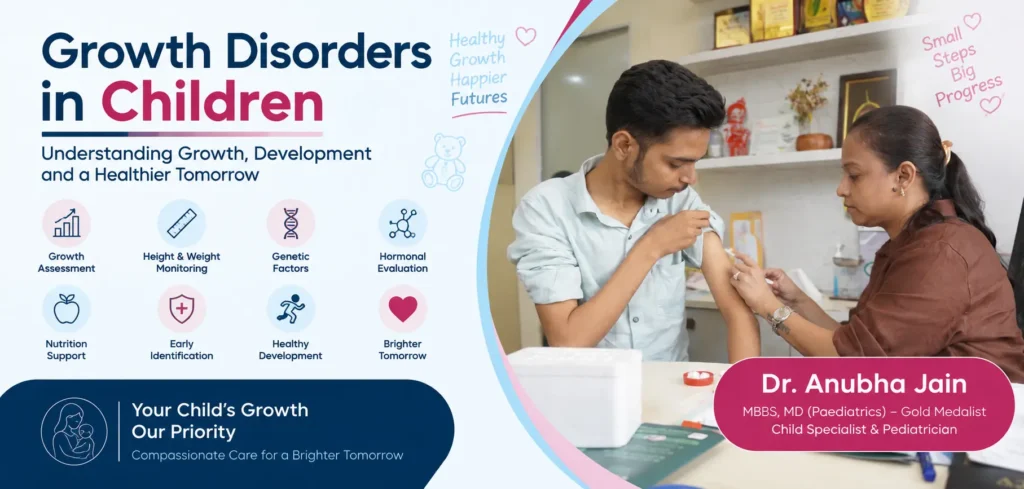
Understanding Your Child’s Growth, Development and Health
Is Your Child Growing as Expected?
Growth is an important part of childhood development. Children do not all grow at exactly the same rate, and differences in height or weight can sometimes be completely normal.
However, a noticeable change in growth pattern, persistent slow growth or concerns about height and weight may require pediatric evaluation.
Dr. Anubha Jain provides pediatric care in Varanasi for children with concerns related to growth, height, weight and development.
What Are Growth Disorders in Children?
Growth disorders refer to conditions or growth patterns in which a child’s physical growth may be significantly different from what would generally be expected for their age and developmental stage.
Growth Can Be Affected By:
- Genetics
- Nutrition
- Hormones
- General health
- Chronic medical conditions
- Developmental factors
A child’s growth should therefore be assessed over time rather than based on a single height or weight measurement.
How Does Normal Child Growth Work?
Children grow rapidly during infancy and early childhood, followed by periods of relatively steady growth before another major growth phase during puberty.
Growth can vary from one child to another.
Factors such as:
- Family height
- Age
- Sex
- Nutrition
- Physical health
- Puberty timing
This is why comparing your child with another child of the same age does not necessarily indicate a medical problem.
Common Signs of Growth Problems in Children
Slow Height Gain
The child’s height appears to increase very slowly over time.
Change in Growth Pattern
The child’s previous growth pattern changes noticeably.
Poor Weight Gain
The child is not gaining weight appropriately or has persistent difficulty gaining weight.
Significant Difference From Family Growth Pattern
The child’s growth appears substantially different from what might be expected based on family growth patterns.
Delayed Development
Growth concerns occur alongside other developmental concerns.
Puberty Concerns
Physical development appears significantly earlier or later than expected.
What Causes Growth Disorders in Children?
Growth problems can have many different causes.
Genetic Factors
Genetics play an important role in determining a child’s height and growth potential.
Some children are naturally shorter or taller because of their family height pattern.
This does not necessarily indicate a medical disorder.
Nutritional Factors
Adequate nutrition is essential for normal growth.
Poor dietary intake, feeding difficulties or certain nutritional deficiencies may affect growth.
Nutrition should therefore be considered when evaluating a child with growth concerns.
Hormonal Factors
Certain hormones play important roles in childhood growth and development.
Hormonal conditions involving growth-related pathways or the thyroid may sometimes affect growth.
If a pediatric evaluation suggests a possible hormonal cause, further assessment may be recommended.
Chronic Health Conditions
Some long-term health conditions can affect a child’s growth.
Depending on the child’s symptoms, medical history and examination, further investigation may be required.
Normal Variation in Growth
Not every child who is shorter or grows differently has a growth disorder.
Some children may simply have:
- Familial short stature
- Different timing of growth
- Later puberty
- Individual growth patterns
Regular monitoring can help distinguish normal variation from a potential concern.
Types of Growth Concerns in Children
Short Stature
A child may be significantly shorter than expected for their age or family growth pattern.
Growth Delay
A child may show slower-than-expected growth over a period of time.
Poor Weight Gain
Inadequate weight gain can sometimes occur alongside nutritional or medical concerns.
Excessive Weight Gain
Rapid or excessive weight gain may also require assessment within the context of the child’s height and growth.
Delayed Puberty
Growth and physical development may sometimes be affected by delayed puberty.
Early Puberty
Earlier-than-expected physical development may also require pediatric evaluation.
How Are Growth Disorders Evaluated?
A proper growth assessment usually involves looking at multiple factors.
1. Growth History
Previous height and weight measurements are reviewed.
2. Height Measurement
Current height is recorded accurately.
3. Weight Measurement
Weight is considered together with height and age.
4. Growth Chart
Measurements may be plotted on an appropriate growth chart to understand the child’s growth trajectory.
5. Family History
Parents’ heights and family growth patterns can provide useful context.
6. Nutrition Assessment
The child’s diet, appetite and nutritional intake may be reviewed.
7. Developmental Assessment
Physical and developmental milestones may be considered.
8. Further Investigation
If clinically indicated, the doctor may recommend appropriate tests or specialist evaluation.
Why Is Growth Monitoring Important?
Regular monitoring allows doctors and parents to understand how a child is growing over time.
Growth Monitoring Can Help Identify:
- Changes in growth velocity
- Persistent poor weight gain
- Height concerns
- Nutritional problems
- Developmental concerns
- Possible need for further evaluation
Early evaluation does not automatically mean that a child has a serious condition.
In many cases, monitoring is an important part of understanding the child’s individual growth pattern.
Growth Disorders and Height Issues
Growth disorders and height concerns are closely related, but they are not exactly the same.
A child may be shorter than peers without having a growth disorder.
The important questions are:
- How has the child grown over time?
- Is the growth pattern consistent?
- Is height progressing appropriately?
- Are there other symptoms?
- Is the child’s overall health normal?
Growth Disorders and Nutrition
Nutrition is an important part of evaluating childhood growth.
Children require adequate:
- Protein
- Energy
- Vitamins
- Minerals
- Healthy fats
- Other essential nutrients
However, simply increasing food intake does not correct every growth problem.
If growth is significantly delayed, the underlying reason should be evaluated rather than assuming that diet alone is responsible.
When Should Parents Consult a Pediatrician?
Parents should consider a consultation when:
- Their child’s growth appears unusually slow
- Height gain has noticeably changed
- Weight gain is inadequate
- The child has persistent feeding or nutrition problems
- Growth concerns are accompanied by other symptoms
- Puberty appears unusually early or delayed
- Parents have ongoing concerns about the child’s development
Growth Assessment for Different Age Groups
Infants
- Weight gain
- Feeding
- Length/height
- Development
Toddlers
- Growth pattern
- Nutrition
- Feeding behaviour
- Developmental milestones
School-Age Children
- Height
- Weight
- Growth velocity
- Nutrition
- Physical development
Adolescents
- Puberty
- Height progression
- Weight
- Hormonal concerns
- Overall development
Growth Disorders and Pediatric Endocrinology
Some growth concerns may require evaluation of hormonal or endocrine factors.
A pediatrician can assess the child initially and determine whether specialist evaluation is appropriate.
Potential endocrine-related concerns may include:
- Growth hormone-related problems
- Thyroid-related concerns
- Puberty-related disorders
- Other hormonal conditions
Why Choose Dr. Anubha Jain for Growth Concerns in Varanasi?
Child-Focused Assessment
Growth is evaluated according to the child’s individual age, development and health history.
Growth Monitoring
Previous measurements can be reviewed to understand the child’s growth trajectory.
Nutrition-Aware Approach
Diet and nutrition can be considered alongside growth and overall health.
Parent Guidance
Parents receive clear guidance regarding monitoring, evaluation and appropriate next steps.
Comprehensive Pediatric Care
Growth concerns can be assessed alongside general pediatric healthcare, vaccination and nutrition.
Frequently Asked Questions
Q1. What are growth disorders in children?
Growth disorders are conditions or patterns in which a child’s physical growth may differ significantly from what would generally be expected. Causes can include genetic, nutritional, hormonal or medical factors.
Q2. How do I know if my child has a growth problem?
A single height measurement cannot usually determine whether a child has a growth problem. Doctors look at growth measurements over time and consider age, development, family history and overall health.
Q3. Is being shorter than other children a growth disorder?
Not necessarily. Genetics and normal variations in growth can make some healthy children shorter than their peers.
Q4. Can nutrition cause growth problems?
Inadequate nutrition can affect normal growth, but growth concerns can also have genetic, hormonal or medical causes.
Q5. Can a pediatrician evaluate growth disorders?
Yes. A pediatrician can assess a child’s growth pattern and determine whether monitoring, further testing or specialist evaluation is appropriate.
Q6. When should I see a pediatric endocrinologist?
If a child’s growth or development suggests a possible hormonal or endocrine concern, a pediatrician may recommend evaluation by a pediatric endocrinology specialist.
Q7. Can growth disorders be treated?
Treatment depends entirely on the underlying cause. Some children may only require monitoring and nutritional guidance, while others may require specific medical treatment or specialist care.
Concerned About Your Child’s Growth?
Don’t rely only on comparison with other children. Understanding your child’s individual growth pattern is the first step toward appropriate care.
Book a Growth Consultation with Dr. Anubha Jain in Varanasi