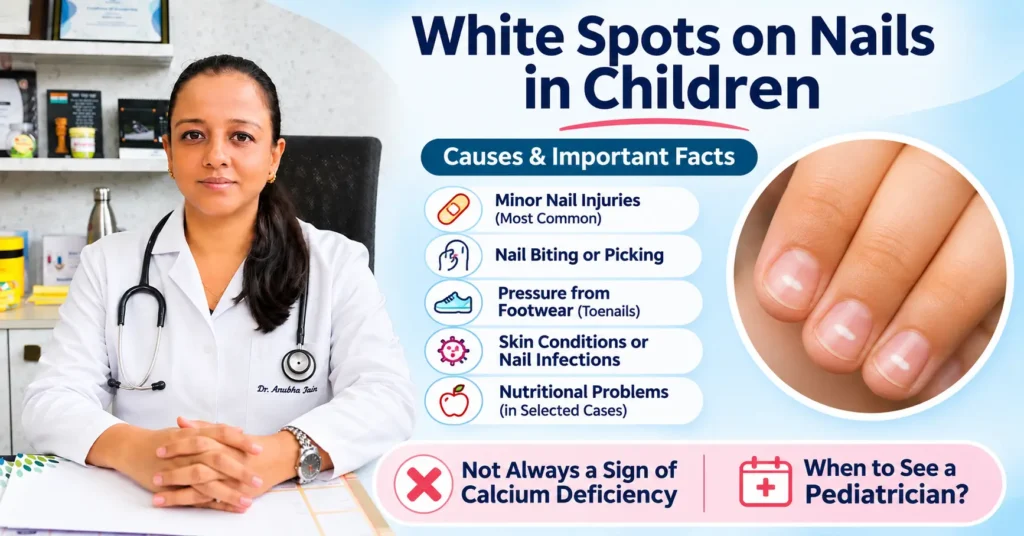
White spots on nails in children are a common reason parents become concerned about their child’s health. A parent may notice one or more small white marks on a child’s fingernails and wonder whether they indicate a calcium deficiency, poor nutrition or another problem.
In many cases, these spots are harmless and occur after minor injury to the part of the nail where new nail tissue develops. Children may not remember bumping or picking at their nails because the marks can become visible sometime after the injury.
However, some nail changes may be associated with skin conditions, infection or other health concerns. Understanding the pattern and associated symptoms helps determine whether medical evaluation is needed.
Quick Answer: What Causes White Spots on Nails in Children?
White spots on nails in children are most commonly associated with minor nail injuries, such as accidental bumps, nail biting or repeated pressure near the nail base.
The medical term for white discoloration of the nail is leukonychia.
Small white spots do not automatically mean a child has low calcium, zinc or another nutrient deficiency.
Seek medical advice if the changes affect many nails, the entire nail turns white, or there is pain, swelling, nail damage or other unexplained symptoms.
What Is Leukonychia in Children?
Leukonychia is a medical term describing white discoloration involving part or all of a nail.
It can appear as small white dots, irregular marks, lines or larger pale areas.
The nail plate is made primarily of keratin, a protein that forms the protective nail structure.
New nail tissue is produced in a region called the nail matrix, located partly beneath the skin at the nail base.
Minor disruption during nail formation can create small white areas that become visible as the nail grows.
The term leukonychia describes a visible nail change rather than one specific disease.
7 Possible Causes of White Spots on Nails in Children
1. Minor Nail Injuries
Minor trauma is a common explanation for small white spots.
Children frequently use their hands while playing, drawing, climbing or participating in sports.
A small injury near the nail base can temporarily affect how the nail develops.
The spot may not be visible immediately. As the nail grows, the white mark moves toward the tip.
2. Nail Biting or Picking
Repeated nail biting, cuticle picking or pressing on the nail can damage delicate nail tissues.
Some children develop these habits when bored, anxious or concentrating on an activity.
Reducing repeated trauma may help prevent new marks.
3. Pressure From Footwear
White nail marks can also appear on toenails.
Repeated pressure from tight shoes or activities that cause the toes to press against footwear may contribute to nail changes.
Ensure footwear fits comfortably and allows adequate room for the toes.
4. Skin Conditions Affecting Nails
Certain skin conditions, including eczema and psoriasis, may affect the nails in some children.
Associated changes can include roughness, pitting, thickening or altered nail shape.
These conditions require assessment based on the overall appearance of the nails and skin.
5. Nail Infections
Some fungal infections can cause superficial white discoloration, roughness or changes in nail texture.
A fungal infection is not the most likely explanation for every small white nail spot.
Treatment should be based on an appropriate diagnosis rather than nail appearance alone.
6. Nutritional Problems in Selected Cases
Certain nutritional deficiencies can be associated with nail changes.
However, an isolated white spot is not a reliable way to diagnose calcium, zinc, iron or vitamin deficiency.
A child’s diet, growth pattern and other symptoms are more informative than a single nail mark.
7. Other Less Common Conditions
Unusual nail patterns can occasionally occur with systemic illness, certain medicines or inherited nail conditions.
These causes are much less common than minor trauma in children with a few small spots.
A pediatrician can assess whether additional investigation is appropriate.
Do White Spots on Nails Mean Calcium Deficiency?
Usually, no. It is a common belief that white spots on fingernails are caused by a lack of calcium.
However, small white nail spots are frequently related to minor injury during nail formation.
There is no reliable way to diagnose calcium deficiency from an isolated white nail spot.
Children need adequate calcium for normal bone development, but calcium supplements should not be started solely because of nail discoloration.
Can Zinc Deficiency Cause White Spots?
Zinc is important for growth, immune function and tissue repair.
Certain patterns of nail changes have been reported in association with zinc deficiency.
Nevertheless, one or two small white spots are not enough to identify zinc deficiency.
A child with poor growth, persistent nutritional concerns or other unexplained symptoms may need a broader assessment.
For nutrition-related concerns, parents can learn more about Pediatric Nutrition in Varanasi .
White Spots on Fingernails vs Toenails
White Spots on Fingernails
Often associated with minor trauma, nail biting, picking or repeated contact with objects.
White Spots on Toenails
May be associated with repeated pressure, footwear irritation or other local nail conditions.
The cause cannot always be determined from the location of the spot alone.
Why Does My Child Have White Spots on Multiple Nails?
A few spots on several nails can still occur from repeated minor trauma.
However, nail changes involving many nails at the same time, particularly larger white bands or widespread discoloration, deserve medical review.
The clinician may look for changes in nail shape, texture, growth and associated skin findings.
Recent illnesses, medicines and nutritional history may also be relevant.
Do White Nail Spots Disappear on Their Own?
When white spots are caused by minor injury to the nail matrix, they generally move outward as the nail grows.
Eventually, the affected portion may reach the nail tip and be trimmed away.
Fingernails grow slowly, so this process may take several months.
There is usually no need to try to scrape away or bleach the spot.
If the white area remains fixed in place, spreads or changes the nail texture, a clinician should evaluate it.
Can Poor Diet Cause Nail Changes in Children?
A balanced diet supports normal growth of skin, hair and nails.
Children benefit from adequate protein, energy, iron, zinc and other essential nutrients.
However, white spots on nails cannot reliably measure whether a child is eating enough.
Parents concerned about restricted food intake can read Healthy Diet Plan for Children .
If there is poor weight gain, persistent fatigue or limited dietary variety, a pediatrician may review the child’s nutritional needs and growth.
White Spots on Nails in Toddlers
Toddlers frequently bump their hands, pick at their nails or experience small injuries during play.
These minor events can contribute to white nail marks.
A toddler who is otherwise well, with one or two small spots and normal nails, may not have a significant medical problem.
However, pain, redness, swelling, nail separation or changes affecting several nails should be evaluated.
How Can Parents Care for Their Child’s Nails?
1. Keep Nails Neatly Trimmed
Use age-appropriate nail clippers and avoid cutting nails too short.
2. Discourage Nail Biting
Help children avoid repeated biting and picking that may damage nail tissues.
3. Avoid Cuticle Injury
Do not aggressively push back or cut cuticles.
4. Maintain Gentle Nail Hygiene
Keep nails clean and dry. Avoid harsh chemicals and unnecessary cosmetic treatments.
5. Support Balanced Nutrition
Offer age-appropriate meals containing a variety of nutritious foods.
Do not give supplements solely to remove nail spots without medical advice.
When Should Parents Worry About Nail Changes?
Warning Signs That Need Medical Review
- The entire nail or several nails become white.
- Nails become unusually thick, rough or brittle.
- White discoloration spreads or changes rapidly.
- There is persistent pain or swelling near the nail.
- The nail begins separating from the skin underneath.
- The child has recurrent nail infections.
- Nail changes occur with poor growth or other health concerns.
- Unexplained changes affect many nails at once.
Seek prompt care for severe pain, spreading redness, pus, fever or rapidly worsening inflammation around a nail.
These symptoms should not be treated as simple cosmetic concerns.
How Does a Pediatrician Evaluate White Nail Spots?
Evaluation usually begins with a medical history and examination of the nails.
A pediatrician may consider:
- How long the spots have been present
- Whether they move as the nails grow
- Which nails are affected
- History of nail biting or local injury
- Changes in nail texture or shape
- Skin conditions or recent illnesses
- Medicines and nutritional concerns
- Growth and other associated symptoms
In many uncomplicated cases, examination and reassurance may be sufficient.
Blood tests or other investigations are not routinely required for a few isolated white spots.
Additional testing depends on the child’s clinical findings.
Parent Checklist Before a Consultation
What to Observe
- When the white marks first appeared
- Whether they affect fingers or toes
- Whether spots move toward the nail tip
- Any recent nail injury
- Nail-biting or picking habits
- Changes in nail thickness or texture
- Pain, redness or swelling
- Changes in appetite, growth or activity
Photographs taken a few weeks apart may help show whether the spots are moving with nail growth.
White Spots on Nails in Children: Pediatric Care in Varanasi
Parents in Varanasi who notice unexplained nail changes or have concerns about their child’s nutrition and growth can seek pediatric evaluation.
Dr. Anubha Jain, MBBS, MD (Pediatrics), provides pediatric consultations in Kabir Nagar, Durgakund, Varanasi.
During consultation, the child’s nail changes, medical history, nutritional concerns and growth may be reviewed.
Further tests or referral to a dermatologist depend on the individual findings.
For pediatric consultation information, visit Pediatrician in Varanasi – Dr. Anubha Jain .
Frequently Asked Questions About White Spots on Nails in Children
1. Are white spots on nails normal in children?
Small white spots are common and often result from minor nail injury. They are usually not serious in an otherwise healthy child.
2. Do white nail spots mean calcium deficiency?
No. White nail spots alone do not diagnose calcium deficiency. Minor trauma is a much more common explanation.
3. Can zinc deficiency cause white spots?
Certain nutritional deficiencies may be associated with nail changes, but isolated white spots cannot establish zinc deficiency.
4. What is leukonychia?
Leukonychia is the medical term for white discoloration of the nails. It can have several causes.
5. Will the white spots disappear?
Spots caused by minor nail-matrix trauma often grow outward with the nail and eventually can be trimmed away.
6. Should I give calcium or zinc supplements?
Not solely because of white nail spots. Supplements should be based on appropriate medical assessment and advice.
7. Can white spots indicate a fungal infection?
Some nail infections can cause white discoloration, but most isolated small spots are not caused by fungal infection.
8. When should I consult a pediatrician?
Arrange assessment for widespread, persistent or changing nail discoloration, pain, nail damage or associated health symptoms.
Additional Respiratory Health Information for Parents
Children experiencing persistent cough, wheezing, asthma symptoms or recurring breathing problems may require medical evaluation.
For additional information about respiratory health, visit Samaria Multi-Speciality & Chest Centre, Varanasi.
Located in Kabir Nagar, Durgakund, Varanasi, the centre provides information about respiratory care and services including asthma management, pulmonary function testing, bronchoscopy, COPD care and other chest-related conditions.
The specialist team also includes Dr. Anubha Jain, Senior Consultant Pediatrician & Child Specialist.
Website: https://chestclinicvns.com/
Address: Plot 36A, Kabir Nagar, Durgakund, Varanasi – 221005.
Contact: +91 8795300333
Note: This resource provides information about respiratory healthcare. Children with severe breathing difficulty require immediate emergency medical attention.
Concerned About Your Child’s Nail Changes?
If your child has persistent white nail marks, unusual nail changes, nutrition concerns or other pediatric symptoms, arrange a consultation.
Dr. Anubha Jain
MBBS, MD (Pediatrics)
Plot 36A, Kabir Nagar,
Durgakund, Varanasi – 221005
OPD Timings:
Monday–Saturday
10:00 AM – 1:30 PM
5:30 PM – 8:00 PM
Sunday: Closed
Medical Disclaimer: This article provides general educational information and does not replace individual medical advice, diagnosis or treatment.