Why Is My Child Not Growing Taller? Causes of Slow Growth in Children
Many parents become concerned when they notice that their child is shorter than other children of the same age or when height does not seem to increase as expected.
Questions like “Why is my child not growing taller?”, “Is my child’s height normal?”, or “Should I consult a doctor for slow growth?” are common concerns among parents.
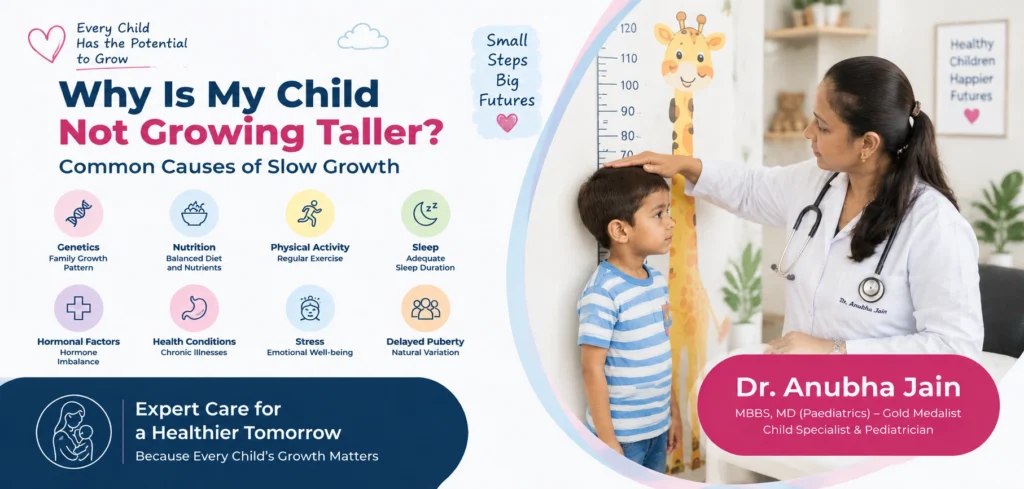
If you are wondering why is my child not growing taller, it is important to look at the child’s overall growth pattern rather than height alone. Genetics, nutrition, hormones, health conditions and individual development can all influence height.
Children grow at different rates, and height depends on several factors including genetics, nutrition, hormones, overall health and development.
A child who is shorter than others does not always have a medical problem. However, a noticeable slowdown in growth or a change in growth pattern may require pediatric evaluation.
How Does Normal Height Growth Happen in Children?
Children experience different growth phases throughout childhood.
Growth is usually faster during:
- Infancy
- Early childhood
- Puberty
During these periods, height increases at different rates depending on the child’s age and development.
Doctors focus on growth pattern over time rather than a single height measurement.
A child who continues growing consistently may have a normal growth pattern even if they are shorter compared with others.
Why Is My Child Not Growing Taller? Understanding Normal Growth
1. Genetics and Family Height
Genetics play an important role in determining a child’s height.
Children often follow patterns similar to their parents.
If parents are shorter in height, the child may naturally have a shorter expected adult height.
This is called familial short stature and is not always a medical concern.
For general child health and growth evaluation, parents can consult a Pediatrician in Varanasi .
2. Nutrition Problems
Nutrition is an important factor for healthy growth.
Children need adequate:
- Protein
- Vitamins
- Minerals
- Healthy fats
- Calories
Poor nutrition, limited food choices or feeding difficulties may affect normal growth.
A Pediatric Nutrition in Varanasi assessment can help identify whether diet may be contributing to growth concerns.
3. Growth Hormone or Hormonal Factors
Hormones play an important role in childhood growth.
Certain hormonal conditions may affect height development.
Possible concerns may involve:
- Growth-related hormones
- Thyroid function
- Puberty-related hormones
If a child’s growth pattern suggests a possible hormonal issue, a pediatrician may recommend further evaluation.
Parents can learn more about Pediatric Endocrinologist in Varanasi for growth and hormone-related concerns.
4. Delayed Growth Pattern
Some children grow at a slower rate during certain periods and catch up later.
Delayed growth may be related to:
- Family growth pattern
- Delayed puberty
- Individual development timing
Regular monitoring helps doctors understand whether growth is progressing normally.
Read more about Growth Disorders in Children and related growth concerns.
5. Chronic Health Conditions
Some long-term health conditions can affect a child’s growth.
Health concerns involving:
- Digestion
- Nutrition absorption
- Long-term illness
- Other medical conditions
may influence height gain.
A pediatric evaluation helps identify whether additional assessment is required.
Signs That Your Child’s Growth May Need Attention
Parents should consider discussing growth concerns with a pediatrician if:
- Your child is not increasing height as expected
- Growth appears slower compared with previous years
- Clothes and shoe sizes are not changing over time
- Height is significantly lower than expected
- Weight gain is also poor
- The child has ongoing health concerns
- Puberty changes appear delayed
Parents can also explore Height Issues in Children for more information about children’s height concerns.
How Do Doctors Evaluate Slow Growth?
A pediatrician evaluates growth using several factors.
Height Measurement
Accurate height measurements are recorded.
Growth Chart Assessment
The child’s measurements are compared with standard growth charts.
Growth Velocity
Doctors check how quickly the child is growing over time.
Family History
Parents’ heights and family growth patterns are considered.
Nutrition Assessment
Diet and nutritional intake are reviewed.
Physical Examination
Overall health and development are assessed.
Can Food Increase a Child’s Height?
A healthy diet supports normal growth, but food alone cannot determine height.
Height is influenced by:
- Genetics
- Hormones
- Nutrition
- Overall health
- Development
Providing a balanced diet helps children reach their natural growth potential.
Parents should avoid unverified height-increasing supplements or products.
For nutrition-related concerns, explore Pediatric Nutrition in Varanasi .
When Should Parents Consult a Pediatrician?
A pediatric consultation may be helpful when:
- Growth seems slower than before
- Child’s height pattern changes
- Parents have ongoing concerns
- There are nutrition-related problems
- Height concerns occur with other symptoms
Early evaluation can help identify whether the child needs monitoring, nutritional guidance or further assessment.
Child Growth Evaluation in Varanasi
Understanding your child’s growth pattern is more important than comparing height with other children.
Dr. Anubha Jain provides pediatric evaluation for:
- Growth concerns
- Height problems
- Nutrition issues
- Development monitoring
- Childhood health concerns
Parents can learn more about Growth Consultation in Varanasi for concerns related to a child’s growth pattern.
Frequently Asked Questions (FAQ)
Why is my child not growing taller?
A child may grow slowly due to genetics, nutrition, hormonal factors, health conditions or normal variation in growth patterns.
Is slow growth always a medical problem?
No. Some children naturally grow slower or are shorter because of family height patterns.
How can I help my child grow taller naturally?
Providing balanced nutrition, adequate sleep, physical activity and regular health monitoring supports healthy growth.
When should I worry about my child’s height?
Parents should consider consultation if growth slows significantly, height gain stops, or other health concerns are present.
Can a pediatrician help with height concerns?
Yes. A pediatrician can evaluate growth patterns and determine whether further assessment is needed.
Conclusion
Every child follows an individual growth pattern. A difference in height does not always indicate a problem.
However, if your child is not growing taller as expected or you notice changes in growth patterns, a pediatric evaluation can help understand the reason and guide the next steps.