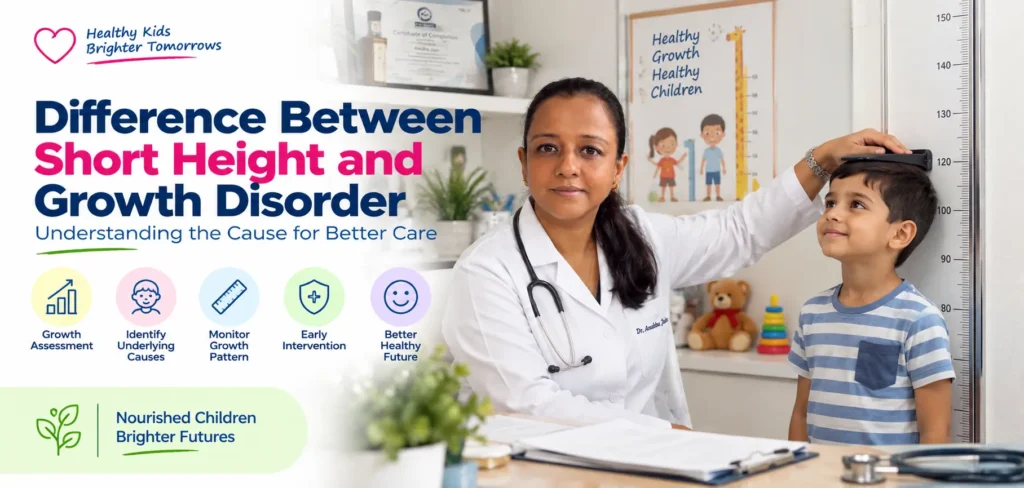
Difference Between Short Height and Growth Disorder
Difference Between Short Height and Growth Disorder is an important topic for parents who become concerned when their child is shorter than other children of the same age.
Parents often ask, “Does being short mean that my child has a growth disorder?” The answer is not necessarily. Children can naturally have different heights because of genetics, family growth patterns, nutrition, development and the timing of puberty.
Understanding the Difference Between Short Height and Growth Disorder can help parents understand why growth pattern over time is often more informative than a single height measurement and when pediatric evaluation may be appropriate.
What Is Short Height in Children?
Short height means that a child is shorter than many other children of the same age and sex. However, being short does not automatically mean that a child has a medical condition.
A child may be shorter because of family genetics, a naturally individual growth pattern, later puberty timing or other normal variations in development.
- Parents are shorter
- Family members are generally shorter
- The child has a consistent individual growth pattern
- Puberty may occur later
- The child’s growth pattern is naturally different
The child’s overall growth history is generally more informative than a single height measurement.
What Is a Growth Disorder?
A growth disorder refers to a condition that affects normal physical growth. A growth concern may involve slower-than-expected height gain, a significant change in growth pattern or an underlying medical, nutritional or hormonal condition.
Not every child with slow growth has the same cause. A pediatrician needs to assess the individual child’s growth history before determining whether further evaluation is required.
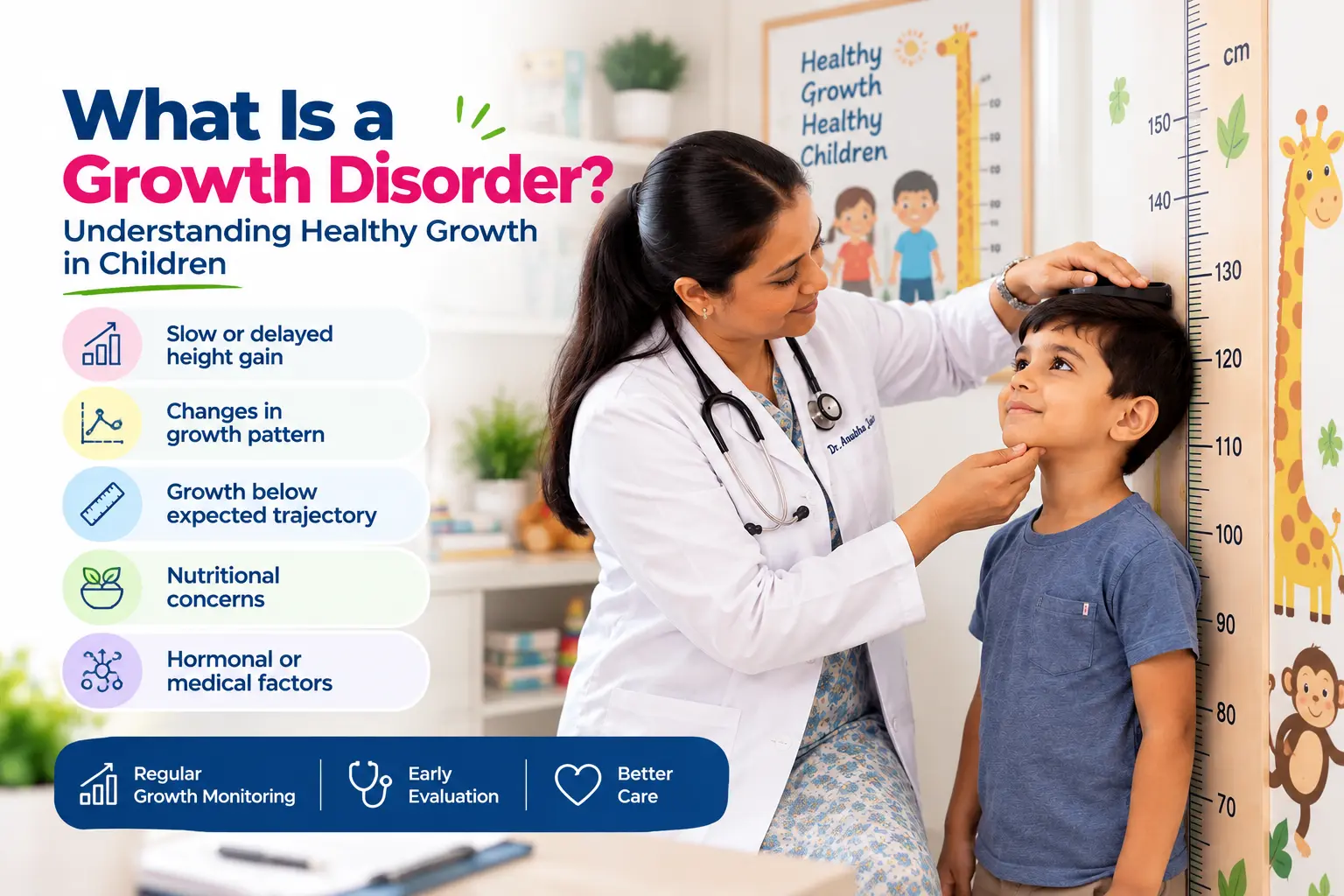
- Slower-than-expected height gain
- Significant changes in growth pattern
- Growth that does not follow the expected trajectory
- An underlying medical condition
- Nutritional or hormonal concerns
Difference Between Short Height and Growth Disorder
The main Difference Between Short Height and Growth Disorder is the child’s growth pattern over time. A child may be naturally short while continuing to grow consistently, whereas another child may have an unusually slow or changing growth pattern that requires further assessment.
| Short Height | Possible Growth Disorder |
|---|---|
| Child may naturally be shorter | Growth may be unusually slow |
| Family height may explain the pattern | There may be an underlying cause |
| Growth can remain consistent | Growth pattern may change |
| Child may otherwise be healthy | Other health concerns may be present |
| Regular monitoring may be sufficient | Further evaluation may be required |
Important for Parents
This comparison should not be used to diagnose a child. A pediatric evaluation is appropriate when there are persistent concerns about height, growth rate, weight, development or overall health.
Why Are Some Children Naturally Short?
Family Genetics
Genetics have a major influence on height. Children with shorter parents may naturally have a shorter expected adult height.
A child can therefore be short while still following a consistent growth pattern.
Normal Growth Variation
Children do not all grow at exactly the same rate. Some children may experience growth spurts earlier, while others may grow more gradually.
Puberty Timing
The timing of puberty can influence when a child experiences a major growth spurt. Some children develop later than their peers and may continue growing at a later stage.
What Can Cause a Growth Disorder?
Growth problems can have different causes. A child’s nutrition, hormonal health, overall health and developmental pattern may all be considered during evaluation.
Nutritional Problems
Inadequate nutrition can affect normal growth. Nutritional concerns may include:
- Poor dietary intake
- Feeding difficulties
- Nutritional deficiencies
- Highly restricted diets
Hormonal Conditions
Hormones play an important role in childhood growth. Certain endocrine conditions can affect height and development.
When appropriate, a pediatrician may recommend further endocrine evaluation based on the child’s growth pattern and clinical assessment.
Understanding Child Growth Charts
Growth charts are commonly used by pediatricians to track a child’s height, weight and growth pattern over time. Parents can also learn more about standardized child growth charts from the CDC Growth Charts .
Chronic Health Conditions
Some long-term medical conditions can affect growth. If slow growth occurs together with other persistent health concerns, further assessment may be appropriate.
What Signs May Suggest a Growth Concern?
Parents should consider discussing their child’s growth with a pediatrician if there are noticeable changes or persistent concerns.
- Height gain appears unusually slow
- The child’s growth pattern has changed
- The child is significantly shorter than expected
- Weight gain is also poor
- There are persistent nutritional concerns
- The child has other ongoing health problems
- Puberty appears unusually early or delayed
These signs do not automatically mean that a child has a growth disorder. They indicate that professional evaluation may be useful.
Why Is Growth Pattern More Important Than One Height Measurement?
A single measurement provides limited information. A child may be short but continue growing steadily, while another child may have previously followed a normal growth pattern and then show a noticeable slowdown.
This is why pediatricians review several aspects of the child’s growth and health, including:
- Previous height measurements
- Weight
- Growth velocity
- Growth charts
- Family height
- Nutrition
- Overall health
How Do Doctors Evaluate Growth Concerns?
1. Height Measurement
The child’s height is measured accurately and recorded for comparison with previous measurements.
2. Previous Growth Records
Earlier measurements help show how the child has grown over time and whether the growth pattern has remained consistent.
3. Growth Chart
Height and weight measurements may be plotted on an appropriate growth chart to understand the child’s growth trajectory.
4. Growth Velocity
The rate of height gain over time is assessed because growth velocity can provide useful information about a child’s growth pattern.
5. Family History
Parents’ heights and family growth patterns are considered when assessing a child’s expected growth pattern.
6. Nutrition Assessment
Diet and nutritional intake may be reviewed to identify whether nutritional factors could be contributing to growth concerns.
7. Physical Examination
Overall health and development are assessed during the physical examination.
8. Further Tests When Appropriate
If the clinical assessment suggests a possible underlying condition, the pediatrician may recommend appropriate investigations.
Can Nutrition Affect Height?
Yes, adequate nutrition supports normal growth. Children need appropriate amounts of protein, energy, vitamins, minerals and healthy fats as part of a balanced diet.
- Protein
- Energy
- Vitamins
- Minerals
- Healthy fats
However, nutrition is only one factor affecting height. Genetics, hormones, health and developmental stage also influence growth.
Parents should avoid unverified products that claim to increase children’s height.
When Should Parents Consult a Pediatrician About Height?
Parents should consider pediatric consultation when they notice persistent concerns about their child’s height or growth pattern.
- Your child’s height gain seems unusually slow
- Growth has changed noticeably
- You have persistent concerns about height
- Weight gain is also poor
- Your child has nutritional problems
- There are concerns about puberty or development
A pediatrician can determine whether the child needs monitoring, nutritional guidance or further evaluation.
Growth Consultation in Varanasi
A proper growth assessment looks at the child’s complete growth history rather than focusing only on current height.
Dr. Anubha Jain provides pediatric consultation in Varanasi for concerns related to:
- Height
- Growth
- Weight
- Nutrition
- Child development
Understanding the Difference Between Short Height and Growth Disorder requires looking at the child’s individual growth pattern, family history, nutrition and overall health.
Frequently Asked Questions About Short Height and Growth Disorder
What is the Difference Between Short Height and Growth Disorder?
The Difference Between Short Height and Growth Disorder is mainly related to the child’s overall growth pattern. A child may naturally be short and continue growing consistently, while a growth disorder may involve an abnormal or changing growth pattern.
Is being short the same as having a growth disorder?
No. Many children are naturally short because of genetics or normal variations in growth. A growth disorder involves an abnormal growth pattern or an underlying condition that may require further evaluation.
How can I know if my child’s short height is normal?
A pediatrician can review height measurements over time, growth velocity, family height, nutrition and overall health to understand the child’s individual growth pattern.
Can a short child still be healthy?
Yes. A child can be shorter than peers and still be healthy if they are following an appropriate and consistent growth pattern.
What causes growth disorders in children?
Possible causes include nutritional problems, hormonal conditions, chronic health conditions and other medical factors. The cause can vary from child to child.
When should I worry about my child’s height?
Consider pediatric evaluation if growth slows significantly, the growth pattern changes or height concerns occur along with poor weight gain or other health concerns.
Can nutrition improve a child’s growth?
Adequate nutrition supports normal growth, but height also depends on genetics, hormones, development and overall health.
Does every child with short height need treatment?
No. Many children with short height only require regular growth monitoring. Further treatment or evaluation, if needed, depends on the underlying cause.
Conclusion
Understanding the Difference Between Short Height and Growth Disorder can help parents focus on their child’s overall growth pattern rather than comparing height with other children.
Being shorter than other children does not automatically mean that a child has a growth disorder. Family genetics, normal growth variation and puberty timing can all influence height.
However, if growth slows significantly, the growth pattern changes or height concerns occur along with poor weight gain, nutritional concerns or other health problems, pediatric evaluation may be appropriate.
If you are concerned about your child’s height or growth, a pediatric consultation can help determine whether regular monitoring or further evaluation is appropriate.