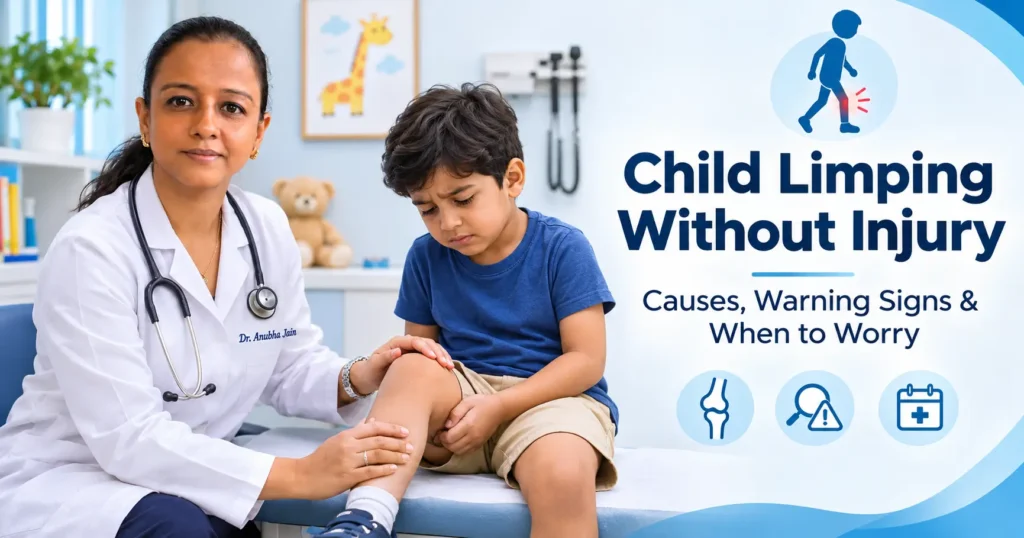
Child limping without injury is a common reason for parents to become concerned. A child who was walking or playing normally may suddenly begin favoring one leg, walking unevenly or avoiding their usual activities. Sometimes this happens without a fall or obvious injury.
There are several possible reasons why children limp. Some causes are temporary, such as inflammation around the hip after a viral illness. Others may involve a small unnoticed fracture, a bone or joint infection, or a condition affecting the developing hip.
A new unexplained limp should be medically assessed. The child’s ability to walk, pain severity, fever and overall condition help determine how urgently care is needed.
Quick Answer: Why Is My Child Suddenly Limping?
A child may suddenly limp because of transient synovitis (irritable hip), minor unnoticed injuries, muscle inflammation, joint conditions or infections.
Seek urgent medical care if your child cannot bear weight, has severe pain, develops fever with a painful limp, or has a hot or swollen joint.
Even if your child seems well, a new unexplained limp should be evaluated by a healthcare professional rather than assumed to be growing pains.
What Does Limping Mean in Children?
Limping describes an abnormal walking pattern. The child may place less weight on one leg, take shorter steps or walk more slowly than usual.
Younger children may not be able to identify exactly where they feel discomfort. Instead, they may refuse to walk, ask to be carried, or become upset when their legs are moved.
A limp may originate from the foot, ankle, knee or hip. Sometimes the painful area is not the source of the underlying problem. For example, a hip condition can cause pain that is felt in the thigh or knee.
Child Limping Without Injury: 7 Possible Causes
1. Transient Synovitis (Irritable Hip)
Transient synovitis is temporary inflammation of the lining of the hip joint. It is a recognized cause of limping in children, particularly in younger school-age groups.
It can occur after a viral illness, such as a cold. Symptoms may include hip discomfort, thigh pain, knee pain or difficulty walking.
Although many cases improve with appropriate care, a doctor must consider other conditions, including serious joint infections.
2. Minor Injuries That Were Not Noticed
Children can experience small injuries while playing without anyone witnessing a fall.
An ankle strain, muscle injury or small fracture may cause a change in their walking pattern.
In toddlers, a lower-leg fracture may occasionally cause limping without obvious swelling or a clear injury history.
Clinical examination and, when appropriate, imaging can help identify the cause.
3. Muscle Pain After a Viral Infection
Some viral illnesses may be followed by temporary muscle inflammation or pain.
Children might complain of painful calf muscles or become reluctant to walk normally.
However, a recent viral illness does not automatically explain every limp. Serious conditions must still be considered when warning signs occur.
4. Bone or Joint Infection
Infections involving a bone or joint, including osteomyelitis and septic arthritis, may cause limping, pain and reduced movement.
Associated symptoms can include fever, swelling, warmth, significant pain or a child appearing generally unwell.
Septic arthritis is an orthopedic emergency because delayed treatment can damage the affected joint.
A serious infection cannot be ruled out simply because fever is absent at a particular moment.
5. Inflammatory Joint Conditions
Some inflammatory conditions may cause joint pain, swelling, morning stiffness or difficulty walking.
Symptoms can occur repeatedly or persist over time.
Children with recurring joint symptoms may require pediatric or specialist evaluation.
Related reading: Joint Pain in Children .
6. Hip Conditions Affecting Growing Children
Conditions such as Perthes disease and slipped capital femoral epiphysis (SCFE) may cause hip, thigh or knee discomfort and limping.
SCFE is particularly important in older children and adolescents and requires urgent orthopedic assessment when suspected.
Children with persistent hip symptoms should avoid strenuous activity until evaluated.
7. Other Underlying Medical Conditions
Less commonly, persistent limping can occur with other bone, blood, neurological or systemic conditions.
Unexplained fatigue, persistent night pain, weight loss or unusual bruising may indicate the need for further medical investigation.
These symptoms do not confirm any particular diagnosis, but they should not be ignored.
Child Limping Without Injury After Fever or Viral Illness
Parents may notice a change in walking after a child recovers from a respiratory illness.
Temporary hip inflammation or post-viral muscle pain may contribute to the symptoms.
However, a child who is currently feverish, unwell or unable to bear weight needs urgent assessment because a bone or joint infection may be responsible.
Do not assume that all limping after fever is harmless or will resolve without evaluation.
Toddler Limping Without Injury: What Parents Should Know
Toddlers may suddenly limp after playing, waking from sleep or recovering from a minor illness.
Because toddlers cannot always explain their discomfort, parents may notice refusal to walk, crying when moving the leg or a preference for being carried.
Possible causes include an unnoticed injury, a toddler’s fracture, transient synovitis or infection.
A new unexplained limp requires clinical assessment. A toddler who cannot stand or bear weight needs urgent care.
Can Growing Pains Cause a Limp?
Typical growing pains usually cause leg discomfort during the evening or night.
They generally do not cause persistent daytime limping.
If your child limps during the day, has joint swelling or experiences localized pain, a different cause should be considered.
It is important not to label an unexplained limp as growing pains without examination.
Can a Child Limp Without Complaining of Pain?
Yes. Some children may limp without clearly reporting pain. This can happen because younger children find it difficult to describe their symptoms.
Some hip conditions may initially cause subtle changes in walking rather than obvious complaints.
Observe whether the limp is persistent, recurrent or associated with reduced movement.
An unexplained painless limp also deserves medical review.
Where Could the Pain Be Coming From?
Foot or Ankle
Minor injury, tenderness or swelling may change walking.
Knee
Knee pain may originate locally or sometimes be referred from the hip.
Hip
Inflammation, infection or developmental conditions can affect movement.
Muscles or Bones
Muscle inflammation, fractures or other conditions may affect the gait.
Warning Signs: When Is Limping an Emergency?
Seek Urgent Hospital Care If:
- The child cannot stand or put weight on a leg.
- There is sudden or severe hip, thigh or knee pain.
- A joint is hot, red or significantly swollen.
- The child has fever with a painful limp.
- The child appears seriously unwell.
- Pain is severe or rapidly worsening.
- There is a significant injury or deformity.
- The child develops serious weakness or reduced responsiveness.
Do not wait for a routine pediatric appointment when these warning signs are present.
What Should Parents Do Before Medical Assessment?
If your child is otherwise well and can walk, take sensible precautions while arranging a medical evaluation.
1. Avoid Forcing Walking
Do not insist that the child runs or continues sports despite pain or limping.
2. Observe the Walking Pattern
Notice when the limp started, which leg is affected and whether the symptoms are worsening.
3. Check for Visible Changes
Look for cuts, blisters, swelling or bruising. Do not forcefully move a painful joint.
4. Check for Fever
Use an appropriate thermometer and record associated symptoms, including recent illnesses.
5. Follow Medical Advice
Pain relief and other treatment should be appropriate for the child’s age, medical history and clinician’s guidance.
How Does a Pediatrician Evaluate a Limping Child?
Evaluation usually starts with the child’s medical history and physical examination.
The pediatrician may ask about recent illnesses, injuries, fever, joint pain and changes in walking.
The examination may include the hips, knees, ankles, feet, spine and surrounding joints.
A doctor may also check how much weight the child can bear and whether any joint has restricted movement.
Depending on the findings, blood tests, X-rays, ultrasound or specialist assessment may be recommended.
Not every child with a limp needs every investigation. Clinical findings determine the next steps.
Does Every Limping Child Need an X-Ray?
No. The need for imaging depends on the child’s symptoms, examination and suspected cause.
An X-ray may be recommended when a fracture or certain bone or joint conditions are suspected.
Blood tests may be useful when a doctor suspects infection or inflammation.
A normal initial test does not exclude every possible cause. Follow-up is important when symptoms persist.
How Long Does a Child’s Limp Last?
The recovery time depends on the underlying condition.
Some mild injuries and cases of transient synovitis may improve over a short period with appropriate medical guidance.
Other causes require specific treatment or specialist follow-up.
If a limp persists, returns or becomes worse, the child should be reassessed.
Parent Checklist Before Visiting a Pediatrician
Details Worth Recording
- When the limp first appeared
- Which leg is affected
- Whether the child can bear weight
- Where pain or tenderness occurs
- Recent fever or illness
- Possible unnoticed injuries
- Swelling, redness or warmth
- Night pain or sleep disturbance
- Changes in appetite or energy
- Whether symptoms are improving or worsening
A short video of normal walking may help the doctor understand the pattern, but never force a child to walk or delay urgent care for a video.
Child Limping Without Injury: Pediatric Care in Varanasi
Parents in Varanasi who notice an unexplained limp can arrange a pediatric evaluation to understand possible causes and appropriate next steps.
Dr. Anubha Jain, MBBS, MD (Pediatrics), provides pediatric consultations in Kabir Nagar, Durgakund, Varanasi.
The consultation may include reviewing the child’s symptoms, recent illness, walking pattern and general health.
When needed, the pediatrician may recommend additional investigation or orthopedic referral.
For information about local pediatric services, visit Pediatrician in Varanasi – Dr. Anubha Jain .
Frequently Asked Questions About Limping in Children
1. Why is my child suddenly limping?
Possible reasons include transient synovitis, minor unnoticed injuries, muscle inflammation or bone and joint conditions. An unexplained limp needs evaluation.
2. Can a child limp after a viral fever?
Yes. Temporary hip or muscle inflammation may follow viral illnesses. However, fever with a painful limp needs urgent assessment.
3. Can growing pains cause limping?
Typical growing pains do not usually cause persistent daytime limping. Another cause should be considered.
4. Is a painless limp serious?
Not always, but it may still indicate a medical condition. An unexplained painless limp needs evaluation.
5. What is an irritable hip?
Irritable hip, or transient synovitis, is temporary inflammation of the hip joint. A medical assessment is important to exclude serious causes.
6. When should parents visit an emergency department?
Seek urgent hospital care if the child cannot bear weight, has severe pain, has a hot swollen joint or is unwell with fever.
7. Will my child need blood tests?
Not necessarily. Tests depend on the suspected cause and clinical findings.
8. Which doctor should examine a limping child?
A pediatrician can provide an initial assessment and recommend orthopedic or other specialist care when required.
Additional Respiratory Health Information for Parents
Children experiencing persistent cough, wheezing, asthma symptoms or recurring breathing problems may require medical evaluation.
For additional information about respiratory health, visit Samaria Multi-Speciality & Chest Centre, Varanasi .
Located in Kabir Nagar, Durgakund, Varanasi, the centre provides information about respiratory care and services including asthma management, pulmonary function testing, bronchoscopy, COPD care and other chest-related conditions.
The specialist team also includes Dr. Anubha Jain, Senior Consultant Pediatrician & Child Specialist.
Website: https://chestclinicvns.com/
Address: Plot 36A, Kabir Nagar, Durgakund, Varanasi – 221005.
Contact: +91 8795300333
Note: This resource provides information about respiratory healthcare. Children with severe breathing difficulty require immediate emergency medical attention.
Concerned About Your Child’s Limp?
If your child has an unexplained limp, ongoing joint discomfort or changes in walking, arrange a pediatric evaluation.
For severe pain, inability to bear weight or fever with a painful joint, seek urgent hospital care.
Dr. Anubha Jain
MBBS, MD (Pediatrics)
Plot 36A, Kabir Nagar,
Durgakund, Varanasi – 221005
OPD Timings:
Monday–Saturday
10:00 AM – 1:30 PM
5:30 PM – 8:00 PM
Sunday: Closed
Medical Disclaimer: This article provides general educational information and does not replace diagnosis, medical examination or emergency care.