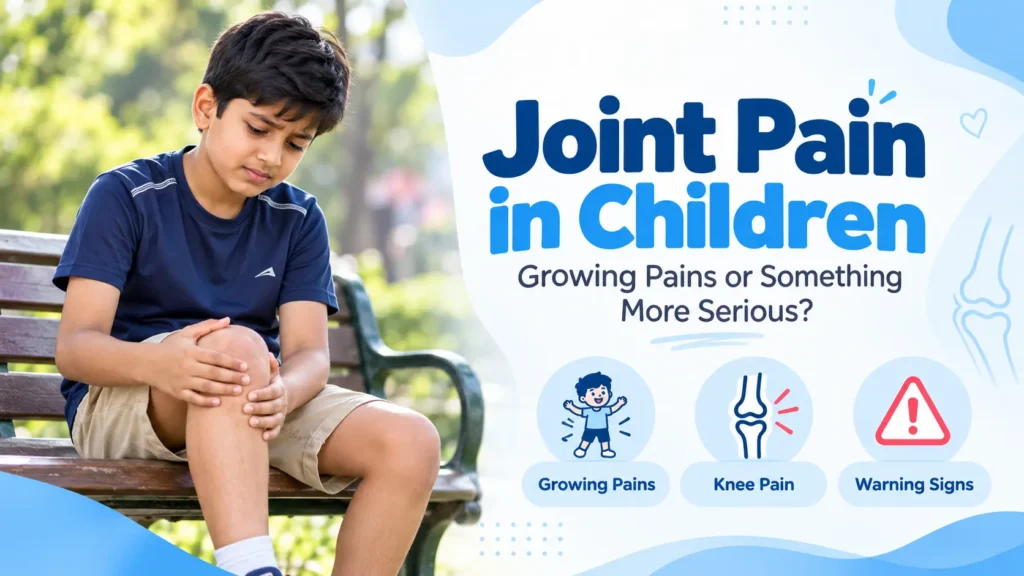
Joint Pain in Children can worry parents when a child complains of knee pain, ankle discomfort, stiff joints or difficulty walking. Some aches are related to minor injuries and physical activity, while others need prompt medical assessment.
Parents sometimes describe any leg pain as “growing pains.” However, typical growing pains affect muscles rather than the joints. Swelling, limping, persistent morning stiffness or fever should not automatically be attributed to normal growth.
This guide explains common patterns of joint pain, how growing pains differ from joint-related problems, warning signs to recognise and when to consult a pediatrician.
Quick Answer for Parents
Mild muscle aches after activity can occur in otherwise healthy children. But actual joint swelling, repeated limping, morning stiffness or pain that disrupts normal activities needs medical assessment.
A child with a hot, swollen joint, fever, severe pain or inability to bear weight requires urgent medical care.
What Is Joint Pain in Children?
A joint is the area where two bones meet, such as the knee, ankle, hip, wrist or elbow. Joint pain may involve discomfort, swelling, stiffness or difficulty moving.
Children sometimes struggle to describe exactly where they feel pain. A problem in the hip, for example, can sometimes be felt as pain in the knee.
The location, duration, activity level, recent injuries and other symptoms help guide medical assessment.
Growing Pains vs Joint Pain in Children
Growing pains is a familiar term used for recurring childhood muscle aches, often involving the legs. Despite the name, these aches are not proven to be caused by bones growing quickly.
Typical Growing Pain Pattern
- Aching in leg muscles, often the calves or thighs
- Often affecting both legs
- Usually occurring during the evening or night
- Generally absent or improved by the next morning
- No swollen, red or hot joints
- Normal walking and activities between episodes
Signs That Do Not Fit Typical Growing Pains
- Pain clearly centred in a swollen joint
- Persistent pain in one location
- Morning stiffness or difficulty getting moving
- Repeated limping or refusal to walk
- Fever, weight loss or unusual tiredness
- Pain that is progressively worsening
A pediatrician should assess any pattern that does not fit a typical harmless muscle ache. Parents should avoid diagnosing growing pains themselves when warning signs are present.
Why Might a Child Complain of Knee Pain?
Knee discomfort can occur after sports, running, jumping or a minor injury. In older active children, repetitive strain around the knee may be relevant.
However, swelling, persistent pain or a limp needs clinical evaluation. A child with knee pain may occasionally have an underlying hip problem, so the examination may include both joints.
Can Sports and Physical Activity Cause Joint Pain?
Sports can place repeated stress on muscles, tendons and joints, particularly when a child suddenly increases activity or has insufficient recovery time.
Some problems are minor and improve with appropriate rest, while others require physiotherapy, orthopaedic assessment or further investigation.
Helpful Activity Habits
- Encourage suitable warm-up and activity routines.
- Allow recovery between strenuous sessions.
- Use comfortable, appropriate footwear.
- Do not force a child to play through significant pain.
- Take new limping or joint swelling seriously.
- Seek assessment for recurring activity-related pain.
What Does Morning Joint Stiffness Mean?
A child who repeatedly wakes with stiff joints, struggles to bend a knee or has difficulty using a hand in the morning should be evaluated.
Persistent swelling and stiffness may sometimes be associated with inflammatory conditions, including juvenile idiopathic arthritis.
This does not mean every stiff joint indicates arthritis. A pediatrician may examine the joints and recommend specialist evaluation when appropriate.
Can a Viral Infection Cause Joint or Muscle Pain?
Some viral illnesses cause temporary muscle aches and discomfort. Certain infections can also produce joint symptoms or inflammation.
However, fever together with a swollen, hot or extremely painful joint can indicate a serious infection and requires urgent assessment.
Parents should not assume a child has a harmless viral ache when walking becomes difficult or joint movement is severely painful.
When Does Joint Pain Need Pediatric Evaluation?
Arrange a medical appointment if pain keeps returning, affects sleep or school, limits play or is associated with a change in walking.
Symptoms Parents Should Report
- Recurring joint pain without a clear cause
- Swelling, redness or warmth around a joint
- Morning stiffness that happens repeatedly
- A new or persistent limp
- Pain that interferes with running or walking
- Night pain that is persistent or worsening
- Unexplained weight loss, pallor or fatigue
- Fever or recent illness accompanying joint symptoms
Child Healthcare in Varanasi
For information about pediatric evaluation of childhood symptoms, visit Pediatrician in Varanasi .
When Is Joint Pain in Children an Emergency?
Seek Urgent or Emergency Medical Care If:
- The child cannot stand, walk or bear weight.
- A joint is hot, swollen and very painful, especially with fever.
- There is severe hip pain or sudden difficulty moving the hip.
- A major injury causes deformity or severe pain.
- There is new weakness or loss of normal movement.
- The child appears seriously ill or difficult to wake.
A joint infection can damage the joint and requires urgent hospital-based care. Do not wait for a routine appointment or try to exercise the affected joint.
What Can Parents Do for Mild Muscle Aches?
If a child has a familiar, mild muscle ache after activity, has no warning signs and walks normally, simple comfort measures may help.
Comfort Measures
- Allow comfortable rest after vigorous play.
- Offer age-appropriate fluids.
- Try gentle massage for typical muscle aches.
- A comfortably warm bath may soothe tired muscles.
- Discuss suitable pain relief with a healthcare professional.
- Monitor whether the pain resolves or changes.
Do not force stretching, massage a hot swollen joint or give adult pain medicines without medical advice.
Does Every Child With Joint Pain Need Blood Tests or an X-ray?
No. Tests depend on the medical history and physical examination. An uncomplicated minor strain may not need investigations.
When symptoms suggest inflammation, infection, injury or another underlying condition, a clinician may recommend blood tests, imaging or specialist referral.
Parents should avoid requesting a particular test without discussing the child’s symptoms with a doctor.
Can Nutrition Affect Bone and Muscle Health?
Age-appropriate nutrition supports healthy bones, muscles and growth. Calcium, vitamin D, protein and overall dietary adequacy are important.
However, joint pain should not be automatically attributed to calcium or vitamin deficiency.
Supplements should be used when clinically appropriate rather than started without a medical assessment.
What Should Parents Record Before the Appointment?
Child Joint Pain Observation Checklist
- Where the pain occurs
- When symptoms first began
- Whether one joint or several areas are affected
- Recent injuries, sports or unusual activity
- Whether pain occurs in the morning, afternoon or night
- Any swelling, redness, fever or morning stiffness
- Whether the child has started limping
- Medicines already given and their effects
A simple symptom diary may help identify patterns, but it should not delay medical care when the child cannot walk or has other urgent symptoms.
How Does a Pediatrician Assess Joint Pain?
The pediatrician may ask about pain location, duration, injuries, illness history, physical activity and growth.
Examination may include checking joint movement, swelling, tenderness, muscle strength and the child’s gait.
Depending on the findings, the child may need orthopaedic, rheumatology or other specialist assessment.
Finding a Pediatrician for Joint Pain in Varanasi
When a child has repeated joint pain, parents should prioritise medical qualifications, timely evaluation and appropriate referral pathways.
For general local healthcare information, visit Best Pediatrician Near Me .
Parents concerned about overall growth can also explore Growth Consultation in Varanasi .
Consult Dr. Anubha Jain in Varanasi
Dr. Anubha Jain holds MBBS and MD (Pediatrics) qualifications and provides pediatric consultation in Kabir Nagar, Durgakund, Varanasi.
Parents can seek an initial pediatric assessment for recurring pains, changes in walking and other childhood health concerns.
Further investigations or referral depend on clinical findings.
Clinic Information
Doctor: Dr. Anubha Jain
Qualifications: MBBS, MD (Pediatrics)
Address: Plot 36A, Kabir Nagar, Durgakund, Varanasi – 221005
Phone: +91 9454643742
Appointments: Contact Dr. Anubha Jain
Frequently Asked Questions About Joint Pain in Children
Are growing pains the same as joint pain?
No. Typical growing pains are muscle aches, often in both legs. Joint swelling or persistent limping needs evaluation.
Why does my child’s knee hurt after playing?
Activity-related strain is one possible cause, but persistent pain, swelling or limping requires medical assessment.
Can a child have arthritis?
Yes. Children can develop inflammatory arthritis. Persistent joint swelling and morning stiffness deserve examination.
Is nighttime leg pain normal in children?
Some children experience benign nighttime muscle aches, but persistent, localised or worsening pain must be assessed.
Should a child play sports with joint pain?
A child should not be forced to play through significant pain. Activity guidance depends on the cause.
Does joint pain always mean vitamin deficiency?
No. Several medical and mechanical conditions can cause pain. Testing and supplements depend on clinical findings.
When should parents seek emergency care?
Seek urgent help for inability to walk, a hot swollen joint with fever, severe hip pain or serious injury.
Which doctor should assess joint pain in a child?
A pediatrician can provide initial evaluation and recommend an orthopaedic or pediatric rheumatology referral if needed.
Additional Respiratory Health Information for Parents
Children experiencing persistent cough, wheezing, asthma symptoms or recurring breathing problems may require medical evaluation.
For additional information about respiratory health, visit Samaria Multi-Speciality & Chest Centre, Varanasi .
Located in Kabir Nagar, Durgakund, Varanasi, the centre provides information about respiratory care and services including asthma management, pulmonary function testing, bronchoscopy, COPD care and other chest-related conditions.
The specialist team also includes Dr. Anubha Jain, Senior Consultant Pediatrician & Child Specialist.
Website: https://chestclinicvns.com/
Address: Plot 36A, Kabir Nagar, Durgakund, Varanasi – 221005.
Contact: +91 8795300333
Note: This resource provides information about respiratory healthcare. Children with severe breathing difficulty require immediate emergency medical attention.
Conclusion: Taking Childhood Joint Pain Seriously
Joint Pain in Children can have different causes, including injuries, inflammation and other medical conditions. Not every leg ache is a problem with the joints, and typical growing pains have a different symptom pattern.
Persistent stiffness, swelling, limping or pain that affects daily life deserves pediatric assessment. Severe symptoms and inability to walk require urgent care.
For local pediatric consultation, visit Pediatrician in Varanasi .
Request Pediatric Consultation Call the ClinicMedical Disclaimer: This article is for general education only and does not replace professional examination, diagnosis or treatment.