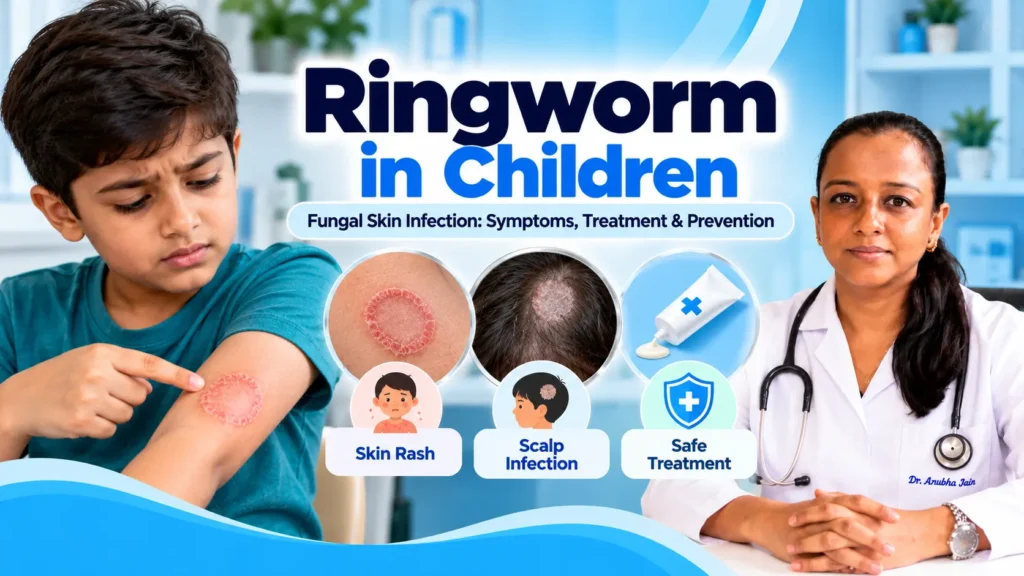
Ringworm in Children is a common fungal skin infection that may appear as an itchy, circular or scaly rash. Parents sometimes notice a small round patch on their child’s arm, neck, face or body that gradually becomes larger. In other cases, the infection affects the scalp and causes scaling, broken hair or patches of hair loss.
Despite the name, ringworm is not caused by a worm. It is caused by fungi known as dermatophytes. The infection can spread through close contact with an affected person, animal or contaminated personal item. Although ringworm is usually treatable, identifying its location and choosing the correct treatment are important.
This parent guide explains the symptoms of ringworm, how scalp ringworm differs from fungal infection on the body, which treatments may be recommended, how to prevent spreading and when to consult a pediatrician.
Quick Answer for Parents
Ringworm in children often causes an itchy, round or ring-shaped rash with a scaly, sometimes raised border. However, the appearance can vary, especially on darker skin tones or after inappropriate cream use.
Limited ringworm on the skin may respond to an appropriate antifungal cream. Ringworm on the scalp usually needs prescription antifungal medicine taken by mouth and cannot be cured by shampoo or skin cream alone.
Avoid steroid-containing combination creams because they may worsen or disguise fungal infection. Seek medical advice for scalp involvement, spreading rash, diagnostic uncertainty or treatment failure.
What Is Ringworm in Children?
Ringworm, also called tinea, is a fungal infection of the skin, scalp or nails. Dermatophyte fungi grow on tissues containing keratin, a protein found in skin, hair and nails.
When ringworm affects the body, it is known as tinea corporis. When it affects the scalp, the condition is called tinea capitis.
Although these infections have related causes, treatment varies depending on where the fungi are growing. Scalp infections usually require a different treatment approach from small patches on the arms or body.
What Are the Main Symptoms of Ringworm in Children?
Circular or Ring-Shaped Rash
A typical ringworm patch may have a scaly outer border and a center that appears less inflamed. However, not every fungal rash forms a perfect circle, and other skin conditions can resemble ringworm.
Itching and Irritation
The affected skin may itch or feel uncomfortable. Scratching can damage the skin and increase the chance of secondary irritation or infection.
Scaling or Flaking
Small dry-looking flakes may appear on the surface or around the edges of a fungal patch. The border can look slightly raised or rough.
Gradually Spreading Patches
Without effective treatment, a fungal patch may become larger or new patches may appear elsewhere on the body. This can happen through scratching, shared items or further exposure.
Scalp Scaling and Hair Loss
Scalp ringworm may cause patches of scale, broken hair, black dots where hairs have snapped or areas of hair loss. Some children develop significant inflammation that requires prompt medical treatment.
What Causes Ringworm in School-Age Children?
Ringworm spreads when dermatophyte fungi move from an infected source to another person’s skin or hair. School-age children may be exposed during close-contact activities, sports or through shared personal items.
Exposure does not always result in infection, and the presence of ringworm does not mean that a child has poor hygiene.
Possible Routes of Transmission
- Direct contact with someone who has ringworm
- Contact with an infected cat, dog or other animal
- Sharing towels, clothing or bedding
- Sharing combs, hairbrushes or headwear
- Contact with contaminated sports equipment
- Exposure to certain shared changing-room or shower surfaces
How Can Parents Recognize Scalp Ringworm?
Scalp ringworm can look different from the classic circular rash found on the body. Parents may notice patches of scaling that initially resemble dandruff, followed by broken hairs or uneven hair loss.
Some children develop redness, swelling or tender areas on the scalp. A severe inflammatory reaction, called a kerion, can produce a painful swollen area and may lead to scarring hair loss if not treated promptly.
Any child with suspected scalp ringworm should be examined by a clinician because creams and ordinary anti-dandruff shampoos are not sufficient to cure infection inside the hair follicles.
Ringworm vs Eczema: What Is the Difference?
Ringworm and eczema can both cause itching, redness or scaling. Their appearance sometimes overlaps, making a diagnosis from a photograph alone unreliable.
| Feature | Possible Ringworm | Possible Eczema |
|---|---|---|
| Cause | Fungal infection | Inflammatory skin condition |
| Appearance | May have a ring-shaped scaly border | Dry, itchy patches in different patterns |
| Contagious? | Yes | No |
| Treatment | Appropriate antifungal medicine | Skin-barrier care and anti-inflammatory treatment when prescribed |
| Diagnostic concern | Can be altered by steroid use | Can resemble fungal rashes |
Because the treatment differs, parents should seek medical advice when the diagnosis is uncertain. Using an anti-inflammatory steroid on an undiagnosed fungal rash can make the infection harder to recognize and treat.
Can Ringworm Appear on Darker Skin Tones?
Yes. Ringworm affects children of all skin tones. On lighter skin, the rash may look red or pink. On darker skin, it may appear brown, grey, purple or darker than the surrounding area.
The border may feel raised or scaly even when redness is difficult to see. The shape, spread and associated itching can provide clues, but they are not enough to establish a diagnosis in every case.
Does Ringworm Always Cause Itching?
No. Although itching is common, some children have relatively little discomfort. Parents may only notice a slowly expanding patch or changes on the scalp.
The absence of itching does not exclude a fungal infection, and a very itchy rash does not automatically confirm one.
A pediatrician or dermatologist may examine the skin or recommend a fungal test if the diagnosis is uncertain.
How Is Ringworm Diagnosed in Children?
A healthcare professional may recognize ringworm from its appearance and the child’s history. The examination may include checking other affected areas, the scalp and the nails.
When the rash is unusual, persistent or has not responded to treatment, a clinician may take a small scraping of skin or a hair sample for fungal examination.
Confirming the diagnosis is particularly important before repeated or prolonged medication, because eczema, psoriasis and other conditions may mimic ringworm.
How Is Ringworm on the Body Treated?
Small, uncomplicated fungal patches on the body can often be treated with an appropriate topical antifungal medicine. Product choice, frequency and treatment duration depend on the medication and the child’s age.
Common antifungal medicines include clotrimazole and terbinafine, but not all formulations are suitable for every age group or body location.
Parents should follow the prescribed or professionally recommended directions and complete the advised course even if the rash begins to look better.
Safe Ringworm Treatment Checklist
- Confirm that the rash is likely fungal before starting medication.
- Choose a product appropriate for the child’s age.
- Follow the instructions for application and duration.
- Wash hands after touching or treating the rash.
- Keep affected skin reasonably clean and dry.
- Avoid scratching and sharing towels.
- Do not use steroid combination creams without medical advice.
- Seek review if the rash spreads or fails to improve.
Why Does Scalp Ringworm Need Different Treatment?
When the fungi infect the scalp and hair shafts, a cream applied to the surface cannot reliably reach all infected hair follicles. Therefore, scalp ringworm usually needs prescription oral antifungal medication.
Depending on the organism and the child’s medical circumstances, a pediatrician or dermatologist may prescribe treatment such as griseofulvin or terbinafine for an appropriate duration.
Medicated shampoo may sometimes be recommended to reduce fungal shedding and transmission, but shampoo alone does not cure scalp ringworm.
Why Should Parents Avoid Steroid Combination Creams?
Some creams sold for itching or fungal infections contain a corticosteroid combined with an antifungal or antibacterial medicine. Unsupervised use of steroid-containing creams can alter the appearance of ringworm and allow fungal infection to spread.
This can result in a condition often called tinea incognito, in which a fungal rash becomes less typical in appearance and may be harder to diagnose.
Inappropriate or repeated antifungal use is also a concern because resistant dermatophyte infections have emerged in several regions, including parts of South Asia. A spreading or nonresponsive infection should be clinically reassessed rather than repeatedly treated with random creams.
Can Ringworm Spread From One Child to Another?
Yes. Ringworm is contagious. Children may acquire the infection through direct contact or by sharing contaminated clothing, towels, combs or equipment.
Families should avoid sharing personal items while treatment is underway and follow the school or clinician’s instructions regarding close-contact activities.
If several household members develop similar rashes, each person should be assessed as appropriate rather than assuming that one tube of medicine can be shared without guidance.
Can Pets Give Children Ringworm?
Yes. Some infected cats, dogs and other animals can transmit ringworm to people. Infected animals may have hairless or scaly patches, but not every infected animal has obvious symptoms.
If a child’s fungal rash seems associated with a pet, arrange veterinary advice for the animal. Do not apply human medication to a pet or veterinary medicine to a child.
Can a Child Attend School With Ringworm?
School attendance depends on the infection’s location, the stage of appropriate treatment and local school policies. Many children with limited skin ringworm can attend school after treatment has begun, provided affected areas are managed appropriately.
Scalp ringworm and participation in close-contact sports may require specific guidance. Parents should check with the treating clinician and school rather than applying a single rule to every child.
Children should avoid sharing hair accessories, towels, helmets and other personal items while the infection is being treated.
How Can Parents Prevent Ringworm From Spreading at Home?
Family Prevention Checklist
- Avoid sharing towels, combs, brushes and hair accessories.
- Wash hands after touching affected skin.
- Keep the child’s personal clothing and towels clean.
- Dry skin thoroughly after bathing and sports activities.
- Clean shared sports equipment and frequently used items.
- Check household members for suspicious rashes.
- Arrange veterinary evaluation for a possibly infected pet.
- Follow treatment instructions and recommended follow-up.
Excessive chemical spraying or fumigation is unnecessary. Focus on appropriate personal hygiene, cleaning and effective treatment of confirmed infections.
When Should Parents Consult a Pediatrician?
A pediatric consultation is appropriate when a circular or scaly rash is persistent, spreading or difficult to identify. Scalp involvement should be assessed promptly because treatment generally requires prescription oral medicine.
Reasons to Schedule Medical Assessment
- Suspected ringworm affecting the scalp
- Broken hair or patches of hair loss
- Several expanding or spreading skin patches
- Recurrent infection after previous treatment
- Rash that worsens with steroid cream
- Persistent symptoms despite correct antifungal use
- Uncertain diagnosis or concern about eczema
- Signs of a secondary bacterial infection
Pediatric Consultation in Varanasi
Parents concerned about recurring fungal rashes, scalp infections or other childhood health issues can seek initial assessment through Pediatrician in Varanasi. Dermatology referral may be recommended according to the findings.
When Does a Fungal Skin Infection Need Urgent Attention?
Seek Prompt or Urgent Medical Care If Your Child Has:
- Rapidly spreading redness with fever
- Painful swelling, pus or suspected skin infection
- A severely swollen, tender scalp lesion
- Significant scalp inflammation with hair loss
- Widespread infection in a child with reduced immunity
- Severe illness or rapidly worsening skin symptoms
Ringworm itself is usually not a medical emergency, but serious scalp inflammation, secondary bacterial infection or infection in a medically vulnerable child may require urgent assessment.
What Happens if Scalp Ringworm Is Left Untreated?
Untreated scalp ringworm can spread and cause increasingly noticeable scaling, broken hairs and hair loss. In severe inflammatory cases, scarring may develop and some hair loss can become permanent.
Timely diagnosis and a complete, appropriate antifungal course help reduce these risks. A child with a painful swollen scalp lesion should not be treated with anti-dandruff shampoo alone.
What Should Parents Record Before the Appointment?
Child Skin Symptom Checklist
- When the first patch appeared
- Where the rash began and whether it spread
- Presence of itching, pain or scaling
- Any patches of hair loss or broken hair
- Contact with someone who has a similar rash
- Exposure to pets with possible skin problems
- Antifungal or steroid creams already used
- Previous similar infections and treatment response
Photographs showing changes over time may help explain the progression. However, a photograph cannot always distinguish fungal infection from other skin conditions.
Consult Dr. Anubha Jain in Varanasi
Dr. Anubha Jain, MBBS, MD (Pediatrics), provides pediatric consultations at Samaria Multi-Speciality & Chest Centre in Kabir Nagar, Durgakund, Varanasi.
Parents concerned about itchy rashes, suspected ringworm, recurrent scalp problems or other school-age health conditions may seek an initial pediatric examination. Treatment and the need for a dermatologist depend on the diagnosis and severity.
Clinic Information
Doctor: Dr. Anubha Jain
Qualifications: MBBS, MD (Pediatrics)
Location: Samaria Multi-Speciality & Chest Centre
Address: Plot 36A, Kabir Nagar, Durgakund, Varanasi – 221005
Contact: +91 9454643742
Appointments: Contact Dr. Anubha Jain
Frequently Asked Questions About Ringworm in Children
What causes ringworm in children?
Ringworm is caused by dermatophyte fungi. It can spread through contact with infected people, animals or contaminated personal items.
Is ringworm caused by a worm?
No. Despite the name, ringworm is a fungal infection and is not caused by a worm.
How can I identify ringworm on my child’s skin?
It may appear as a circular, scaly or itchy patch with a more prominent border. However, eczema and other conditions can resemble ringworm.
Can ringworm cause hair loss?
Yes. Scalp ringworm may cause broken hair and patches of hair loss. Severe inflammation can occasionally lead to scarring.
Can antifungal shampoo alone cure scalp ringworm?
No. Scalp ringworm generally needs oral antifungal medicine prescribed by a clinician. Shampoo may be recommended to reduce transmission but is not sufficient by itself.
Should parents use steroid creams for ringworm?
Not without a clinician’s direction. Steroid-containing creams can worsen or disguise fungal infections and make diagnosis more difficult.
Can ringworm spread through towels and combs?
Yes. Sharing contaminated towels, brushes, clothing or other personal items may spread the fungus.
When should a child see a pediatrician?
Arrange an assessment for scalp infection, spreading lesions, recurrent ringworm, uncertain diagnosis or a rash that does not respond to treatment.
Additional Respiratory Health Information for Parents
Children experiencing persistent cough, wheezing, asthma symptoms or recurring breathing problems may require medical evaluation.
For additional information about respiratory health, visit Samaria Multi-Speciality & Chest Centre, Varanasi.
Located in Kabir Nagar, Durgakund, Varanasi, the centre provides information about respiratory care and services including asthma management, pulmonary function testing, bronchoscopy, COPD care and other chest-related conditions.
The specialist team also includes Dr. Anubha Jain, Senior Consultant Pediatrician & Child Specialist.
Website: https://chestclinicvns.com/
Address: Plot 36A, Kabir Nagar, Durgakund, Varanasi – 221005.
Contact: +91 8795300333
Note: This resource provides information about respiratory healthcare. Children with severe breathing difficulty require immediate emergency medical attention.
Conclusion: Understanding Ringworm in Children
Ringworm in children is a contagious fungal infection that can affect the body, scalp or nails. It often causes a scaly, itchy rash, but its appearance may vary and other skin conditions can look similar.
Appropriate diagnosis, antifungal treatment and good hygiene help prevent ongoing infection and transmission. Scalp ringworm usually requires prescription oral medication, while steroid-containing creams should not be used without medical direction.
For pediatric consultation information in Varanasi, visit Pediatrician in Varanasi.
Request Pediatric Consultation
Call the Clinic
Medical Disclaimer: This article is for general educational purposes and does not replace an individual medical examination, fungal testing, prescription instructions or dermatology assessment.