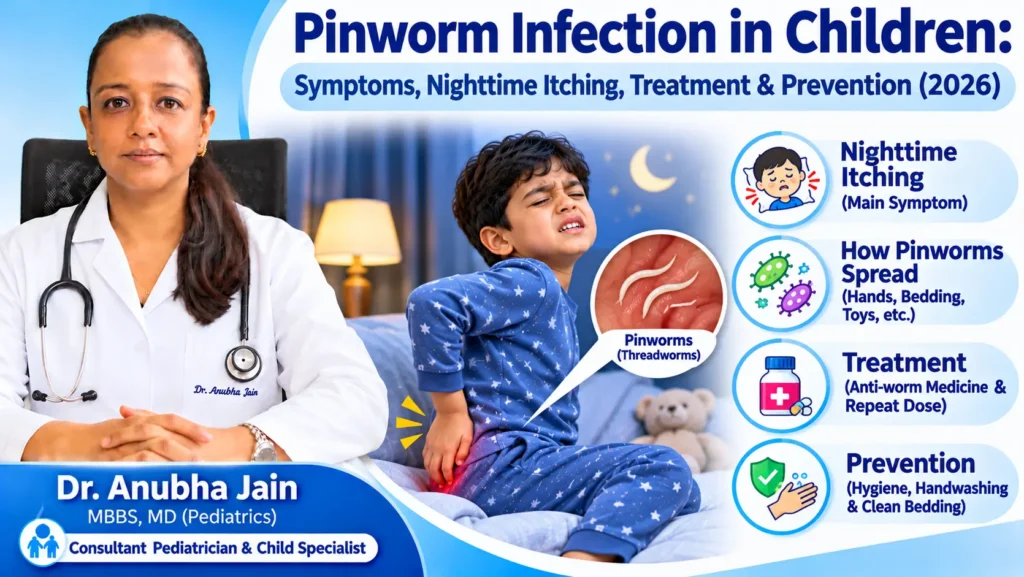
Pinworm Infection in Children: Symptoms, Nighttime Itching, Treatment & Prevention (2026)
Pinworm infection in children is a common intestinal parasitic infection that can cause itching around the anus, particularly at night. Parents may notice their child scratching their bottom, waking frequently or struggling to sleep comfortably.
Pinworms, also called threadworms, are tiny, thin, white worms that live in the intestine. They spread easily among young children and people living in the same household.
Although pinworm infection is usually treatable and does not commonly cause serious illness, repeated infection can be frustrating for families.
This guide explains pinworm symptoms, how infection spreads, how doctors diagnose it, treatment options, home hygiene measures and when to consult a pediatrician in Varanasi.
Quick Answer: What Are the Signs of Pinworms in Children?
The most characteristic symptom of pinworm infection in children is itching around the anus, especially at night. Some children experience restless sleep, irritability or irritation of nearby skin.
Parents may occasionally see small, moving, white thread-like worms around the anal area or on underwear.
A healthcare professional may recommend a morning adhesive tape test to help confirm infection. Treatment commonly includes an appropriate anti-worm medicine, a repeat dose after two weeks when prescribed and careful household hygiene.
Persistent symptoms, significant skin inflammation or uncertain diagnosis require medical assessment.
What Is Pinworm Infection?
Pinworm infection, medically called enterobiasis, is caused by a small roundworm named Enterobius vermicularis.
The worms live in the intestinal tract. Adult female worms move to the skin around the anus, usually at night, to lay eggs.
The eggs and associated irritation can cause intense itching while a child is sleeping.
Pinworms are different from other intestinal parasites. Not every stomach complaint, poor appetite or episode of itching indicates pinworms.
The infection occurs worldwide and is especially common among preschool and school-age children.
Common Symptoms of Pinworm Infection in Children
Some children have very mild symptoms or none at all. Others develop troublesome itching and disturbed sleep.
- Itching around the anus, especially at night
- Frequent scratching around the bottom
- Restless sleep or repeated nighttime waking
- Irritability associated with poor sleep
- Red or irritated skin around the anal area
- Occasional abdominal discomfort
- Visible tiny white thread-like worms in some cases
- Vulval or vaginal irritation in some girls
These symptoms are not specific to pinworms. Skin irritation, dermatitis and certain infections can cause similar discomfort.
If the child develops persistent itching or unusual discharge, a clinician should assess the underlying cause.
Why Does Pinworm Itching Become Worse at Night?
The female pinworm usually moves out of the intestine while the infected person is sleeping and deposits eggs on the skin around the anus.
This process can cause itching and irritation, sometimes enough to wake a child from sleep.
Scratching transfers microscopic eggs onto fingers and beneath fingernails.
If the child later touches their mouth without washing their hands, they may swallow the eggs and become infected again.
A child who experiences repeated anal itching at night should be assessed for possible pinworms and other skin conditions.
How Do Pinworms Spread Among Children?
Pinworms spread when infective eggs are swallowed. The eggs are too small to see without a microscope.
1. Hand-to-Mouth Contact
Eggs may collect beneath fingernails after scratching and be swallowed when a child touches their mouth.
2. Shared Toys
Eggs can be transferred onto frequently handled toys or other objects.
3. Clothing and Bedding
Microscopic eggs may remain on underwear, pajamas, bed sheets and towels.
4. Household Contact
Close contact between family members may allow infection to spread and recur.
5. Schools and Daycare
Children sharing facilities and objects may be exposed to eggs from infected contacts.
6. Inadequate Handwashing
Not washing hands after toilet use or before eating increases the chance of swallowing eggs.
Pinworm infection is not proof of poor parenting or an unclean household. It spreads easily, including among families that follow regular hygiene practices.
What Do Pinworms Look Like?
Adult pinworms are small, thin and white. They may resemble short pieces of white sewing thread.
Sometimes parents see a moving worm around the anal opening after the child has been asleep.
The worms may also be seen occasionally on underwear or stool. However, they are not always visible.
A child can have pinworm infection even if a parent has never seen a worm.
Do not insert objects or attempt to remove worms from inside the anus at home.
Pinworms vs Other Causes of Anal Itching in Children
Not every child with itching around the bottom has a parasitic infection.
Pinworm Infection
Often causes nighttime itching, sometimes with small moving white worms visible.
Skin Irritation
Harsh soaps, excessive wiping, moisture or friction can cause redness and discomfort.
Perianal Skin Infection
Certain bacterial infections may cause a distinctly red, painful rash around the anus.
Other Skin Conditions
Eczema and other skin problems may also cause persistent itching.
A pediatrician can review the symptoms and decide whether pinworm testing, skin treatment or further evaluation is appropriate.
How Does a Pediatrician Diagnose Pinworm Infection?
A pediatrician may consider pinworm infection when a child has persistent nighttime anal itching or a history of similar symptoms among household members.
1. Review the Symptoms
The doctor may ask when itching occurs, whether the child has trouble sleeping and whether worms have been observed.
2. Examine the Affected Skin
An examination may help identify irritation, scratching-related changes or another possible skin condition.
3. Consider the Tape Test
The clinician may recommend an adhesive tape test to collect eggs from the skin around the anus.
4. Review Household Symptoms
Because pinworms spread easily, the doctor may ask whether other family members have nighttime itching.
What Is the Pinworm Tape Test?
The tape test is a commonly used method for identifying pinworm eggs.
A clinician may instruct parents to gently apply the sticky side of clear adhesive tape to the skin around the anus early in the morning.
It is usually done before bathing, using the toilet or getting dressed.
The doctor may recommend collecting samples on three consecutive mornings because eggs may not be present on every single sample.
The collected specimen can be examined under a microscope.
Parents should follow the clinic’s instructions for collection and storage. Wash hands thoroughly after handling samples.
An ordinary stool test may not reliably detect pinworm eggs, so it is not generally the preferred test for pinworms.
Pinworm Treatment for Children
Pinworm infection can usually be treated with appropriate anti-parasitic medication and hygiene measures.
Medicines that may be used include mebendazole, albendazole or pyrantel pamoate, depending on the child’s age, local availability and clinical advice.
A common treatment approach uses a dose followed by a second dose about two weeks later.
The repeat treatment is important because medicines kill worms but do not reliably destroy eggs.
However, the correct medicine, dose and schedule must be determined according to the child’s individual circumstances.
Important Medicine Safety Advice
- Do not use leftover deworming medicine without advice.
- Use a medicine suitable for the child’s age and health condition.
- Children younger than two years need individual medical guidance.
- Do not repeat doses more frequently than recommended.
- Ask a healthcare professional about household treatment.
- Continue hygiene measures even after taking medicine.
Treatment for pinworms should not be confused with routine deworming programs, which may address other intestinal parasites.
Should the Whole Family Be Treated for Pinworms?
Pinworms can spread among household members, including people who have no symptoms.
CDC guidance recommends simultaneous treatment of infected people, their caregivers and household contacts to help prevent recurrence.
A clinician should determine the appropriate medicine and precautions for young children, pregnant or breastfeeding people, and anyone with other medical conditions.
Treating only one child without household hygiene measures may allow the infection to return.
How to Prevent Pinworm Infection From Returning
Good hygiene is especially important because pinworm eggs can remain in the environment after the worms are treated.
1. Wash Hands Regularly
Teach children to wash with soap and water after using the toilet, after changing diapers and before eating.
2. Keep Fingernails Short
Trim and clean nails to reduce the chance of eggs collecting underneath them.
3. Bathe Every Morning
Morning showering can help remove eggs deposited on the skin overnight.
4. Change Underwear Daily
Use clean underwear each morning and encourage children to avoid scratching.
5. Wash Bedding and Sleepwear
Launder affected clothing, towels and bed linen carefully according to fabric instructions. Use hot washing and drying where suitable.
6. Avoid Shaking Bedding
Handle used sheets and clothes carefully rather than shaking them around the room.
7. Clean Shared Surfaces
Regularly clean bathroom surfaces, toys and other high-touch objects.
8. Continue Hygiene After Treatment
Continue recommended hygiene precautions for at least two weeks after the final treatment dose.
Can a Child With Pinworms Go to School?
In many cases, a child with pinworms does not need to stay home from school or daycare solely because of the infection.
However, children should follow the school’s illness policies and any specific medical advice.
Parents should reinforce handwashing and bathroom hygiene, particularly in shared environments.
If the child is unwell for another reason or has significant symptoms, school attendance may need to be reconsidered.
Why Does Pinworm Infection Keep Coming Back?
Reinfection is common because pinworm eggs can be transferred between hands, objects, clothes and bedding.
Another household member may also carry pinworms without obvious symptoms.
Repeated infection may occur when eggs are swallowed again after treatment.
If symptoms repeatedly return despite appropriate medication and hygiene, the pediatrician may review whether the diagnosis is correct, whether household contacts need treatment and whether another skin condition is causing itching.
Common Myths About Worm Infection in Children
Myth 1: Grinding Teeth Means a Child Has Worms
Teeth grinding alone is not a reliable sign of pinworms or any other worm infection.
Myth 2: Every Child With Stomach Pain Has Worms
Abdominal pain has many possible causes. Pinworms should not be diagnosed from stomach pain alone.
Myth 3: One Medicine Dose Always Prevents Recurrence
Pinworm treatment often requires a repeat dose and hygiene precautions because eggs can survive the first dose.
Myth 4: Pets Are the Main Source of Pinworms
Human pinworms spread between people. Ordinary household pets are not considered a reservoir for human pinworm infection.
When Should Parents Seek Medical Attention?
Arrange pediatric assessment if the child has:
- Persistent nighttime anal itching
- Significant redness or pain around the anus
- Bleeding or skin changes caused by repeated scratching
- Vaginal irritation, pain or discharge
- Symptoms that continue despite treatment
- Repeated suspected pinworm infections
- Unexplained weight loss or poor growth
- Persistent abdominal pain or other unexplained symptoms
Severe abdominal pain, a significantly ill appearance, difficulty breathing or reduced responsiveness requires urgent or emergency assessment as appropriate.
Do not assume that severe symptoms are caused by an ordinary pinworm infection.
What Should Parents Record Before the Pediatric Visit?
Pinworm Symptom Checklist
- When the itching first started
- Whether itching is worse at night
- Whether worms have been seen
- Any redness, pain or skin irritation
- Sleep disturbances
- Other household members with symptoms
- Medicines already used
- Whether symptoms returned after treatment
- Changes in appetite, weight or general health
This information can help the doctor decide whether a tape test or treatment is needed.
Pinworm Infection in Children: Pediatric Care in Varanasi
Parents in Varanasi may seek medical advice when their children experience persistent nighttime itching, restless sleep or recurrent suspected worm infection.
Dr. Anubha Jain, MBBS, MD (Pediatrics), provides pediatric consultations in Kabir Nagar, Durgakund, Varanasi.
A consultation can help review symptoms, consider appropriate testing and discuss treatment or prevention measures.
Families seeking a pediatrician in Varanasi can explore Pediatrician in Varanasi – Dr. Anubha Jain .
Frequently Asked Questions About Pinworm Infection in Children
1. What are the main symptoms of pinworms in children?
The most typical symptom is itching around the anus at night. Some children have disturbed sleep, irritability or visible worms.
2. Why does my child’s bottom itch at night?
Pinworms are one possible cause because female worms lay eggs around the anus at night. Other skin conditions can cause similar itching.
3. How is pinworm infection diagnosed?
A clinician may recommend a morning adhesive tape test to look for pinworm eggs.
4. Can pinworms go away without treatment?
Strict hygiene can sometimes help break the infection cycle, but effective medication is commonly recommended when appropriate. Ask a healthcare professional for guidance.
5. Can children get pinworms more than once?
Yes. Reinfection is common because eggs can spread through hands, bedding, clothing and shared surfaces.
6. Do pinworms cause weight loss?
Most infections are mild. Unexplained weight loss or poor growth should not automatically be attributed to pinworms and needs medical evaluation.
7. Should every family member be treated?
Household treatment may be recommended to reduce reinfection. A clinician should confirm suitable medicines and precautions, especially for young children and pregnancy.
8. When should parents consult a pediatrician?
Consult a pediatrician for persistent anal itching, recurrent infection, significant skin irritation, vaginal symptoms or uncertainty about the diagnosis.
Additional Respiratory Health Information for Parents
Children experiencing persistent cough, wheezing, asthma symptoms or recurring breathing problems may require medical evaluation.
For additional information about respiratory health, visit Samaria Multi-Speciality & Chest Centre, Varanasi.
Located in Kabir Nagar, Durgakund, Varanasi, the centre provides information about respiratory care and services including asthma management, pulmonary function testing, bronchoscopy, COPD care and other chest-related conditions.
The specialist team also includes Dr. Anubha Jain, Senior Consultant Pediatrician & Child Specialist.
Website: https://chestclinicvns.com/
Address: Plot 36A, Kabir Nagar, Durgakund, Varanasi – 221005.
Contact: +91 8795300333
Note: This resource provides information about respiratory healthcare. Children with severe breathing difficulty require immediate emergency medical attention.
Medical Disclaimer
This article provides general educational information and does not replace professional medical advice, diagnosis or treatment.
Suspected worm infection, persistent symptoms or recurrent itching should be discussed with a qualified healthcare professional.
Do not give anti-parasitic medication to a young child without age-appropriate medical or pharmacy guidance.
Clinical review by Dr. Anubha Jain is pending. Add the actual medical review date only after approval.
Concerned About Nighttime Itching or Worm Infection?
If your child experiences persistent nighttime itching, restless sleep or repeated suspected worm infections, arrange a pediatric consultation.
Dr. Anubha Jain
MBBS, MD (Pediatrics)
Plot 36A, Kabir Nagar,
Durgakund, Varanasi – 221005