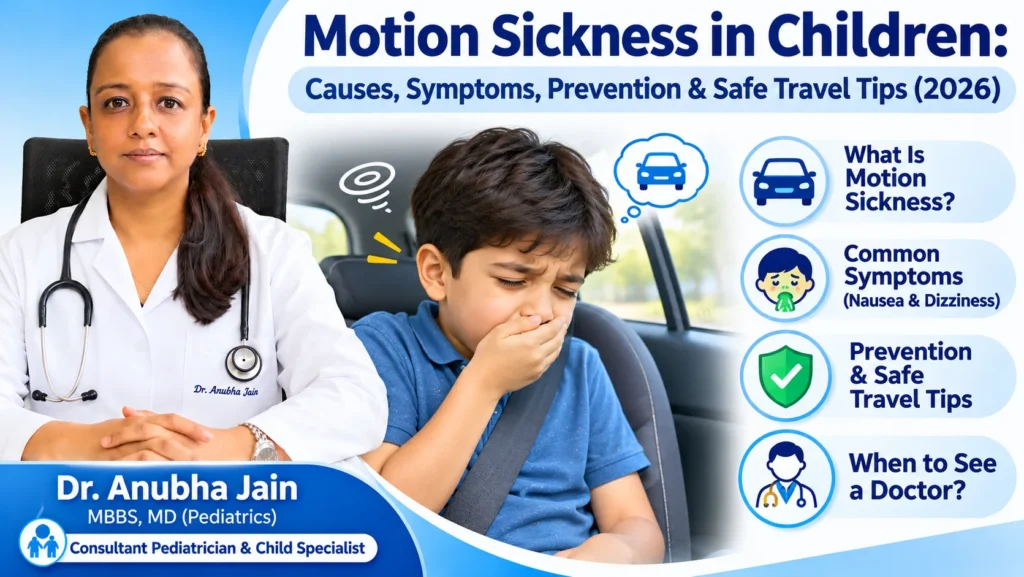
Motion Sickness in Children: Causes, Symptoms, Prevention & Safe Travel Tips (2026)
Family trips, school journeys and holiday travel can be exciting for children. However, some children begin feeling uncomfortable shortly after travelling in a car, bus, train or boat.
A child may complain of dizziness, nausea, headache or stomach discomfort. In some cases, the child may vomit repeatedly during the journey.
Motion sickness in children is a common travel-related problem that occurs when the brain receives conflicting information about movement from the eyes, inner ears and body.
Although motion sickness is usually temporary, it can make travel difficult for both children and parents.
This guide explains the possible causes, early symptoms, practical prevention strategies, safe travel care and when to consult a pediatrician.
Quick Answer: How Can Parents Prevent Motion Sickness in Children?
Parents can help reduce motion sickness by encouraging children to look ahead through a window, avoiding reading or screens during travel, maintaining fresh airflow and taking breaks on longer journeys.
Small, light meals before travel may be better tolerated than heavy meals. Resting and avoiding unnecessary movement can help when symptoms begin.
Medicines for motion sickness should only be used according to the child’s age and professional medical advice. Some medicines can cause significant drowsiness or unusual agitation.
Persistent vomiting, dehydration, severe headache or symptoms occurring without travel require medical assessment.
What Is Motion Sickness in Children?
Motion sickness is a condition that develops when movement causes a mismatch between different sensory signals received by the brain.
For example, a child sitting inside a moving car may look down at a stationary book or mobile phone.
The inner ear detects the car’s movement, while the child’s eyes focus on an object that appears still.
This mismatch may contribute to nausea, dizziness, sweating and vomiting.
Motion sickness can occur in cars, buses, trains, aircraft, boats and amusement rides.
It is not contagious and does not automatically indicate an infection.
What Causes Motion Sickness in Children?
The main cause is a sensory mismatch during movement, but several factors can make some children more susceptible.
1. Conflicting Sensory Signals
The inner ear detects movement while the eyes may focus on something stationary inside the vehicle.
2. Reading During Travel
Reading books or looking down at a phone may increase visual and vestibular mismatch.
3. Winding Roads
Frequent turns, accelerations and changes in vehicle movement may trigger symptoms in susceptible children.
4. Lack of Sleep
Insufficient sleep before a journey can make some children more susceptible to motion sickness.
5. Migraine Susceptibility
Children with a history of migraine may be more likely to experience motion-related nausea.
6. Individual Sensitivity
Some children are naturally more sensitive to movement than others. Susceptibility can change with age.
A pediatrician can help when symptoms are severe, recurrent or do not follow a typical motion-related pattern.
At What Age Does Motion Sickness Start in Children?
Motion sickness can affect children of different ages. However, it is relatively uncommon in children younger than two years.
Susceptibility generally increases during childhood and may be particularly noticeable in school-age children.
Children approximately 7–12 years old can be especially susceptible, although individual experiences vary.
Some children experience less motion sickness as they grow older.
A child developing repeated vomiting during travel at an unusually young age may need assessment for other causes.
Common Symptoms of Motion Sickness in Children
Symptoms often develop gradually after travel begins and may improve when movement stops.
- Nausea or feeling sick
- Vomiting during a journey
- Dizziness or lightheadedness
- Pale facial appearance
- Cold sweating
- Excessive salivation
- Stomach discomfort
- Loss of appetite
- Yawning or unusual tiredness
- Headache
- Reduced interest in activities
- General discomfort during movement
Young children may not be able to describe nausea clearly.
Parents may instead notice a child becoming quiet, pale, sweaty or unusually tired before vomiting begins.
Early Warning Signs Before a Child Vomits During Travel
Recognizing symptoms early may allow parents to reduce movement exposure before vomiting develops.
Sudden Quietness
A usually active child may become unusually quiet or less interested in talking.
Pale Face
The child’s face may appear pale, sometimes with noticeable sweating.
Frequent Yawning
Repeated yawning and drowsiness can sometimes precede nausea.
Stomach Discomfort
The child may complain of an uncomfortable feeling in the stomach before vomiting.
When these symptoms appear, a safe travel break and fresh air may help.
Why Does My Child Vomit During Car Travel?
Car travel can trigger motion sickness because the vehicle accelerates, brakes and turns while the child’s body remains seated.
Looking down at books, toys or electronic devices may worsen symptoms.
The problem may become more noticeable on winding roads or during long journeys.
For a child whose vomiting occurs only during movement and improves after the journey ends, motion sickness is one possible explanation.
However, recurrent vomiting outside travel should not automatically be attributed to motion sickness.
How to Prevent Motion Sickness in Children During Travel
Non-medicine strategies should usually be tried first because they avoid medication side effects.
1. Encourage Looking Ahead
Encourage children to look toward a distant stationary point or the horizon when a suitable outside view is available.
2. Avoid Reading and Screens
Avoid books, mobile phones, tablets and video games when these activities trigger symptoms.
3. Provide Fresh Air
Comfortable ventilation may help reduce nausea. Avoid strong smells inside the vehicle.
4. Offer Light Meals
Avoid very heavy or greasy meals before travel. A small, familiar meal or snack may be better tolerated.
5. Encourage Adequate Sleep
Maintain an appropriate sleep schedule before the journey. Fatigue may worsen motion sickness.
6. Plan Travel Breaks
For long car journeys, stop at safe locations to allow the child to rest, drink fluids and get fresh air.
7. Use Safe Seating
Always follow the child’s age-appropriate car-seat and seat-belt requirements. Never move a young child into an unsafe front seat to reduce motion sickness.
8. Try Gentle Distraction
Conversation, singing or listening to music can help some children without requiring them to look down at a screen.
Motion Sickness in Cars, Buses, Trains and Flights
Car Travel
Children should remain in an appropriate child-restraint system. Use a clear forward view when safely possible. Avoid reading and unnecessary screen use.
Bus Travel
If possible, use a seat where forward visibility is comfortable. Encourage rest and avoid looking down at books during winding journeys.
Train Travel
Looking outside at a distant point and taking breaks from reading may reduce symptoms in some children.
Air Travel
Children susceptible to motion sickness may benefit from resting, adequate hydration and appropriate seating when available.
Boat Travel
Motion on water can also trigger nausea. Looking toward the horizon and choosing a stable location when safe may help.
Are Motion Sickness Medicines Safe for Children?
Some medicines can reduce motion sickness, but they are not suitable for every child.
Certain antihistamine medicines may cause drowsiness, dry mouth or unusual agitation.
Some medications are not approved for younger children or may have age-specific restrictions.
Parents should not use adult travel-sickness medicines, sedatives, patches or combination products without professional guidance.
The correct treatment depends on the child’s age, weight, medical history and medicines already being taken.
Medication should not replace proper hydration, safe travel arrangements or evaluation of concerning symptoms.
Important Medicine Safety Advice
- Consult a qualified clinician before giving travel-sickness medicine.
- Follow age-appropriate product licensing and instructions.
- Never use adult doses for a child.
- Avoid combining sedating medicines without medical advice.
- Do not use scopolamine travel patches in children without specialist guidance; they can cause serious adverse effects.
- Do not give medication merely to make a child sleep during travel.
What to Do If Your Child Feels Sick During Travel
When symptoms begin, parents should focus on comfort and safety.
Step 1: Pause the Journey Safely
If travelling by car, stop in a safe location when possible. Do not unbuckle a child while the vehicle is moving.
Step 2: Reduce Visual Stimulation
Ask the child to stop reading or using a screen. Looking ahead or closing the eyes may help.
Step 3: Allow Rest
A quiet break can help. Maintain a safe sitting or resting position, particularly if the child is nauseated.
Step 4: Offer Fluids
If the child vomits, offer small, age-appropriate amounts of fluid when tolerated. Oral rehydration solution may be appropriate when vomiting is repeated.
Step 5: Reassess Symptoms
If symptoms do not settle after movement stops, or the child develops significant pain, fever or other new symptoms, seek medical assessment.
Motion Sickness in Toddlers and Young Children
Toddlers may not describe the sensation of nausea or dizziness accurately.
They may become pale, unusually quiet, irritable or sleepy during travel.
Parents should ensure the child remains in a correctly fitted, age-appropriate restraint while the vehicle is moving.
Do not change car-seat position, remove the harness or allow unsafe sleeping arrangements to prevent nausea.
Repeated vomiting in infants or very young children deserves medical assessment, especially if it occurs without a clear movement-related pattern.
What Should Children Eat Before a Long Journey?
A comfortable feeding routine can help reduce some travel-related stomach discomfort.
Parents may offer a small, familiar meal before departure instead of a very heavy or greasy meal.
Age-appropriate fluids can help maintain hydration. Avoid forcing food when the child is nauseated.
There is no specific food that reliably prevents motion sickness in every child.
If the child also has ongoing feeding or nutrition concerns, a pediatric consultation may be useful.
For feeding and diet-related questions, visit Pediatric Nutrition in Varanasi .
Can Repeated Travel Vomiting Cause Dehydration?
Repeated vomiting may reduce fluid intake and contribute to dehydration, especially during long journeys or hot weather.
Parents should monitor the child’s urine output, alertness and ability to tolerate fluids.
Possible dehydration signs include:
- Reduced urination
- Dry mouth
- Unusual thirst
- Reduced energy or increased tiredness
- Difficulty keeping fluids down
Young children can become dehydrated more quickly than adults. Seek medical advice if vomiting persists or fluid intake is poor.
When Is Vomiting During Travel a Medical Warning Sign?
Motion sickness is usually temporary, but not every episode of vomiting or dizziness is caused by travel.
Seek prompt medical assessment when your child experiences:
- Persistent vomiting after the journey ends
- Repeated vomiting unrelated to movement
- Severe or worsening headache
- Significant abdominal pain
- Signs of dehydration
- Persistent dizziness or balance problems
- Fever with unusual illness symptoms
- Unexpected changes in alertness or behaviour
Seek emergency care immediately for reduced consciousness, seizures, severe neurological symptoms, breathing difficulty, green vomit or other signs of serious illness.
Do not delay medical care while assuming the symptoms are ordinary motion sickness.
Motion Sickness vs Stomach Infection: How Are They Different?
Motion sickness typically begins during travel and often improves when movement stops.
A stomach infection may cause vomiting with diarrhea, fever or abdominal symptoms, and may continue regardless of travel.
However, these patterns can overlap. Parents cannot reliably diagnose the cause based on one symptom alone.
Children with persistent or worsening vomiting require appropriate medical evaluation.
Child Travel Sickness Prevention Checklist
Before and During the Journey
- Plan age-appropriate rest before departure.
- Avoid very heavy meals immediately before travel.
- Keep water and suitable snacks available.
- Use proper child car seats and seat belts.
- Encourage looking ahead when possible.
- Avoid prolonged reading and screen use.
- Maintain comfortable ventilation.
- Plan safe rest breaks for long car journeys.
- Carry supplies for possible vomiting.
- Discuss recurring severe motion sickness with a pediatrician.
These measures may reduce symptoms, although they may not completely prevent motion sickness in every child.
When Should Parents Consult a Pediatrician?
An occasional episode of motion-related nausea may improve with simple travel adjustments.
However, consult a pediatrician when:
- Motion sickness occurs on nearly every journey.
- Vomiting is severe or recurrent.
- The child becomes dehydrated.
- Symptoms continue after travel.
- There are recurrent headaches or balance concerns.
- Parents need advice about age-appropriate medication.
- Symptoms interfere with school or family travel.
The doctor can assess the symptom pattern and determine whether additional evaluation is appropriate.
Motion Sickness in Children: Pediatric Care in Varanasi
Parents in Varanasi may experience difficulty when children develop nausea or vomiting during car and bus journeys.
Although many cases improve with practical travel changes, persistent or severe symptoms deserve medical evaluation.
Dr. Anubha Jain, MBBS, MD (Pediatrics), provides pediatric consultations in Kabir Nagar, Durgakund, Varanasi.
Parents can discuss recurrent vomiting, travel-related symptoms, hydration and other childhood health concerns during a consultation.
For information about a pediatrician in Varanasi, visit Pediatrician in Varanasi – Dr. Anubha Jain .
Frequently Asked Questions About Motion Sickness in Children
1. What causes motion sickness in children?
Motion sickness occurs when the brain receives conflicting signals about movement from the eyes, inner ears and body.
2. Why does my child vomit during car travel?
Car movement may trigger nausea and vomiting in susceptible children. Reading or looking down at a screen can worsen symptoms.
3. At what age does motion sickness begin?
Motion sickness is relatively uncommon under two years but becomes more common during childhood, especially school age.
4. Can mobile phones cause travel sickness?
Looking down at a mobile phone during travel may worsen motion sickness by increasing sensory mismatch.
5. What helps prevent car sickness in kids?
Looking ahead, avoiding reading, getting fresh air, using comfortable meal routines and taking safe travel breaks may help.
6. Are motion sickness tablets safe for children?
Some medicines are suitable only for specific ages and may cause significant side effects. Ask a qualified clinician before giving medication.
7. Is motion sickness dangerous?
Typical motion sickness is usually temporary. However, repeated vomiting may cause dehydration, and atypical symptoms need assessment.
8. When should I visit a pediatrician?
Arrange a consultation if travel-related vomiting is severe, frequent, persistent or accompanied by other unexplained symptoms.
Additional Respiratory Health Information for Parents
Children experiencing persistent cough, wheezing, asthma symptoms or recurring breathing problems may require medical evaluation.
For additional information about respiratory health, visit Samaria Multi-Speciality & Chest Centre, Varanasi.
Located in Kabir Nagar, Durgakund, Varanasi, the centre provides information about respiratory care and services including asthma management, pulmonary function testing, bronchoscopy, COPD care and other chest-related conditions.
The specialist team also includes Dr. Anubha Jain, Senior Consultant Pediatrician & Child Specialist.
Website: https://chestclinicvns.com/
Address: Plot 36A, Kabir Nagar, Durgakund, Varanasi – 221005.
Contact: +91 8795300333
Note: This resource provides information about respiratory healthcare. Children with severe breathing difficulty require immediate emergency medical attention.
Medical Disclaimer
This article is for general educational purposes and does not replace individualized medical advice, diagnosis or treatment.
Parents should consult a qualified clinician before giving motion sickness medication to a child.
Persistent vomiting, dehydration or other concerning symptoms require appropriate medical evaluation.
Clinical review by Dr. Anubha Jain is pending. Add the actual medical review date only after approval.
Concerned About Your Child’s Travel Sickness?
If your child frequently experiences nausea, vomiting or dizziness during travel, arrange a pediatric consultation for appropriate guidance.
Dr. Anubha Jain
MBBS, MD (Pediatrics)
Plot 36A, Kabir Nagar,
Durgakund, Varanasi – 221005