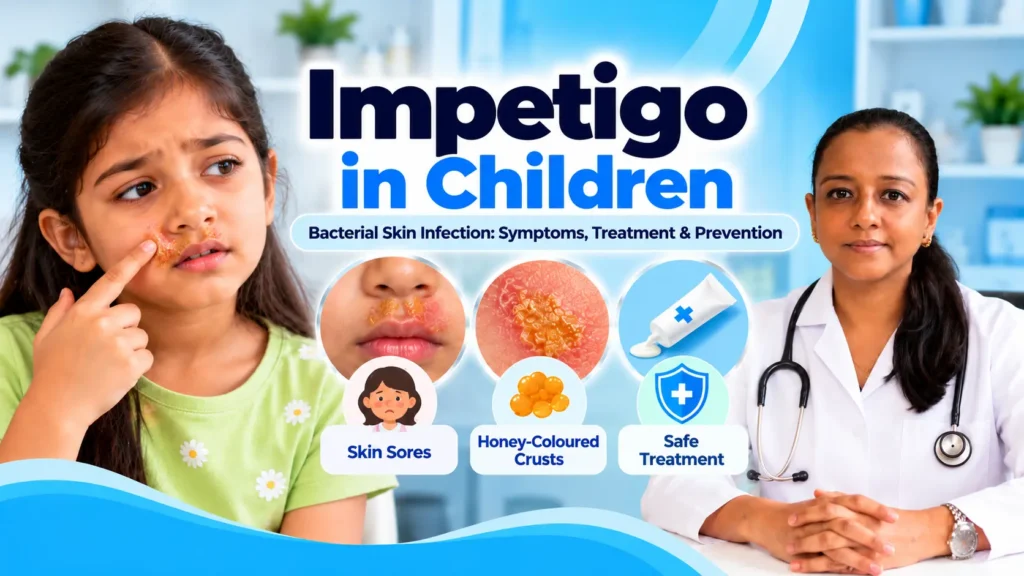
Impetigo in Children is a contagious bacterial skin infection that often begins with small sores or blisters. Parents may first notice irritated spots around a child’s nose or mouth, which later break open and develop a yellow or golden crust. Similar lesions can also appear on the arms, legs and other exposed skin.
Impetigo is especially common in younger children, but school-age children can also develop it. The infection may spread through skin-to-skin contact, scratching or shared personal items. Although most cases are treatable, early diagnosis and appropriate antibiotics help reduce the risk of transmission and complications.
This guide explains how to identify impetigo, the difference between its common forms, how it spreads, what treatment may be recommended and when parents should seek pediatric medical care.
Quick Answer for Parents
Impetigo is a superficial bacterial skin infection commonly caused by Staphylococcus aureus or Streptococcus pyogenes. It may cause itchy sores that rupture and develop golden, honey-coloured crusts.
Limited infection may be treated with a suitable prescribed topical antibiotic, while more widespread infection may require antibiotics taken by mouth. The choice depends on the child’s examination.
Keep affected areas clean, discourage scratching and avoid sharing towels. Seek medical assessment for suspected impetigo. Fever with spreading redness, severe pain or rapidly worsening swelling needs urgent care.
What Is Impetigo in Children?
Impetigo is an infection affecting the outer layers of the skin. It is caused by bacteria that can enter through small breaks in the skin or sometimes infect skin that appears otherwise normal.
The condition is commonly seen in children because frequent close contact, scratching, minor cuts and insect bites can make bacterial transmission easier.
Impetigo is usually treatable and most children recover without serious complications. However, the infection can spread to other parts of the body or to other people if appropriate precautions are not taken.
What Are the Early Symptoms of Impetigo in Children?
The appearance of impetigo changes as the infection progresses. Some lesions begin as small irritated spots, while others initially look like tiny blisters.
Small Red or Irritated Sores
Early sores may appear around the nose, mouth, hands or legs. Depending on skin tone, inflammation may look red, pink, brownish or darker than the surrounding skin.
Fluid-Filled Blisters
Some children develop small blisters containing clear or cloudy fluid. The blisters may rupture and leave moist or irritated skin.
Honey-Coloured Crusts
One of the most recognizable signs is a yellow or golden crust over a healing sore. The crust may look sticky or thick and can occur after a blister or pustule breaks open.
Itching or Mild Discomfort
Some children complain of itching around affected areas. Repeated scratching can spread bacteria to nearby skin and increase irritation.
New Lesions on Nearby Skin
Without appropriate treatment, additional sores may appear around the original lesion or elsewhere on the body, especially when the child scratches and touches other areas.
Why Does Impetigo Cause Honey-Coloured Crusts?
The distinctive golden crust forms when an infected sore releases fluid that dries on the skin surface. This is particularly characteristic of non-bullous impetigo.
Not every infected skin lesion has exactly the same colour or appearance. Skin tone, stage of healing and previous use of creams can affect how the rash looks.
A honey-coloured crust is an important clue, but it is not a complete diagnosis on its own. A clinician may need to distinguish impetigo from eczema, herpes infection, insect bites and other skin conditions.
What Causes Impetigo in Children?
Impetigo is mainly caused by two types of bacteria: Staphylococcus aureus and group A Streptococcus. These bacteria can spread through contact with infected skin or objects carrying infectious material.
A small cut, scratched insect bite, eczema patch or other break in the skin may give bacteria an opportunity to enter and multiply.
Impetigo can occur in different seasons. Warm, humid conditions can increase its frequency in some places, but children can develop the infection at any time of year.
What Is the Difference Between Non-Bullous and Bullous Impetigo?
Impetigo has more than one clinical form. The two commonly recognized forms are non-bullous and bullous impetigo.
| Feature | Non-Bullous Impetigo | Bullous Impetigo |
|---|---|---|
| Typical appearance | Small sores that develop crusts | Larger fluid-filled blisters |
| Crusting | Often honey-coloured | May leave a thin crust or peeling skin |
| Common cause | Staph or strep bacteria | Usually toxin-producing Staph aureus |
| Diagnosis | Usually clinical examination | Clinical examination, sometimes further assessment |
| Treatment | Depends on extent and severity | Often needs clinician-directed antibiotic treatment |
Parents should not attempt to identify the bacterial organism or select antibiotics from the appearance alone.
Where Does Impetigo Commonly Appear?
Impetigo often affects exposed skin, particularly around the nose and mouth. It can also occur on the arms, legs and areas that have been scratched or injured.
Children with eczema or frequent insect bites may develop secondary bacterial infection in irritated skin. A pediatrician may examine whether an underlying skin condition needs management to reduce repeated infections.
Is Impetigo Contagious?
Yes. Impetigo spreads readily through close contact with infected skin or contaminated personal items. It can pass between siblings, classmates and other people who have direct contact with the sores.
Touching an affected lesion and then scratching another area can also spread the infection over the child’s body.
Ways to Reduce Transmission
- Encourage frequent handwashing with soap and water.
- Discourage scratching, rubbing and picking at sores.
- Keep lesions covered when practical.
- Use separate clean towels and washcloths.
- Avoid sharing clothing and bedding during active infection.
- Wash recently used towels and clothing regularly.
- Follow the clinician’s prescribed treatment.
- Follow school infection-control rules.
Can Impetigo Develop After an Insect Bite?
Yes. An insect bite can create itchy skin that a child repeatedly scratches. Scratching may damage the protective skin barrier, making bacterial infection more likely.
Parents may notice that what began as a minor bite becomes moist, crusted or increasingly irritated.
Not every scratched insect bite is impetigo. A doctor can assess whether a secondary infection has developed.
Impetigo vs Ringworm in Children
Ringworm and impetigo are both contagious skin conditions, but they have different causes and require different treatments.
Ringworm is caused by dermatophyte fungi and often produces an expanding scaly patch. Impetigo is caused by bacteria and commonly produces sores, blisters or golden crusts.
Antifungal cream does not treat a bacterial infection, while antibiotic cream does not treat ringworm. Using the wrong medicine may delay recovery.
Related Reading: Parents can also explore Pediatrician in Varanasi for evaluation of persistent childhood skin problems and infections.
Impetigo vs Hand, Foot and Mouth Disease
Hand, foot and mouth disease is a viral illness typically associated with fever, mouth ulcers and a rash on the palms, soles or other areas. Impetigo is a bacterial skin infection that more commonly produces crusted sores.
Both conditions can involve blisters, so appearance alone may be misleading. Associated mouth symptoms, lesion distribution and the child’s examination can help distinguish them.
A child with fever, mouth sores and new skin lesions should be assessed when the diagnosis is uncertain or the illness is worsening.
How Is Impetigo Diagnosed in Children?
A pediatrician can often diagnose impetigo by examining the skin and asking how the lesions developed. The doctor may review the duration of symptoms, recent scratches or bites and whether other family members have similar sores.
Routine laboratory tests are not necessary for every uncomplicated case. However, recurrent infections, unusual lesions or treatment failure may warrant a bacterial swab or further testing.
How Is Impetigo Treated in Children?
Antibiotic treatment is commonly recommended for diagnosed impetigo. The type of treatment depends on the number of lesions, their location and severity.
For a small number of localized sores, a clinician may prescribe a topical antibiotic such as mupirocin. When lesions are numerous, widespread or associated with certain complications, an oral antibiotic may be appropriate.
Parents should follow the full prescribed course and use the medicine exactly as directed. They should not share prescription creams between children or repeatedly use leftover antibiotics without medical advice.
Important Treatment Checklist
- Confirm the diagnosis before starting treatment.
- Use only the medication prescribed or recommended for the child.
- Apply treatment using clean hands as directed.
- Keep the affected skin gently clean.
- Avoid picking at crusts or scratching sores.
- Cover lesions when appropriate and practical.
- Complete the recommended treatment course.
- Contact the pediatrician if new sores appear or symptoms worsen.
Should Parents Remove the Yellow Crusts?
Gentle cleaning may help remove loose crusting, but parents should not forcibly scrape, peel or pull scabs away from the child’s skin.
If advised by the clinician, gently soak the area with clean lukewarm water and wash carefully before applying the prescribed medicine.
Forceful removal can damage the skin and increase pain or irritation. The exact cleaning method should follow medical guidance, particularly when lesions are extensive.
Can Home Remedies Cure Impetigo?
Household oils, toothpaste, lemon juice, harsh antiseptics and herbal mixtures are not reliable substitutes for appropriate medical treatment. Some may irritate damaged skin or delay healing.
Because impetigo is bacterial, it may need prescription antibiotics. Parents should avoid using unprescribed steroid combination creams or repeatedly changing treatments.
Good hygiene supports recovery but does not replace necessary antibiotic treatment.
How Long Does Impetigo Take to Heal?
Many children begin to improve within a few days of effective treatment. Complete skin healing may take longer depending on the size and number of lesions.
A child whose sores continue spreading, become more painful or fail to improve after starting treatment needs reassessment.
Even after the infection clears, temporary differences in skin colour can remain while the skin heals. Persistent scarring or unusual skin changes should be discussed with a clinician.
Can Impetigo Return After Treatment?
Yes. Some children develop recurrent impetigo, particularly when bacterial exposure continues or an underlying skin condition repeatedly damages the skin barrier.
Recurrent episodes may require assessment of eczema, scratching habits, household transmission and previous antibiotic response.
In selected cases, a clinician may consider a bacterial swab or other steps to address recurrent infections. Parents should not start routine antibiotic creams or antiseptic washes indefinitely without guidance.
When Can a Child Return to School After Impetigo?
School exclusion recommendations differ between health authorities. CDC guidance permits return once a child is well enough and has received at least 12 hours of appropriate antibiotic treatment for group A streptococcal impetigo, with lesions covered. NHS guidance commonly recommends waiting until sores have crusted and healed or 48 hours after starting appropriate treatment.
In India, parents should follow the treating doctor’s advice and the school’s applicable infection-control policy. The child should also feel well enough to participate normally.
Do not assume that the absence of fever means the infection is no longer contagious.
How Can Parents Prevent Repeated Impetigo?
Prevention focuses on limiting bacterial spread and protecting the skin from avoidable damage.
Daily Skin Infection Prevention Checklist
- Clean minor cuts and scratches appropriately.
- Encourage regular handwashing.
- Keep fingernails reasonably short and clean.
- Discourage picking at bites and skin sores.
- Avoid sharing towels and personal washcloths.
- Wash clothing and bedding used during infection.
- Manage underlying eczema with medical guidance.
- Seek review for repeated or spreading skin infections.
When Should Parents Consult a Pediatrician?
Suspected impetigo should be assessed so the correct treatment can be started and other skin conditions can be excluded.
Reasons to Schedule Pediatric Evaluation
- Honey-coloured crusts around the nose or mouth
- New or spreading skin sores
- Blisters that break open and leave moist skin
- Repeated episodes of similar skin infection
- Possible infection of an eczema patch
- Lesions that fail to improve with prescribed treatment
- Several household members developing sores
- Uncertainty whether the rash is bacterial, fungal or viral
Pediatric Consultation in Varanasi
For evaluation of childhood skin infections, contagious rashes and other health concerns, visit Pediatrician in Varanasi.
When Is Impetigo a Medical Emergency?
Seek Urgent or Emergency Care If Your Child Has:
- Rapidly spreading redness, warmth or swelling
- Fever with worsening skin infection
- Severe pain or extensive blistering
- Significant swelling around the eyes
- Severe weakness or unusual drowsiness
- Breathing difficulty or facial swelling after a medicine
- Confusion, collapse or reduced responsiveness
These symptoms may suggest a more serious infection or another urgent medical condition. Do not delay emergency care to try home remedies.
Can Impetigo Cause Complications?
Most impetigo infections improve with appropriate treatment. However, infection can sometimes spread into deeper skin layers, leading to cellulitis.
Rarely, an immune-related kidney condition called post-streptococcal glomerulonephritis can occur after certain streptococcal skin infections. Warning signs may include dark or blood-coloured urine, facial puffiness, reduced urination or high blood pressure.
These symptoms require prompt medical evaluation, including if the original skin infection has already improved. Such complications are uncommon, but parents should be aware of them.
What Should Parents Record Before the Appointment?
Skin Infection Symptom Diary
- When the first sore appeared
- Where the lesions are located
- Whether new sores are appearing
- Presence of yellow crusting or blisters
- Any itching, pain or fever
- Recent insect bites, scratches or eczema
- Medicines or creams already used
- Similar symptoms in family members or classmates
Consult Dr. Anubha Jain in Varanasi
Dr. Anubha Jain, MBBS, MD (Pediatrics), provides pediatric consultations at Samaria Multi-Speciality & Chest Centre, Kabir Nagar, Durgakund, Varanasi.
Parents concerned about contagious skin sores, bacterial skin infections or recurring childhood rashes may seek an initial pediatric assessment. Treatment and the need for specialist referral depend on the individual child’s examination.
Clinic Information
Doctor: Dr. Anubha Jain
Qualifications: MBBS, MD (Pediatrics)
Location: Samaria Multi-Speciality & Chest Centre
Address: Plot 36A, Kabir Nagar, Durgakund, Varanasi – 221005
Contact: +91 9454643742
Appointments: Contact Dr. Anubha Jain
Frequently Asked Questions About Impetigo in Children
What are the first signs of impetigo in children?
Impetigo may start with small itchy sores or blisters that break open and develop golden crusts, commonly around the nose or mouth.
Is impetigo a bacterial or fungal infection?
Impetigo is bacterial. It is commonly caused by Staphylococcus aureus, Streptococcus pyogenes or both.
Why do impetigo sores turn yellow?
Fluid from an infected lesion can dry into a thick yellow or honey-coloured crust.
Can impetigo spread between school children?
Yes. Direct contact with infected skin or shared contaminated items can spread the bacteria.
Does impetigo always need oral antibiotics?
No. A few localized lesions may be treated with a prescribed topical antibiotic. More widespread infection may require oral treatment.
Is impetigo the same as ringworm?
No. Impetigo is caused by bacteria, while ringworm is a fungal skin infection. Their treatments are different.
Can my child attend school with impetigo?
School return depends on appropriate treatment, lesion coverage, the child’s condition and local school guidance. Exclusion intervals differ between health authorities.
When should parents seek urgent care?
Rapidly spreading redness, fever with worsening infection, severe pain, eye-area swelling or serious illness requires urgent medical assessment.
Additional Respiratory Health Information for Parents
Children experiencing persistent cough, wheezing, asthma symptoms or recurring breathing problems may require medical evaluation.
For additional information about respiratory health, visit Samaria Multi-Speciality & Chest Centre, Varanasi.
Located in Kabir Nagar, Durgakund, Varanasi, the centre provides information about respiratory care and services including asthma management, pulmonary function testing, bronchoscopy, COPD care and other chest-related conditions.
The specialist team also includes Dr. Anubha Jain, Senior Consultant Pediatrician & Child Specialist.
Website: https://chestclinicvns.com/
Address: Plot 36A, Kabir Nagar, Durgakund, Varanasi – 221005.
Contact: +91 8795300333
Note: This resource provides information about respiratory healthcare. Children with severe breathing difficulty require immediate emergency medical attention.
Conclusion: Understanding Impetigo in Children
Impetigo in children is a contagious bacterial skin infection that often causes sores, blisters and honey-coloured crusts. Although most cases are treatable, appropriate medical assessment is important to distinguish impetigo from fungal and viral rashes.
Parents should follow the recommended antibiotic treatment, practice hand hygiene, cover lesions when practical and avoid sharing personal items. Spreading infection, fever or other warning signs require prompt medical attention.
For pediatric consultation information in Varanasi, visit Pediatrician in Varanasi.
Request Pediatric Consultation
Call the Clinic
Medical Disclaimer: This article provides general educational information and does not replace professional diagnosis, prescription antibiotic treatment or emergency medical care.