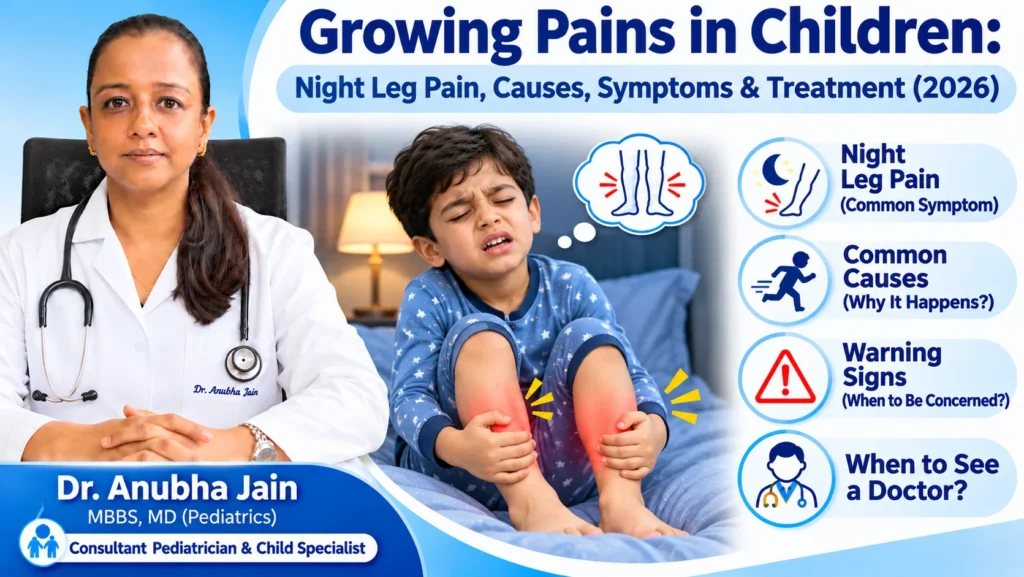
Growing Pains in Children: Night Leg Pain, Causes, Symptoms & Treatment (2026)
Growing pains in children are a common explanation for recurring leg aches that appear during the evening or at night and disappear by morning. Many parents notice this problem when their child suddenly complains of pain in the calves, thighs or behind the knees.
A child may wake up crying because both legs hurt, but the following morning may be able to run, walk and play without discomfort.
Although this pattern can be consistent with growing pains, parents should not assume that every episode of leg pain is harmless.
This guide explains typical symptoms, possible contributing factors, safe home care, medical evaluation, warning signs and when to consult a pediatrician in Varanasi.
Quick Answer: What Are Growing Pains in Children?
Growing pains are episodes of aching or throbbing leg pain that commonly affect children aged approximately 3 to 12 years.
The pain usually affects both legs, often in the thigh or calf muscles, and develops during the late afternoon, evening or night. It typically disappears by morning.
Despite the name, growing pains are not known to be caused by bones growing or by an increase in height. Their precise cause is uncertain.
Gentle massage, appropriate warmth and rest may help. A child with limping, fever, swollen joints, persistent daytime pain or pain limited to one leg needs medical assessment.
What Are Growing Pains?
Growing pains are a pattern of recurrent musculoskeletal discomfort seen in otherwise healthy children. The discomfort is usually felt in the muscles of the lower limbs.
Parents may hear a child describe the sensation as aching, pulling, throbbing or soreness.
Episodes can be intermittent. Some children experience pain after an active day, while others may go several weeks without any discomfort.
An important feature is that children usually remain active and pain-free between episodes.
Growing pains are generally a clinical diagnosis, meaning the pattern of symptoms and a reassuring physical examination help the doctor decide whether this explanation is appropriate.
There is no single blood test or scan that confirms growing pains.
At What Age Do Growing Pains Occur?
Growing pains most often occur in children between approximately 3 and 12 years of age.
A preschool child may wake up with discomfort in both legs after a day of running, playing or climbing.
School-age children may describe the pain more clearly and identify the calves, shins, thighs or areas behind the knees.
The pain often becomes less frequent as children get older.
New, severe or persistent pain in a baby or very young toddler should not automatically be labelled growing pains.
Common Symptoms of Growing Pains in Children
The typical symptom pattern is important because other medical conditions can also cause childhood leg pain.
- Aching or throbbing in both legs
- Pain in the calves, thighs or shins
- Discomfort behind the knees rather than inside the joint
- Pain beginning late in the afternoon or evening
- Episodes that sometimes wake a child from sleep
- Normal walking and running the following morning
- No persistent joint swelling or redness
- Periods without pain between episodes
- Comfort with gentle massage or warmth
The severity of pain varies. Some episodes are mild, while others may disturb the child’s sleep.
However, the diagnosis should be reconsidered if a child develops a limp, persistent tenderness, swollen joints or an unusual pain pattern.
Where Do Children Feel Growing Pains?
Calf Muscles
Children may complain of aching in the back of the lower legs, especially after active play.
Thigh Muscles
Pain can be felt in the front or back of the thighs during evening or nighttime episodes.
Shins
Some children describe pain along the front of the lower legs.
Behind the Knees
Discomfort can occur around the muscles behind the knees, rather than inside the knee joint itself.
Typical growing pains affect the muscles and generally do not cause a swollen or inflamed joint.
Persistent pain focused inside one joint requires a different clinical evaluation.
What Causes Growing Pains in Children?
The precise cause is unknown. Growing pains are not understood to result from the bones lengthening during growth.
Several possible contributing factors have been studied, but none fully explains every case.
1. Active Play
Some children notice more leg discomfort after a day of extensive running, jumping or physical activity.
2. Muscle Fatigue
Temporary muscle soreness after physical activity may contribute to discomfort in some children.
3. Individual Pain Sensitivity
Children vary in how they perceive and respond to muscle discomfort.
4. Joint Flexibility
Growing pains may be more common in some children with flexible joints, although the relationship is not fully understood.
Parents should not assume that growing pains prove a child is experiencing a growth spurt.
Similarly, nighttime leg pain does not automatically mean a child has calcium or vitamin D deficiency. Such conditions need an appropriate clinical assessment when suspected.
Why Does My Child Have Leg Pain at Night?
Nighttime leg pain can be particularly worrying when a child wakes up crying after falling asleep normally.
Growing pains often appear after the child’s daytime activities have ended. They may occur before bedtime or during the first hours of sleep.
The child may ask a parent to rub their legs or may prefer to stretch or change position.
An important reassuring feature is the absence of symptoms the next morning.
However, persistent nighttime pain in one particular location, especially if it is worsening or accompanied by fever or swelling, should not be assumed to be growing pains.
Growing Pains vs Other Causes of Child Leg Pain
Not all leg pain in children has the same cause. A pediatrician considers the location, timing, severity and associated symptoms.
Growing Pains
Usually involve both legs, occur in the evening or night and resolve by morning without persistent limping.
Muscle Injury
Pain may follow a fall, sports activity or specific injury and can persist with movement.
Joint Inflammation
Pain may be associated with joint swelling, stiffness, warmth or difficulty moving.
Infection or Other Illness
Fever, worsening pain, inability to bear weight or unusual tiredness may indicate a need for urgent assessment.
Certain nutritional, bone and neurological conditions can also cause leg discomfort. Investigations are guided by medical findings, not by leg pain alone.
Are Growing Pains Related to Height or Growth Spurts?
Despite the name, growing pains are not caused by a measurable increase in height.
Children can experience leg pain during years when they are also growing, but that does not prove the growth itself is responsible.
Height and weight should be evaluated separately, using appropriate growth charts over time.
If a child has leg pain alongside poor height gain, unexplained weight loss or another growth concern, the pediatrician may evaluate both issues.
For concerns about height, weight or growth patterns, explore Child Growth Consultation in Varanasi and Height Issues in Children .
Safe Home Care for Growing Pains in Children
For a child with a typical growing-pains pattern and no warning signs, simple comfort measures may help during episodes.
1. Gently Massage the Legs
A light massage of the aching muscles can help some children feel more comfortable. Avoid vigorous rubbing or pressure over a visibly swollen area.
2. Apply Gentle Warmth
A warm bath or a safely wrapped warm compress may soothe aching muscles. Never use excessively hot water or leave a heat pack on a sleeping child.
3. Encourage Comfortable Rest
Allow the child to rest during an episode, then return to usual activity once the discomfort has resolved.
4. Discuss Gentle Stretching
Gentle age-appropriate stretching may be helpful for some children. Ask a healthcare professional which movements are suitable.
5. Use Medicines Only When Appropriate
If pain relief is needed, a clinician may recommend age- and weight-appropriate paracetamol or ibuprofen. Avoid aspirin in children unless specifically prescribed.
6. Track Recurring Symptoms
Record which leg hurts, when the pain begins, whether it follows activity and whether the child is pain-free by morning.
Should Children Stop Playing Sports Because of Growing Pains?
Children with typical growing pains are usually able to remain active during the day.
Routine physical activity does not automatically need to be stopped.
However, if the child develops pain while running, starts limping or has symptoms that interfere with activity, medical evaluation is needed.
Parents can encourage a healthy balance of activity, rest and age-appropriate exercise.
Persistent activity-related pain should not be ignored or automatically labelled growing pains.
Can Nutrition Affect Leg Pain in Children?
Balanced nutrition supports normal growth, bone health and muscle function.
Children need appropriate dietary intake of nutrients, including calcium, vitamin D and protein.
However, ordinary growing pains are not necessarily caused by a deficiency.
Giving supplements without a medical indication does not guarantee that leg pain will stop.
Parents concerned about restricted diets, poor weight gain or nutritional deficiency can discuss the child’s feeding history with a pediatrician.
Learn more about Pediatric Nutrition in Varanasi for individualized feeding and nutrition concerns.
Warning Signs: When Is Leg Pain Not Typical Growing Pain?
Arrange prompt medical assessment when a child has any of the following:
- Pain affecting only one leg repeatedly
- Pain that continues into the morning
- Pain while walking or running
- A new limp or difficulty bearing weight
- Swelling, redness or warmth around a joint
- Persistent pain in one specific bone or joint
- Fever with leg pain
- Unexplained bruising, rash or weight loss
- Persistent weakness or unusual tiredness
- Severe pain or worsening symptoms
Seek urgent medical care if the child cannot walk, refuses to bear weight, has a swollen joint with fever or appears seriously ill.
Severe injury, reduced responsiveness or other life-threatening symptoms require emergency care.
How Does a Pediatrician Diagnose Growing Pains?
A pediatrician usually starts by reviewing the child’s symptoms and performing a physical examination.
1. Review the Pain Pattern
The doctor may ask whether pain affects one or both legs, when it begins and whether it disappears by morning.
2. Assess Walking and Movement
The clinician may observe the child’s walking pattern and check for limping or movement limitations.
3. Examine Muscles and Joints
Examination may include checking for tenderness, joint swelling, redness, injury or restricted movement.
4. Review Medical and Growth History
The doctor may consider recent illness, injuries, physical activity, nutrition and growth patterns when relevant.
5. Recommend Tests Only If Needed
Typical growing pains with a normal examination usually do not require routine scans or blood tests. Unusual findings may require investigations.
Common Myths About Growing Pains
Myth 1: Leg Pain Means My Child Is Growing Taller
Growing pains are not known to be caused by height gain. The name does not describe the actual mechanism.
Myth 2: Every Nighttime Leg Pain Is Harmless
No. Pain in one leg, persistent swelling, limping or associated fever needs evaluation.
Myth 3: Children With Growing Pains Need Calcium Supplements
Supplements should be used only when medically appropriate. Growing pains do not independently confirm a deficiency.
Myth 4: A Child Must Stop All Exercise
Most children with typical growing pains remain normally active during the day. Pain affecting daytime movement needs assessment.
Growing Pains Diary: What Should Parents Record?
Parent Observation Checklist
- Date and time the leg pain began
- Whether one or both legs hurt
- Exact location of discomfort
- Duration and severity of the episode
- Physical activities earlier that day
- Presence of fever, swelling or injury
- Whether massage or warmth helped
- Whether symptoms resolved by morning
- Any limping or difficulty walking
A symptom diary can help the pediatrician identify patterns. However, record keeping should never delay medical assessment when warning signs are present.
Growing Pains in Children: Pediatric Care in Varanasi
Parents in Varanasi may become concerned when a child repeatedly complains of leg pain at night but appears comfortable the next day.
Typical growing pains are usually benign, but unusual symptoms require a qualified clinical assessment.
Dr. Anubha Jain, MBBS, MD (Pediatrics), provides pediatric consultations in Kabir Nagar, Durgakund, Varanasi.
Parents can discuss recurrent leg pain, growth concerns, nutrition and other childhood health symptoms during a consultation.
For information about a pediatrician in Varanasi, visit Pediatrician in Varanasi – Dr. Anubha Jain .
Frequently Asked Questions About Growing Pains in Children
1. What causes growing pains in children?
The precise cause is unknown. Pain may be more noticeable after physical activity, but it is not known to be caused by actual growth.
2. At what age do growing pains occur?
They are most common between approximately 3 and 12 years of age.
3. Why does my child complain of leg pain only at night?
Growing pains typically occur during the evening or nighttime and resolve by morning. Other causes must be considered if the pain pattern is unusual.
4. Do growing pains occur in one leg?
Typical growing pains usually affect both legs. Repeated pain affecting only one leg requires medical assessment.
5. Can massage help growing pains?
Gentle massage and appropriate warmth may reduce discomfort during an uncomplicated episode.
6. Does my child need an X-ray?
Most children with a typical symptom pattern and normal examination do not require routine imaging. Tests depend on clinical findings.
7. Are growing pains a sign of vitamin D deficiency?
Not necessarily. Vitamin D deficiency can cause musculoskeletal symptoms, but growing pains alone do not establish a deficiency.
8. When should I take my child to a pediatrician?
Seek assessment for one-sided pain, limping, daytime pain, fever, swelling, weight loss or symptoms that persist or worsen.
Additional Respiratory Health Information for Parents
Children experiencing persistent cough, wheezing, asthma symptoms or recurring breathing problems may require medical evaluation.
For additional information about respiratory health, visit Samaria Multi-Speciality & Chest Centre, Varanasi.
Located in Kabir Nagar, Durgakund, Varanasi, the centre provides information about respiratory care and services including asthma management, pulmonary function testing, bronchoscopy, COPD care and other chest-related conditions.
The specialist team also includes Dr. Anubha Jain, Senior Consultant Pediatrician & Child Specialist.
Website: https://chestclinicvns.com/
Address: Plot 36A, Kabir Nagar, Durgakund, Varanasi – 221005.
Contact: +91 8795300333
Note: This resource provides information about respiratory healthcare. Children with severe breathing difficulty require immediate emergency medical attention.
Medical Disclaimer
This article is for general educational purposes and does not replace professional medical advice, diagnosis or treatment.
Persistent or unusual leg pain, limping, fever, swelling or difficulty walking requires an appropriate medical assessment.
Clinical review by Dr. Anubha Jain is pending. Add the actual medical review date only after approval.
Concerned About Your Child’s Leg Pain at Night?
If your child experiences recurrent leg pain, unexplained discomfort, growth concerns or other childhood health symptoms, arrange a pediatric consultation.
Dr. Anubha Jain
MBBS, MD (Pediatrics)
Plot 36A, Kabir Nagar,
Durgakund, Varanasi – 221005