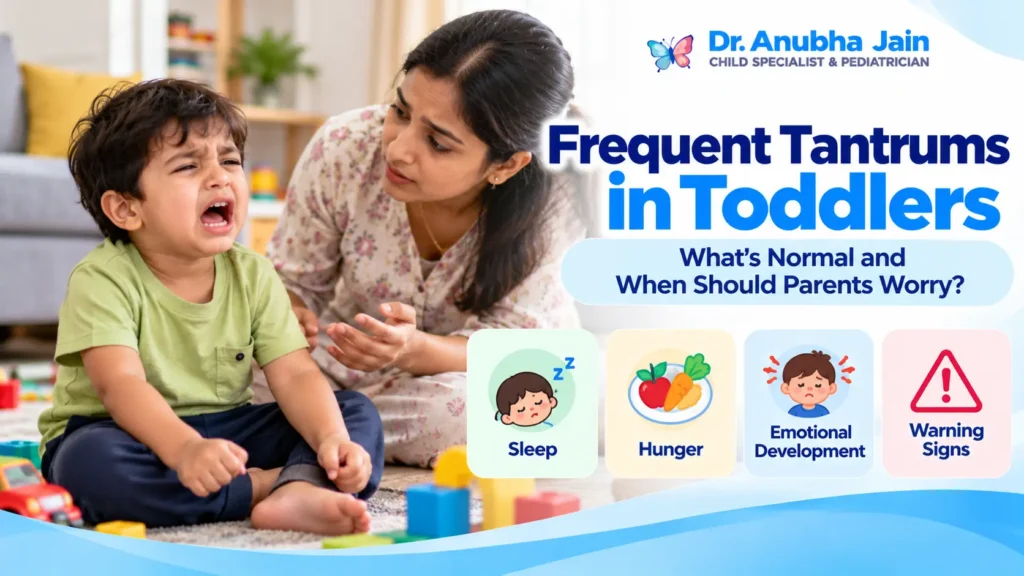
Frequent tantrums in toddlers can leave parents feeling worried and unsure about how to respond. A young child may cry, shout, throw toys or refuse a simple request when frustrated, tired or overwhelmed. These emotional outbursts are especially common during the early childhood years.
Between ages one and five, children are developing language, independence and emotional regulation skills. They may experience strong feelings before they have learned how to express them clearly or manage disappointment.
This guide explains what toddler tantrums are, why they happen, how parents can respond safely and when recurring behaviour may require pediatric assessment.
Quick Answer for Parents
Tantrums are common in toddlers and preschool-aged children, particularly during transitions, frustration, hunger or tiredness.
A calm response, consistent boundaries and age-appropriate communication can help children gradually develop emotional regulation skills.
If behaviour causes repeated injuries, significant disruption or occurs alongside developmental concerns, parents should discuss it with a qualified pediatrician.
What Are Frequent Tantrums in Toddlers?
A tantrum is an emotional outburst that may include crying, shouting, stamping feet, dropping to the floor or refusing instructions.
Tantrums often occur when children want something they cannot have, struggle to complete an activity or find it difficult to communicate their needs.
The frequency and intensity vary between children. A tantrum alone does not establish a behavioural or developmental disorder.
Why Do Children Between 1 and 5 Years Have Tantrums?
Early childhood involves rapid changes in thinking, language and independence. Children increasingly want control over their daily activities but still need considerable adult support.
Difficulty Expressing Feelings
A child may understand what they want but lack the language to explain it. Frustration can build when a parent does not understand the request.
Hunger and Tiredness
Children may find it harder to manage emotions when meals are delayed or they have not slept adequately.
Regular routines can reduce some predictable triggers.
Transitions Between Activities
Stopping playtime, leaving a park or switching off a screen may be difficult for a toddler, especially when the change happens unexpectedly.
Overstimulation
Busy surroundings, loud sounds, crowded events or several demands at once may overwhelm some children.
A quieter environment may help a child recover.
Developing Independence
Toddlers often want to make their own choices. They may become upset when an adult sets an important safety boundary or says no.
Are Tantrums Normal at Ages 1, 2, 3, 4 and 5?
Tantrums can occur throughout early childhood, but the pattern often changes as language and emotional skills develop.
Age-Related Developmental Context
- Age 1: Frustration may appear when a child cannot communicate a need.
- Age 2: Strong preferences and increasing independence may trigger outbursts.
- Age 3: Language skills are growing, but handling disappointment may remain difficult.
- Age 4: Many children begin using more words and strategies to express frustration.
- Age 5: Emotional regulation often improves, although occasional outbursts can still happen.
These descriptions are general patterns, not strict milestones. The child’s developmental history, environment and individual circumstances matter.
5 Helpful Ways to Handle Toddler Tantrums
1. Stay Calm and Keep the Child Safe
Respond with a calm voice and avoid shouting. Move dangerous objects away if the child is throwing things or moving unpredictably.
Physical punishment and humiliation are not appropriate responses to emotional outbursts.
2. Acknowledge the Child’s Feelings
Use simple words such as “I can see you are upset.” This helps a child begin connecting emotions with language.
Acknowledging feelings does not mean agreeing to every request.
3. Maintain Clear, Consistent Boundaries
Keep rules simple and age-appropriate. For example, a parent can explain that hitting is not allowed while still supporting the child through frustration.
4. Offer Limited Choices
When suitable, let the child choose between two acceptable options, such as which shirt to wear or which book to read.
This provides some independence without creating an overwhelming decision.
5. Teach Calming Skills After the Tantrum
Once the child is calm, help them name the feeling and practise a simple alternative response.
Examples include asking for help, taking a break or using words to explain what they need.
What Should Parents Avoid During a Tantrum?
An adult’s response can influence how safe and supported the child feels during an emotional episode.
Unhelpful Responses to Avoid
- Shouting or insulting the child
- Hitting, shaking or physically punishing the child
- Threatening abandonment
- Expecting complex explanations during intense distress
- Using sweets or screens as the automatic solution to every outburst
- Ignoring immediate safety risks
Some children need a quiet space, while others need a calm adult nearby. A supportive response can be adapted to the child’s age and needs.
Can Lack of Sleep Make Toddler Tantrums Worse?
Yes. Tired children may have more difficulty coping with frustration or following routines.
Sleep requirements depend on age. Children between one and two years generally need approximately 11–14 hours of sleep in 24 hours, including naps. Children aged three to five generally need 10–13 hours, including naps.
A regular bedtime and comfortable sleep environment can support healthy daily behaviour.
Can Speech Delay Contribute to Tantrums?
Some children become frustrated when they cannot communicate their needs or understand what is expected.
However, tantrums do not automatically mean that a child has a speech delay.
If parents are concerned about language development, social communication or hearing, a pediatrician can review developmental milestones and recommend assessment.
Do Frequent Tantrums Mean a Child Has Autism or ADHD?
No. Tantrums alone cannot diagnose autism, ADHD or another developmental condition.
A pediatrician considers the child’s complete development, including communication, social interaction, attention, behaviour and everyday functioning.
Concerns such as loss of previously acquired skills, limited communication or significant difficulty participating in daily life should be evaluated.
When Should Parents Consult a Pediatrician?
Parents should seek professional advice when outbursts become difficult to manage safely or are associated with other developmental concerns.
Reasons to Arrange an Assessment
- Repeated self-injury or aggression that creates a safety risk
- Very intense or prolonged outbursts that disrupt daily life
- Marked changes in behaviour without a clear explanation
- Tantrums accompanied by speech or developmental concerns
- Significant sleep or feeding difficulties
- Ongoing concerns raised by caregivers or preschool staff
- Parents needing support with safe behaviour-management strategies
The aim of consultation is to understand the child’s needs rather than label ordinary childhood emotions as illness.
When Can a Behaviour Change Be a Medical Emergency?
Seek Immediate Medical Attention If:
- The child has a significant injury or uncontrolled bleeding.
- There is sudden confusion or reduced responsiveness.
- The child develops a seizure or serious neurological symptoms.
- There is suspected poisoning or ingestion of a harmful substance.
- The behaviour occurs with severe pain or other signs of critical illness.
A typical tantrum is not itself a medical emergency. However, an abrupt change in behaviour alongside serious physical symptoms requires prompt care.
How Can Parents Prevent Common Tantrum Triggers?
Not all tantrums can be prevented. However, predictable routines and developmentally appropriate expectations may reduce some episodes.
Everyday Parenting Checklist
- Maintain regular meals and snack times.
- Follow an age-appropriate sleep routine.
- Give simple warnings before transitions.
- Offer opportunities for supervised independent choices.
- Use short, clear instructions.
- Praise positive communication and cooperation.
- Allow time for active play and connection.
- Seek support when behaviour becomes difficult to manage.
What Information Should Parents Bring to a Consultation?
A brief description of behaviour patterns can help the pediatrician understand the concern.
Parent Behaviour Diary
- The child’s age and developmental history
- When outbursts usually happen
- Common triggers before each episode
- Approximate duration and intensity
- Whether the child or anyone else is injured
- Sleep and mealtime routines
- Speech, hearing or communication concerns
- Strategies already tried by caregivers
A pediatrician may recommend developmental assessment, parent guidance or referral to a relevant professional depending on clinical findings.
Pediatric Consultation for Toddler Behaviour in Varanasi
Parents can discuss childhood behaviour alongside other aspects of health and development during pediatric visits.
For information about local child healthcare, visit Pediatrician in Varanasi .
Parents comparing nearby consultation options can also explore the Best Pediatrician Near Me guide.
Consult Dr. Anubha Jain in Varanasi
Dr. Anubha Jain holds MBBS and MD (Pediatrics) qualifications and provides pediatric consultation in Kabir Nagar, Durgakund, Varanasi.
Parents may discuss general child health, developmental milestones, sleep, feeding and behavioural concerns during a pediatric consultation.
Clinic Information
Doctor: Dr. Anubha Jain
Qualifications: MBBS, MD (Pediatrics)
Address: Plot 36A, Kabir Nagar, Durgakund, Varanasi – 221005
Phone: +91 9454643742
Appointments: Contact Dr. Anubha Jain
Frequently Asked Questions About Frequent Tantrums in Toddlers
Are frequent tantrums normal in a two-year-old?
Tantrums are common around this age as independence and communication skills are still developing.
Why does my toddler cry when I say no?
Young children may struggle with disappointment and have limited emotional regulation skills.
Should parents ignore every tantrum?
No. Responses should focus on safety, calm support and consistent boundaries. Some children need active reassurance.
Can hunger cause tantrums?
Hunger may lower a child’s ability to manage frustration. Regular meals and snacks can help prevent some triggers.
Can speech delay cause frustration?
Communication difficulties can contribute to frustration. Persistent language concerns deserve developmental assessment.
Do tantrums mean a child has ADHD?
No. Tantrums alone cannot diagnose ADHD or another developmental condition.
When should parents worry about tantrums?
Seek assessment when behaviour causes repeated injuries, major daily disruption or occurs with developmental concerns.
Which doctor can assess toddler behaviour?
A pediatrician can review general development and recommend appropriate specialist support when necessary.
Additional Respiratory Health Information for Parents
Children experiencing persistent cough, wheezing, asthma symptoms or recurring breathing problems may require medical evaluation.
For additional information about respiratory health, visit Samaria Multi-Speciality & Chest Centre, Varanasi .
Located in Kabir Nagar, Durgakund, Varanasi, the centre provides information about respiratory care and services including asthma management, pulmonary function testing, bronchoscopy, COPD care and other chest-related conditions.
The specialist team also includes Dr. Anubha Jain, Senior Consultant Pediatrician & Child Specialist.
Website: https://chestclinicvns.com/
Address: Plot 36A, Kabir Nagar, Durgakund, Varanasi – 221005.
Contact: +91 8795300333
Note: This resource provides information about respiratory healthcare. Children with severe breathing difficulty require immediate emergency medical attention.
Conclusion: Supporting Emotional Development in Toddlers
Frequent tantrums in toddlers can be part of normal early childhood development. Young children are learning how to express strong feelings, respond to boundaries and handle disappointment.
Calm responses, predictable routines and patient communication can support emotional development. When tantrums become unsafe, highly disruptive or associated with developmental concerns, a pediatrician can help determine the next steps.
For more information about child healthcare in Varanasi, visit Pediatrician in Varanasi .
Request Pediatric Consultation Call the ClinicMedical Disclaimer: This article is for general education. It does not replace individual developmental or medical assessment. Seek urgent care for serious injuries, sudden changes in consciousness or other emergency symptoms.