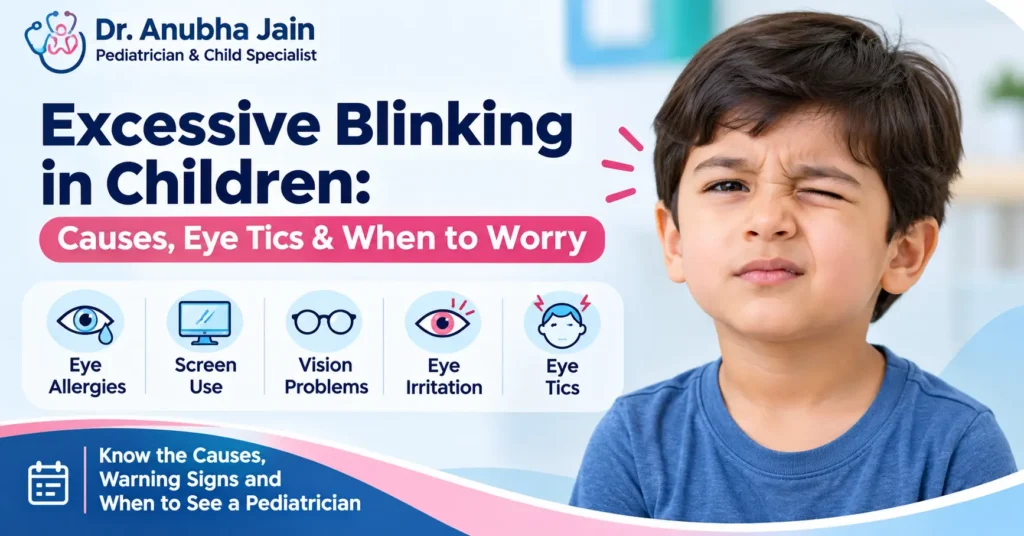
Have you noticed your child blinking repeatedly, squeezing their eyelids tightly, or blinking much more often than usual? Excessive blinking in children can worry parents, particularly when the behavior starts suddenly or continues for several days.
Children blink naturally to protect and moisten their eyes. However, unusually frequent blinking may sometimes be related to eye irritation, allergies, an uncorrected vision problem, a temporary motor tic, or another condition that deserves attention.
Many causes are treatable or temporary. Nevertheless, parents should not assume that repeated blinking is always a harmless habit or automatically caused by too much screen time.
This guide explains the possible causes of excessive blinking, differences between eye irritation and motor tics, warning signs, safe steps parents can take, and when to arrange a pediatric or eye specialist consultation.
Quick Answer: What Causes Excessive Blinking in Children?
Excessive blinking in children can occur because of eye allergies, dryness, eyelid irritation, a foreign body, the need for glasses, eye alignment problems, or motor tics.
Some children blink more during stressful periods or when they are tired. However, these patterns alone do not establish the cause.
A pediatrician or eye specialist may examine the eyes, check vision, review associated symptoms, and decide whether further assessment is necessary.
Seek urgent medical care if frequent blinking is accompanied by significant eye pain, sudden vision changes, chemical exposure, a penetrating eye injury, or other serious symptoms.
What Is Normal Blinking in Children?
Blinking is an automatic action that helps spread tears across the surface of the eyes. It keeps the eyes comfortable and provides some protection from dust, wind, and other irritants.
The usual blinking pattern varies by age, activity, and individual circumstances. Young children may blink less frequently than adults, while blinking often increases with age.
There is no single number of blinks that parents should use at home to diagnose a medical problem.
Instead, pay attention to a noticeable change from your child’s usual pattern, especially when blinking is associated with rubbing, redness, visual complaints, or unusual facial movements.
8 Possible Causes of Excessive Blinking in Children
1. Eye Allergies
Allergic eye irritation is one possible explanation for repeated blinking. Children may experience itchy, watery, or red eyes after exposure to dust, pollen, animal allergens, or other triggers.
Frequent rubbing and blinking may occur together because the child is trying to relieve discomfort.
Parents may also notice sneezing, a runny nose, or nasal congestion.
If your child experiences persistent allergy-related symptoms, read more about dark circles and nasal allergies in children.
2. Dry Eyes or Surface Irritation
When the surface of the eye becomes uncomfortable, children may blink more frequently in an attempt to relieve the sensation.
Dry air, environmental irritation, or prolonged periods of visually demanding activity may contribute to discomfort in some children.
However, excessive blinking is not sufficient evidence to diagnose dry eye disease. An examination may be needed to identify the actual problem.
3. Eyelash or Foreign-Body Irritation
An eyelash, dust particle, or another small irritant may cause repeated blinking, especially when one eye is affected more than the other.
The child may complain that something feels stuck in the eye or may repeatedly rub the affected side.
Parents should avoid attempting to remove an embedded object or using sharp instruments near the eye.
Persistent discomfort, tearing, or suspected injury requires medical assessment.
4. Vision Problems or the Need for Glasses
Some children blink excessively when they are having difficulty seeing clearly.
Uncorrected refractive errors, such as certain degrees of farsightedness, nearsightedness, or astigmatism, may contribute to eye strain or visual discomfort.
Parents might also notice frequent squinting, headaches, difficulty reading, or moving very close to books and screens.
A comprehensive eye examination can determine whether glasses or another form of treatment is appropriate.
5. Temporary Motor Tics
A motor tic is a sudden, repeated movement that may involve the eyelids, face, or other body areas.
Forceful blinking can be one type of motor tic in childhood.
Tics sometimes become more noticeable when a child is tired, excited, or under stress. Many are temporary, but their course varies.
Parents should avoid scolding a child or repeatedly demanding that they stop blinking. If the behavior continues, causes distress, or occurs with other movements or sounds, discuss it with a pediatrician.
6. Eye Alignment Problems
Some eye alignment conditions may be associated with excessive blinking or squinting.
Parents might notice one eye occasionally turning outward or inward, particularly when the child is tired or looking at distant objects.
Eye misalignment should not be assumed to be a simple habit.
An ophthalmologist, preferably one experienced in children’s eye conditions, can assess visual alignment and determine whether treatment is necessary.
7. Eyelid Inflammation
Irritation or inflammation around the eyelids can contribute to repeated blinking.
Associated findings may include crusting near the eyelashes, redness around the lid edges, itching, or discomfort.
The cause should be identified before using medicated eye drops or ointments.
8. Stress, Fatigue, or Changes in Routine
Some children blink more during periods of tiredness or emotional stress, particularly when blinking is part of a tic pattern.
Parents may notice changes around school transitions, sleep disruption, or other stressful situations.
However, stress should not be assumed to be the cause until relevant eye problems have been considered.
Eye Blinking Tic vs Eye Irritation: How Are They Different?
Parents sometimes find it difficult to distinguish between a blinking tic and an eye problem.
The pattern and associated symptoms can provide clues, but a clinical examination may still be needed.
Possible Eye Irritation
Blinking may occur with itching, watering, redness, burning, discharge, or the sensation of something being in the eye.
The child may also rub their eyes repeatedly.
Possible Motor Tic
Blinking may be forceful, repetitive, and occur without obvious redness or discomfort.
Other brief facial movements or sounds may sometimes be present.
Neither pattern is definitive. A child can have eye irritation and a tic at different times, or occasionally both problems together.
If the cause is unclear or symptoms continue, medical evaluation is preferable to guessing.
Can Too Much Screen Time Cause Excessive Blinking?
Parents frequently notice blinking during or after television, mobile phone, tablet, or computer use.
Digital screen use can influence normal blinking behavior and may contribute to eye discomfort in some children, especially during prolonged use without breaks.
However, screen time alone does not explain every case of excessive blinking.
A child who develops repeated blinking after screen use may also have dry eye symptoms, an uncorrected vision problem, or another cause.
Practical Screen Habits for Parents
- Encourage regular breaks from prolonged close-up screen activities.
- Support age-appropriate recreational screen limits.
- Avoid using digital devices continuously immediately before bedtime.
- Encourage outdoor play and a balanced daily routine.
- Observe whether your child also has headaches, squinting, or difficulty seeing.
- Arrange an eye examination if visual symptoms persist.
Reducing screen time may improve discomfort in some situations, but it is not a substitute for assessing persistent eye symptoms.
Excessive Blinking in Toddlers: Should Parents Worry?
A toddler who suddenly begins blinking repeatedly may be experiencing irritation, an emerging vision issue, or a temporary movement pattern.
Because toddlers may not be able to describe itching, pain, or blurry vision, parents often have to observe behavior rather than rely on verbal complaints.
Look for frequent rubbing, avoidance of bright light, unusual eye movements, tearing, or redness.
If blinking continues, increases, or affects daily activities, arrange an appropriate medical review.
For a young child with severe eye pain or a suspected injury, do not delay assessment.
Why Is My Child Blinking One Eye More Than the Other?
Repeated blinking or squeezing of just one eye may occur because of localized irritation, an eyelash problem, a foreign body, or other conditions affecting that eye.
Some movement tics may also involve one side more noticeably.
Parents should not assume that blinking affecting a single eye is always harmless.
Eye pain, significant redness, persistent tearing, visual changes, or a suspected scratch warrant prompt evaluation.
What Can Parents Do When a Child Blinks Excessively?
Simple observation and gentle care may help while arranging an appropriate appointment, particularly if the child is otherwise comfortable.
1. Observe When the Blinking Happens
Notice whether it occurs during reading, screen use, outdoor play, bedtime, or throughout the day.
Record whether both eyes are involved and whether the blinking seems forceful or uncomfortable.
2. Avoid Repeatedly Correcting the Child
If blinking is related to a motor tic, drawing attention to it repeatedly may increase distress.
Stay supportive and avoid telling the child that they must stop.
3. Discourage Eye Rubbing
Rubbing may worsen irritation or introduce additional contaminants.
Help young children keep their hands clean and encourage them to report discomfort.
4. Support Regular Sleep
Consistent sleep routines can support general health and may help children whose tic-like movements become more noticeable when tired.
Sleep alone is not a treatment for an underlying eye condition.
5. Do Not Use Eye Drops Without Guidance
Avoid using steroid eye drops, leftover antibiotics, redness-relief drops, or another person’s prescription.
Some eye medications can be inappropriate or harmful when used for the wrong condition.
6. Arrange an Eye Examination When Needed
Persistent blinking, vision complaints, eye discomfort, or suspected eye alignment problems deserve professional assessment.
A pediatrician can help coordinate appropriate evaluation or referral.
When Should Parents Worry About Excessive Blinking?
Not every child who blinks frequently has a serious medical problem. However, certain symptoms require prompt or urgent medical attention.
Warning Signs That Require Medical Assessment
- Significant or persistent eye pain.
- Marked redness, swelling, or discharge.
- Blurred vision or a new difficulty seeing.
- Strong sensitivity to light.
- Repeated blinking after an eye injury.
- One eye turning inward or outward unexpectedly.
- Frequent headaches associated with visual symptoms.
- Blinking accompanied by other persistent movements or unusual sounds.
- Symptoms that interfere with school, reading, or daily activities.
Seek urgent or emergency care for sudden significant vision loss, severe eye injury, chemical exposure, severe eye pain, or serious neurological symptoms.
Do not wait for a routine clinic appointment when emergency symptoms are present.
How Does a Pediatrician Evaluate Frequent Blinking?
The assessment usually begins with the child’s medical history and a discussion of when the blinking started.
The doctor may ask whether the child has itchy eyes, redness, tearing, headaches, changes in vision, or a history of allergies.
Other questions may focus on sleep, emotional stress, school activities, and whether repeated movements occur elsewhere.
What May Be Checked During Examination?
- Eye redness, discharge, or visible irritation.
- General eyelid and eye appearance.
- Age-appropriate vision screening.
- Eye alignment and movement.
- Possible allergic symptoms.
- Other repeated facial or body movements.
- Relevant developmental or neurological symptoms.
Depending on the findings, referral to an ophthalmologist or another appropriate specialist may be recommended.
Not every child needs blood tests, brain scans, or specialist investigations. Testing should be guided by the clinical examination and associated symptoms.
Common Myths About Excessive Blinking in Children
Myth 1: Excessive Blinking Always Means Too Much Screen Time
Fact: Screen-related discomfort is one possibility, but allergies, eye surface problems, visual needs, and tics must also be considered.
Myth 2: Every Blinking Tic Is a Serious Neurological Disease
Fact: Many childhood tics are temporary. However, persistent symptoms, additional movements, or other concerning findings should be reviewed clinically.
Myth 3: Children Can Simply Stop Blinking If Told Repeatedly
Fact: Repetitive blinking is not always under voluntary control. Scolding or pressuring a child is not an appropriate treatment approach.
Myth 4: Eye Drops Are Always the Best Treatment
Fact: Treatment depends on the actual cause. Eye drops will not necessarily help a motor tic or an uncorrected vision problem.
Parent Checklist Before a Pediatric Appointment
What to Observe and Record
- When the blinking first started.
- Whether one or both eyes are affected.
- Whether there is redness, itching, pain, or tearing.
- Whether blinking increases during reading or screen use.
- Whether the child squints or complains of blurry vision.
- Whether the child has allergy symptoms.
- Any recent eye injury or exposure to irritants.
- Whether other facial movements or sounds occur.
- Any effect on school, sleep, or everyday activities.
A brief video of the blinking pattern may be useful for the clinician if the episodes are not occurring during the appointment. Do not delay necessary care to make a recording.
Excessive Blinking in Children: Pediatric Care in Varanasi
Parents in Varanasi may seek a medical consultation when their child begins blinking frequently or develops other eye-related symptoms.
Dr. Anubha Jain, MBBS, MD (Pediatrics), provides pediatric consultations in Kabir Nagar, Durgakund, Varanasi.
A pediatric consultation can help review the child’s symptoms, possible allergy history, general health, and need for an eye specialist assessment.
For more information about pediatric consultations, visit Dr. Anubha Jain – Pediatrician in Varanasi.
Children with suspected eye disease may need assessment by an ophthalmologist, including a pediatric ophthalmologist when appropriate.
Frequently Asked Questions About Excessive Blinking in Children
1. Why is my child suddenly blinking a lot?
Sudden excessive blinking may occur because of eye irritation, allergies, a foreign body, vision problems, or a motor tic. The cause depends on associated symptoms and examination findings.
2. Can excessive blinking in children be a tic?
Yes. Repetitive forceful blinking can be a motor tic. However, eye irritation and vision problems should also be considered.
3. Is excessive blinking related to screen time?
Screen use may contribute to eye discomfort in some children, but it is not the only possible cause of frequent blinking.
4. Can allergies cause frequent blinking?
Yes. Eye allergies can cause itching, irritation, tearing, and repeated blinking, sometimes alongside sneezing or nasal congestion.
5. Why does my toddler blink both eyes tightly?
Forceful blinking may occur with a tic or eye discomfort. Persistent symptoms should be evaluated, especially when there is redness, pain, or a visual concern.
6. Does excessive blinking mean my child needs glasses?
Not necessarily. Some visual problems may contribute to blinking, but only an appropriate vision assessment can determine whether glasses are needed.
7. Should I stop my child from blinking repeatedly?
Avoid scolding or repeatedly drawing attention to the behavior. Instead, observe the symptoms and seek assessment when needed.
8. Will excessive blinking go away on its own?
Some causes, including certain temporary tics, may improve over time. Other problems require treatment, so persistent symptoms should not be ignored.
9. When is excessive blinking an emergency?
Seek urgent medical attention if blinking occurs with significant eye injury, sudden vision changes, severe pain, chemical exposure, or other serious symptoms.
10. Which doctor should evaluate excessive blinking in children?
A pediatrician can provide an initial assessment. An ophthalmologist may be needed to check eye health, vision, or eye alignment.
11. Can stress increase blinking in children?
Stress or fatigue may make certain tics more noticeable, but persistent blinking should not automatically be attributed to stress.
12. Where can I consult a pediatrician in Varanasi?
Parents can explore Dr. Anubha Jain’s pediatric consultation services in Varanasi for information about appointments and general pediatric care.
Additional Respiratory Health Information for Parents
Some children with eye allergies may also experience sneezing, nasal congestion, or other respiratory allergy symptoms. Persistent cough, wheezing, asthma symptoms, or recurring breathing problems may require separate medical evaluation.
For additional information about respiratory health, visit Samaria Multi-Speciality & Chest Centre, Varanasi.
Located in Kabir Nagar, Durgakund, Varanasi, the centre provides information about respiratory care and services including asthma management, pulmonary function testing, bronchoscopy, COPD care, and other chest-related conditions.
The specialist team also includes Dr. Anubha Jain, Senior Consultant Pediatrician & Child Specialist.
Website: https://chestclinicvns.com/
Address: Plot 36A, Kabir Nagar, Durgakund, Varanasi – 221005.
Contact: +91 8795300333
Note: This centre’s respiratory information does not replace an eye examination. Children with severe breathing difficulty require immediate emergency medical attention.
Conclusion: Understanding Excessive Blinking in Children
Excessive blinking in children can result from several causes, including eye irritation, allergies, vision problems, eyelid conditions, and motor tics.
Parents should observe whether blinking occurs alongside itching, redness, visual complaints, headaches, or other symptoms rather than assuming that every case is caused by screen time or stress.
Many children improve with appropriate care, but persistent or unusual blinking deserves medical assessment.
Early recognition of eye problems and timely referral when needed can help address symptoms and protect a child’s visual health.
Book a Pediatric Consultation in Varanasi
If your child has persistent excessive blinking, allergy-related concerns, or other health symptoms, you can arrange a pediatric consultation with Dr. Anubha Jain. An eye specialist referral may be recommended when appropriate.
Dr. Anubha Jain
MBBS, MD (Pediatrics)
Plot 36A, Kabir Nagar,
Durgakund, Varanasi – 221005
OPD Timings:
Monday–Saturday
10:00 AM – 1:30 PM
5:30 PM – 8:00 PM
Sunday: Closed
Phone: +91 9454643742
Book a Pediatric Consultation Call +91 9454643742Medical Disclaimer: This article provides general educational information and does not replace individual medical advice, diagnosis, treatment, specialist eye assessment, or emergency care.