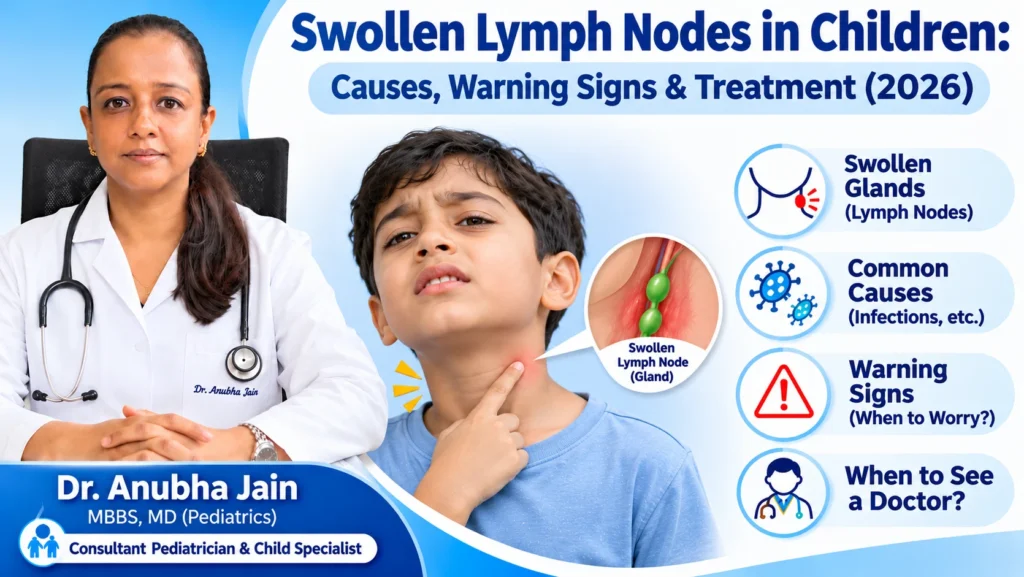
Swollen Lymph Nodes in Children: Causes, Warning Signs & Treatment (2026)
Finding a small lump on your child’s neck or under the jaw can be worrying. Parents may notice the swelling while bathing their child, brushing their hair or helping them get dressed.
Swollen lymph nodes in children are common and often develop when the immune system responds to a cold, sore throat, ear infection or another nearby illness.
Most enlarged lymph nodes in childhood are reactive, meaning they become temporarily bigger while helping the body respond to infection.
However, certain changes, including rapidly increasing swelling, redness, severe pain or unexplained persistent lumps, require medical evaluation.
This guide explains why children develop swollen glands, where lymph nodes are located, how long swelling may last, available treatments and when parents should consult a pediatrician in Varanasi.
Quick Answer: Why Do Children Get Swollen Lymph Nodes?
Swollen lymph nodes in children usually occur because the immune system is responding to an infection or inflammation.
Common causes include viral colds, throat infections, ear infections, dental problems and skin infections.
Small, mobile lymph nodes may remain noticeable for several weeks after a childhood infection.
Seek prompt medical assessment if a node grows quickly, becomes red or very painful, feels hard and fixed, or occurs with persistent fever, unexplained weight loss or night sweats.
What Are Lymph Nodes?
Lymph nodes are small structures that form part of the lymphatic and immune systems. They filter lymphatic fluid and contain immune cells that help the body respond to germs.
Lymph nodes are present throughout the body, although many are too small or too deep to feel.
Parents most commonly notice them around the neck, under the jaw, behind the ears, in the armpits or around the groin.
A lymph node may enlarge when immune cells become active during an infection. This does not necessarily mean that the lymph node itself is infected.
What Is Lymphadenopathy?
Lymphadenopathy means enlargement or abnormality of lymph nodes. It is a descriptive medical term, not a diagnosis of a specific disease.
What Is Lymphadenitis?
Lymphadenitis refers to inflammation or infection affecting lymph nodes. An infected node may be particularly painful, red, warm and swollen.
Common Causes of Swollen Lymph Nodes in Children
1. Common Cold
Viral upper respiratory infections frequently cause temporary enlargement of lymph nodes around the neck.
2. Throat Infection
A sore throat or tonsillitis may cause nearby lymph nodes to become tender and enlarged.
3. Ear Infection
Some ear infections may trigger swelling of nearby lymph nodes, depending on the location and type of infection.
4. Dental Infection
Tooth decay, gum inflammation or dental abscesses can cause swelling under the jaw or nearby areas.
5. Skin or Scalp Infection
Skin inflammation or infection may cause nearby lymph nodes to enlarge as the immune system responds.
6. Bacterial Lymphadenitis
A bacterial infection involving the node may cause tenderness, warmth, redness and sometimes fever.
7. Other Viral Illnesses
Some viral infections can cause enlarged lymph nodes in more than one area of the body.
8. Less Common Conditions
Persistent enlarged lymph nodes may occasionally relate to inflammatory diseases, specific infections or other conditions requiring further evaluation.
The majority of enlarged lymph nodes in otherwise healthy children are associated with common and usually self-limiting causes.
However, parents should not attempt to diagnose the cause from location or size alone.
Swollen Lymph Nodes in a Child’s Neck
Neck lymph nodes are especially noticeable in children because respiratory infections are common during childhood.
A parent may feel one small lump or several nearby lumps on either side of the neck.
These may become more noticeable during or shortly after a cold. Some remain slightly palpable even after a child feels better.
Under the Jaw
Swelling under the jaw may occur with throat or dental problems.
Along the Sides of the Neck
These nodes may react to viral or bacterial infections affecting the nose, throat or surrounding tissues.
Back of the Neck
Nodes behind the neck may respond to irritation or infection affecting the scalp or nearby areas.
Above the Collarbone
A new or enlarged lymph node above the collarbone warrants prompt medical evaluation, even if the child otherwise seems well.
Swollen Glands Behind the Ear in Children
Lymph nodes behind the ear may enlarge in response to local skin or scalp irritation and some infections.
However, not every lump behind the ear is a lymph node. Skin cysts and other conditions can appear in the same region.
Painful swelling behind the ear with fever, ear redness or an ear that appears pushed forward requires prompt assessment because a serious ear-related infection is one possible cause.
Parents should avoid squeezing, massaging or applying strong home remedies to the lump.
Symptoms of Swollen Lymph Nodes in Children
Symptoms vary depending on the underlying cause. Some children feel completely well, while others have signs of infection.
- A lump under the jaw or along the neck
- One or more enlarged glands
- Mild tenderness when touched
- Swelling accompanying a sore throat
- Fever during an infection
- Redness or warmth over an inflamed node
- Difficulty moving the neck because of pain
- Occasionally enlarged nodes in the armpits or groin
The symptoms accompanying the lump are often more important than the lump alone.
Unexplained weight loss, persistent fever, drenching night sweats or unusual fatigue require medical review.
What Are Reactive Lymph Nodes in Children?
Reactive lymph nodes become temporarily enlarged because immune cells are responding to infection or inflammation.
They are common in younger children, who encounter many new infections as their immune systems develop.
Reactive nodes may be slightly tender and often move under the skin.
As the infection resolves, they usually shrink gradually. This may take several weeks.
Some small lymph nodes remain palpable even after symptoms disappear.
A mobile node is often reassuring, but its mobility alone cannot confirm that it is harmless.
How Long Do Swollen Lymph Nodes Last in Children?
The time needed for swelling to settle depends on its cause.
After a common viral infection, nodes may gradually reduce in size over two to four weeks. Some remain noticeable longer.
Parents should focus on whether swelling is improving, remaining unchanged or growing.
When Duration Becomes Important
- Swelling that steadily decreases after an illness is often less concerning.
- Swelling that increases quickly needs prompt assessment.
- A large node lasting longer than four weeks should be reviewed.
- A persistent unexplained node may need examination even without fever.
- Nodes with associated weight loss or other warning signs require earlier review.
Do not wait four weeks if a child has severe pain, rapid enlargement, difficulty swallowing or other concerning symptoms.
Swollen Lymph Node on One Side of a Child’s Neck
A lump on one side of the neck can occur when a nearby area has an infection.
For example, throat, dental or skin infections may affect nearby nodes.
A bacterial infection of a lymph node may cause a painful lump with redness or fever.
One-sided swelling is not automatically dangerous. However, marked tenderness, rapid enlargement, warmth or increasing redness requires assessment.
Do Swollen Lymph Nodes Mean Cancer in Children?
This is a common concern for parents who discover a persistent neck lump.
Most enlarged lymph nodes in children are not caused by cancer. Infections and normal immune responses are much more common explanations.
Nevertheless, certain findings need evaluation. These include a hard or fixed lump, enlargement above the collarbone, persistent unexplained swelling or symptoms such as weight loss, night sweats and unusual bruising.
These warning signs do not prove a diagnosis of cancer, but they may justify further tests.
A qualified clinician should assess persistent or concerning lumps rather than relying on internet descriptions or photographs.
How Does a Pediatrician Evaluate Swollen Lymph Nodes?
The first step is usually a detailed medical history and physical examination.
1. Review Recent Illnesses
The doctor may ask about recent fever, sore throat, ear infection, skin infection, dental pain or other relevant symptoms.
2. Examine the Swelling
The clinician may assess the node’s location, approximate size, tenderness, mobility and surrounding skin.
3. Check Other Areas
Examination may include other lymph node regions and relevant parts of the body depending on the history.
4. Review Growth and General Health
The pediatrician may review the child’s weight trend, energy levels, appetite and any persistent systemic symptoms.
5. Decide Whether Testing Is Needed
Many uncomplicated reactive lymph nodes need only clinical monitoring. Other situations may require further tests.
Which Tests May Be Needed for Swollen Lymph Nodes?
Not every child with an enlarged gland needs blood tests, an ultrasound or a biopsy.
The clinician chooses investigations based on the examination and associated symptoms.
Blood Tests
A complete blood count or other laboratory tests may be considered when clinical findings suggest a need.
Ultrasound
A neck ultrasound may help characterize persistent or atypical swelling when appropriate.
Infection Evaluation
Specific investigations may be recommended for suspected bacterial or other infections.
Specialist Referral
ENT, pediatric surgery or another specialist may be involved when necessary.
A biopsy is not routinely required for ordinary reactive lymph nodes. It is considered only in selected clinical situations.
Treatment for Swollen Lymph Nodes in Children
Treatment depends on the underlying cause. The goal is not simply to make the lump disappear.
Observation for Reactive Nodes
If the child is otherwise well and the swelling is consistent with a recent viral infection, the pediatrician may recommend observation and follow-up.
Care for Viral Infections
Most uncomplicated viral illnesses improve with time and supportive care. Antibiotics do not treat ordinary viral infections.
Antibiotics for Bacterial Infection
A suspected bacterial lymph node infection may require prescribed antibiotics and follow-up assessment.
Drainage in Selected Cases
Occasionally, a significant collection of pus may require specialist treatment or drainage.
Further Treatment
Persistent swelling related to a specific underlying condition requires management directed at that cause.
Safe Home Care for Mildly Swollen Lymph Nodes
When a child has a mildly enlarged gland and is otherwise well, parents can support normal recovery.
1. Encourage Rest
Allow the child to rest while recovering from a recent illness.
2. Maintain Hydration
Offer age-appropriate fluids, particularly when the child has fever or a sore throat.
3. Avoid Squeezing the Lump
Do not repeatedly press, squeeze or massage the lymph node.
4. Monitor Changes
Notice whether swelling is decreasing or increasing and whether redness, pain or fever develops.
5. Use Medicines Appropriately
If pain or fever requires treatment, use medicines suitable for the child’s age and medical condition according to professional guidance.
Do not start antibiotics, steroids or unverified herbal treatments without an appropriate medical assessment.
Swollen Lymph Nodes With Fever, Night Sweats or Weight Loss
A child with mild neck swelling during a cold may not need extensive investigation.
However, persistent gland enlargement combined with unexplained fever, weight loss, drenching night sweats or unusual fatigue requires medical review.
These symptoms can have several causes, including infections and less common medical conditions.
The clinician may consider the duration, severity and complete symptom pattern before recommending further tests.
For recurring illness, growth concerns or general child-health assessment, explore Pediatrician in Varanasi .
Swollen Lymph Nodes in Babies and Young Infants
Young infants need particular caution because symptoms of serious infection may be less obvious than in older children.
A baby younger than three months with a measured temperature of 38°C (100.4°F) or higher requires immediate medical assessment.
A newborn with a new unexplained lump, poor feeding, unusual sleepiness, skin redness or significant swelling should be evaluated.
Parents should not give medicine or attempt treatment of the lump without medical advice.
Warning Signs: When Should Parents Seek Urgent Medical Care?
Seek prompt or same-day assessment if the lymph node:
- Becomes rapidly larger
- Develops red, purple or unusually warm overlying skin
- Is very painful or tender
- Feels hard, fixed or difficult to move
- Is noticeably enlarged above the collarbone
- Is associated with persistent unexplained fever
- Occurs with unusual bruising, weight loss or drenching night sweats
- Is associated with significant neck stiffness or restricted movement
- Persists without improvement or continues enlarging
Seek emergency care immediately if a child has severe breathing difficulty, cannot swallow normally, is unresponsive or appears critically ill.
Do not wait for a routine appointment when serious symptoms are present.
Parent Checklist: What to Observe Before the Doctor Visit
Helpful Information to Record
- When the swelling was first noticed
- Whether it is increasing or decreasing
- Whether the child has pain or tenderness
- Any fever, cough or sore throat
- Recent dental, ear or skin problems
- Whether the lump is red or warm
- Changes in appetite, energy or weight
- Swelling in other body areas
- Any recent medicines or infections
This information can help a pediatrician assess the problem, but it should not delay urgent care.
Swollen Lymph Nodes in Children: Pediatrician in Varanasi
Parents in Varanasi may notice swollen glands in a child after a cold, throat infection or another illness.
Although many swollen lymph nodes resolve without specific treatment, persistent or concerning lumps should be evaluated.
Dr. Anubha Jain, MBBS, MD (Pediatrics), provides pediatric consultations in Kabir Nagar, Durgakund, Varanasi.
A consultation may include reviewing the child’s illness history, physical examination, growth and whether further tests are needed.
Parents searching for a pediatrician in Varanasi can learn more through Pediatrician in Varanasi – Dr. Anubha Jain .
Frequently Asked Questions About Swollen Lymph Nodes in Children
1. Are swollen lymph nodes common in children?
Yes. Swollen lymph nodes are common in children, particularly during or after infections. Most are reactive and not dangerous.
2. What causes a lump in a child’s neck?
Possible causes include enlarged lymph nodes, skin conditions, cysts and other neck structures. A medical examination helps identify the cause.
3. How long can swollen glands last after a cold?
They often gradually shrink over several weeks. Persistent, large or enlarging nodes need assessment.
4. Can a throat infection cause swollen lymph nodes?
Yes. Both viral and bacterial throat infections may cause nearby neck glands to enlarge.
5. Do swollen lymph nodes always need antibiotics?
No. Reactive nodes associated with viral illnesses generally do not require antibiotics. Treatment depends on the cause.
6. Are swollen lymph nodes a sign of cancer?
Most swollen lymph nodes in children are not cancerous. However, persistent or unusual findings should be evaluated.
7. Can I massage a swollen lymph node?
No. Avoid squeezing or repeatedly massaging the lump because this may worsen irritation.
8. When should I consult a pediatrician?
Seek evaluation for rapid growth, redness, severe tenderness, persistent swelling, unexplained fever or other concerning symptoms.
Additional Respiratory Health Information for Parents
Children experiencing persistent cough, wheezing, asthma symptoms or recurring breathing problems may require medical evaluation.
For additional information about respiratory health, visit Samaria Multi-Speciality & Chest Centre, Varanasi.
Located in Kabir Nagar, Durgakund, Varanasi, the centre provides information about respiratory care and services including asthma management, pulmonary function testing, bronchoscopy, COPD care and other chest-related conditions.
The specialist team also includes Dr. Anubha Jain, Senior Consultant Pediatrician & Child Specialist.
Website: https://chestclinicvns.com/
Address: Plot 36A, Kabir Nagar, Durgakund, Varanasi – 221005.
Contact: +91 8795300333
Note: This resource provides information about respiratory healthcare. Children with severe breathing difficulty require immediate emergency medical attention.
Medical Disclaimer
This article provides general educational information and does not replace individualized medical advice, diagnosis or treatment.
Persistent, rapidly enlarging or unusual lymph node swelling should be assessed by a qualified healthcare professional.
Clinical review by Dr. Anubha Jain is pending. Add the actual review date only after approval.
Concerned About Swollen Glands in Your Child?
If your child has persistent neck swelling, painful lymph nodes, unexplained fever or other health concerns, arrange an appropriate pediatric consultation.
Dr. Anubha Jain
MBBS, MD (Pediatrics)
Plot 36A, Kabir Nagar,
Durgakund, Varanasi – 221005