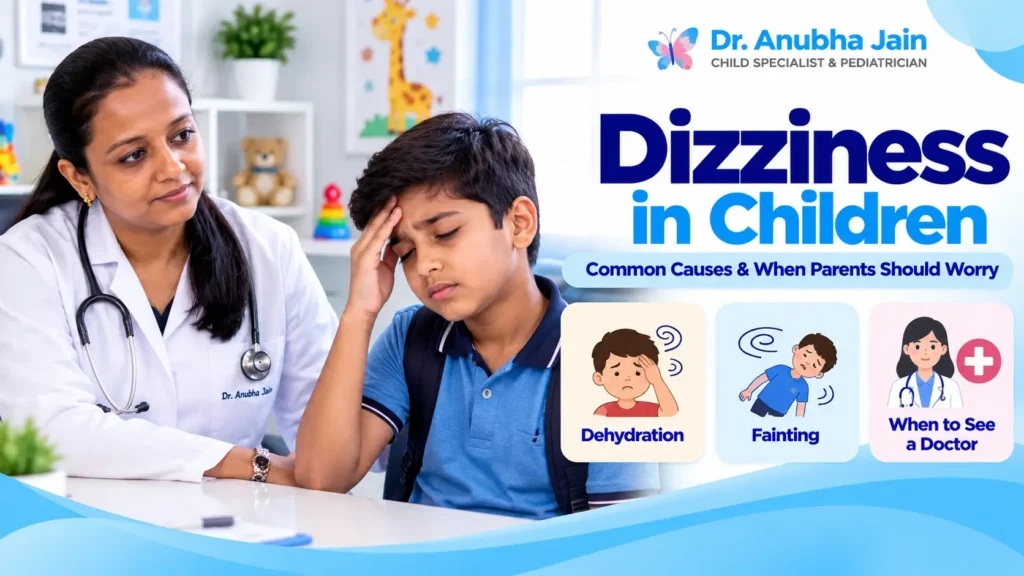
Dizziness in Children
can be unsettling for both children
and parents. A child may describe
feeling lightheaded, unsteady,
weak or as though the surroundings
are spinning. Some children feel
dizzy after getting out of bed,
standing in a school assembly
or playing outdoors on a hot day.
Many episodes are temporary and
related to factors such as
insufficient fluids, missed meals
or standing up suddenly.
However, dizziness that recurs,
disrupts daily activities or
occurs with fainting may
require medical assessment.
This guide explains common
causes, important differences
between dizziness and fainting,
safe first steps and when
parents should consult
a pediatrician.
Quick Answer for Parents
If a child briefly feels
lightheaded after standing
up quickly, dehydration
or a temporary blood
pressure change may
be contributing.
Have the child sit or lie
down safely and avoid
standing suddenly.
If fully alert and able
to swallow normally,
offer appropriate fluids.
Severe dizziness,
difficulty walking,
fainting during exercise,
chest pain or breathing
difficulty needs urgent
medical evaluation.
What Does Dizziness in Children Feel Like?
Children use the word
“dizzy” to describe
different sensations.
Understanding what
a child actually
experiences can help
identify the cause.
Lightheadedness
The child feels faint,
weak or as though
they might pass out.
They may also have
blurred vision, nausea
or a brief feeling
of warmth.
Loss of Balance
The child feels unsteady
when standing or walking.
Some may need support
or avoid movement
because of the sensation.
Vertigo
Vertigo is a spinning
sensation, as though
the surroundings
or the child are moving
when they are not.
It differs from ordinary
lightheadedness and may
need specific evaluation.
What Are the Common Causes of Dizziness in Children?
The circumstances surrounding
an episode are often
as important as the
symptom itself.
Dehydration and Hot Weather
Insufficient fluid intake,
heavy sweating or
illness-related fluid
loss can contribute
to dizziness.
A child may notice
symptoms during
outdoor sports,
school assemblies
or hot weather.
Standing Up Too Quickly
Some children experience
temporary lightheadedness
after rising quickly
from a sitting or
lying position.
Blood pressure and
circulation need
a moment to adjust
when body position changes.
Skipping Meals
Long gaps between meals
may contribute to
weakness or dizziness.
The likelihood and
mechanism depend
on the child’s
general health
and circumstances.
Persistent episodes
should not automatically
be labeled low blood sugar
without medical evaluation.
Illness and Fever
Viral illnesses,
fever and reduced
fluid intake may
temporarily make
children feel weak
or lightheaded.
Symptoms should be
considered alongside
the child’s hydration,
activity and overall
condition.
Anemia or Other Medical Conditions
Iron-deficiency anemia
and other medical
conditions may sometimes
contribute to dizziness,
particularly when
symptoms are recurrent.
A pediatrician decides
whether examination
or laboratory testing
is needed.
Less Common Heart or Neurological Causes
Occasionally, dizziness
or fainting may be
associated with
abnormal heart rhythms,
other cardiovascular
conditions or neurological
problems.
These possibilities are
especially important
when symptoms occur
during physical exercise
or with other warning signs.
Why Does My Child Feel Dizzy After Standing Up?
When a child stands
suddenly, blood can
briefly collect in
the lower body.
This may temporarily
reduce blood flow
to the brain.
The child may experience
lightheadedness,
blurred vision
or a sensation
of nearly fainting.
For mild, brief
episodes, standing
up more gradually,
regular meals and
appropriate hydration
may help.
Repeated episodes,
falls or actual
fainting should
be discussed with
a pediatrician.
Can Dizziness Be a Sign of Anemia?
Anemia can cause
tiredness, weakness
and sometimes
dizziness.
It is not possible
to diagnose anemia
from dizziness alone.
Other causes are
often more likely.
A pediatrician may
review the child’s
diet, growth,
other symptoms
and medical history.
Blood tests may be
recommended when
clinically appropriate.
For pediatric information
about blood-related
conditions, explore
Blood Disorders in Children
.
What Is the Difference Between Dizziness and Fainting?
Dizziness describes
an uncomfortable
sensation of feeling
lightheaded, unsteady
or spinning.
Fainting, also known
as syncope, involves
a brief loss
of consciousness.
Some children experience
warning signs before
fainting, such as
nausea, sweating,
blurred vision
or sudden weakness.
If a child has
actually fainted,
parents should arrange
medical assessment
even if the child
quickly feels better.
What Should Parents Do When a Child Feels Dizzy?
Immediate Safety Steps
- Ask the child to stop the activity and sit or lie down safely.
- Keep the child away from stairs, traffic and other fall hazards.
- Encourage slow movements rather than standing suddenly.
- Move the child to a cooler location if heat may be involved.
- Offer suitable fluids if the child is fully alert and able to swallow.
- Observe breathing, alertness and other symptoms.
- Seek medical advice if dizziness persists or returns.
Do not give food or
drink to an unconscious
or poorly responsive child.
Do not allow a dizzy
child to immediately
return to sports,
cycling or activities
where a fall
could cause injury.
What If a Child Actually Faints?
If a child collapses,
check responsiveness
and normal breathing.
Call emergency services
if the child is
unresponsive, not
breathing normally
or has other
emergency symptoms.
Follow emergency
dispatcher instructions,
including CPR
if required.
For a child who has
briefly fainted but
is breathing normally,
keep them safely lying
down and monitor them.
If vomiting occurs,
position the child
on their side
when safe to do so.
Any fainting episode
deserves appropriate
medical follow-up.
Fainting during
exercise warrants
urgent assessment.
When Is Dizziness in Children an Emergency?
Seek Immediate Emergency Care If Your Child Has:
- Dizziness with chest pain, difficulty breathing or a concerning abnormal heartbeat.
- Fainting during exercise or physical activity.
- Loss of consciousness with difficulty waking or abnormal breathing.
- Severe headache, confusion, seizure or new weakness.
- Inability to stand or walk without support.
- Severe dizziness after a significant head injury.
- Signs of serious dehydration or severe illness.
These symptoms should
not be managed solely
with rest or home remedies.
Seek emergency medical
care promptly.
Can Poor Sleep Cause Dizziness?
Inadequate sleep may
contribute to fatigue
and reduced wellbeing.
A tired child may
also report feeling
weak or lightheaded.
However, recurring
dizziness should
not automatically
be attributed
to poor sleep.
Parents should consider
whether symptoms occur
alongside missed meals,
illness, dehydration
or other health concerns.
Is Dizziness During Sports Normal?
Heat exposure,
dehydration and
overexertion can
contribute to
lightheadedness.
However, a child
who becomes dizzy
during sports should
stop exercising
and be assessed
according to the
severity of symptoms.
Fainting while
actively exercising,
especially with
chest pain or
palpitations,
requires urgent
medical evaluation.
Do not restart
strenuous exercise
until a clinician
has advised that
it is safe following
a concerning episode.
Can Diet and Meal Timing Help?
Regular, balanced
meals and adequate
fluids support a
child’s everyday
health.
A child who repeatedly
skips breakfast
or spends long
periods without
eating may feel
weak or unwell.
Nutrition alone
does not treat
every cause
of dizziness.
For child dietary
concerns and
individualized
nutrition guidance,
visit
Pediatric Nutrition in Varanasi
.
When Should Parents Schedule a Pediatric Consultation?
Arrange a consultation
when episodes recur,
last longer than
expected or interfere
with school,
sports or daily life.
Symptoms That Need Medical Review
- Repeated dizziness over several days or weeks.
- Episodes that interrupt school or routine activities.
- Dizziness accompanied by unusual fatigue or paleness.
- Symptoms related to standing that occur frequently.
- Any history of fainting.
- Associated ear symptoms, headaches or balance problems.
- Family history of significant heart rhythm problems or sudden cardiac death.
If symptoms are severe,
sudden or associated
with red flags,
seek urgent care
rather than waiting
for a routine appointment.
Pediatric Consultation in Varanasi
For general pediatric
evaluation of recurring
dizziness and related
child health concerns,
visit
Pediatrician in Varanasi
.
How Does a Pediatrician Evaluate Dizziness?
The doctor may ask
when the dizziness
began, how long
episodes last,
whether it happens
when standing and
whether the child
has ever fainted.
An assessment may
include blood pressure,
pulse, hydration,
physical examination
and a review of
medicines, nutrition
and medical history.
Depending on the
symptoms, the doctor
may recommend an
ECG, blood tests
or specialist referral.
Testing is selected
based on clinical
findings rather
than being necessary
for every child.
What Should Parents Record Before the Appointment?
Dizziness Symptom Diary
- Exact date and approximate time of the episode.
- Whether the child was sitting, standing or exercising.
- How long the symptoms lasted.
- Any blurred vision, headache, nausea or palpitations.
- Recent fluid intake and missed meals.
- Associated fever, illness or medication.
- Whether the child fell or lost consciousness.
- Family history of relevant cardiac conditions.
This record can help
a pediatrician identify
patterns and decide
whether additional
evaluation is needed.
Consult Dr. Anubha Jain for Pediatric Care in Varanasi
Dr. Anubha Jain,
MBBS, MD (Pediatrics),
provides pediatric
consultations in
Kabir Nagar,
Durgakund, Varanasi.
Her practice is located
at Samaria Multi-Speciality
& Chest Centre,
Plot 36A, Kabir Nagar,
Durgakund, Varanasi.
Parents concerned
about recurring
dizziness, growth,
nutrition or general
childhood symptoms
may seek pediatric
assessment and
guidance on whether
specialist evaluation
is necessary.
Clinic Information
Doctor: Dr. Anubha Jain
Qualifications: MBBS, MD (Pediatrics)
Location: Samaria Multi-Speciality & Chest Centre
Address: Plot 36A, Kabir Nagar, Durgakund, Varanasi – 221005
Contact: +91 9454643742
Appointments:
Contact Dr. Anubha Jain
Frequently Asked Questions About Dizziness in Children
Why does my child feel dizzy after standing up?
A temporary change in
blood pressure or circulation
may contribute, especially
when a child stands suddenly.
Repeated episodes deserve
medical review.
Can dehydration cause dizziness in children?
Yes. Inadequate fluids,
heat and excessive
sweating can contribute
to lightheadedness.
Can skipping breakfast make a child dizzy?
Missing meals can
contribute to weakness
or lightheadedness,
although other causes
may also be involved.
Is dizziness the same as fainting?
No. Dizziness describes
a sensation of feeling
lightheaded or unsteady.
Fainting involves
temporary loss
of consciousness.
Can anemia cause dizziness?
Yes, in some cases.
However, dizziness alone
cannot confirm anemia.
A clinician decides
if testing is required.
When is dizziness dangerous in children?
Dizziness with chest
pain, fainting during
exercise, breathing
difficulty, confusion
or inability to walk
requires urgent care.
Should a child return to sports after fainting?
A child with fainting
during exercise should
not resume strenuous
activity until medically
evaluated and cleared.
Which doctor should parents consult?
A pediatrician can
provide initial
assessment and recommend
cardiology, ENT or
other specialist
review when indicated.
Additional Respiratory Health Information for Parents
Children experiencing persistent cough,
wheezing, asthma symptoms or recurring
breathing problems may require
medical evaluation.
For additional information about
respiratory health, visit
Samaria Multi-Speciality & Chest Centre,
Varanasi
.
Located in Kabir Nagar,
Durgakund, Varanasi,
the centre provides
information about
respiratory care and
services including
asthma management,
pulmonary function testing,
bronchoscopy, COPD care
and other chest-related
conditions.
The specialist team
also includes
Dr. Anubha Jain,
Senior Consultant Pediatrician
& Child Specialist.
Website:
https://chestclinicvns.com/
Address:
Plot 36A, Kabir Nagar,
Durgakund, Varanasi – 221005.
Contact:
+91 8795300333
Note: This resource provides
information about respiratory healthcare.
Children with severe breathing difficulty
require immediate emergency
medical attention.
Conclusion: Understanding Dizziness in Children
Dizziness in children
may result from
temporary triggers
such as dehydration,
heat exposure,
missed meals or
standing up suddenly.
Parents should observe
the pattern of symptoms
and prioritize safety
during an episode.
Recurring dizziness,
fainting or symptoms
that interfere with
daily activities
deserve medical
assessment. Emergency
warning signs require
immediate care.
For pediatric consultation
information in Varanasi,
visit
Pediatrician in Varanasi
.
Request Pediatric Consultation
Medical Disclaimer:
This article is for
general educational purposes.
It does not replace
professional diagnosis,
emergency assessment
or individualized
medical treatment.