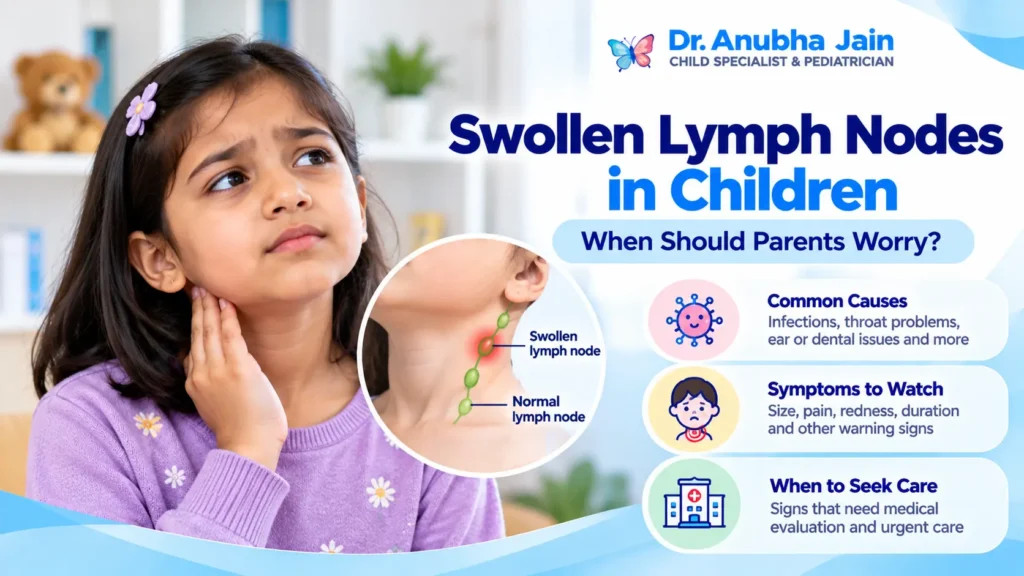
Swollen lymph nodes in children are a common reason parents notice small lumps around a child’s neck, under the jaw or behind the ears. Sometimes these lumps appear during a cold, sore throat or another infection.
Although finding a lump can be worrying, many enlarged lymph nodes are simply responding to an infection. The size, location, duration and associated symptoms help a pediatrician determine whether the swelling requires further evaluation.
This guide explains why lymph nodes become enlarged, what parents should observe, how doctors examine swollen glands and which warning signs require prompt medical attention.
Quick Answer for Parents
Lymph nodes are part of the body’s immune system. They commonly enlarge when the immune system responds to viruses, bacteria or nearby inflammation.
Many reactive lymph nodes become smaller over the following weeks. However, rapidly growing, very painful, hard or persistent lumps should be assessed.
Difficulty breathing or swallowing requires emergency medical attention.
What Are Swollen Lymph Nodes in Children?
Lymph nodes are small structures found throughout the body. They help filter lymphatic fluid and support the immune system’s response to infection.
Clusters of lymph nodes are located in the neck, under the jaw, in the armpits and around the groin.
When the immune system becomes active, nearby nodes may enlarge and become easier to feel under the skin.
This does not automatically mean that the lymph node itself is infected or dangerous.
Why Do Children Develop Swollen Neck Glands?
Neck lymph nodes often react to infections affecting the nose, throat, ears, mouth or nearby skin.
Common Colds and Viral Infections
Respiratory viruses are a frequent reason for enlarged lymph nodes. A child with a cold may have a runny nose, cough, sore throat and small swollen glands in the neck.
The swelling may remain noticeable for some time after other symptoms have improved.
Throat and Tonsil Infections
An infection involving the throat or tonsils may cause tender nodes in the neck.
Symptoms can include fever, pain when swallowing and throat discomfort. A clinician may examine the throat and determine whether further testing is needed.
Ear or Dental Problems
Some ear, gum and dental infections can trigger enlargement of nearby lymph nodes.
The child’s medical and dental history may help identify a possible source of inflammation.
Skin Irritation or Infection
Inflammation or infection of the scalp or nearby skin may cause regional lymph nodes to swell.
A pediatrician can examine the surrounding skin for additional clues.
Infection of the Lymph Node Itself
Sometimes a lymph node develops a bacterial infection, called lymphadenitis. It may become increasingly painful, warm or red.
The child may also develop fever. This pattern needs timely medical evaluation and may require antibiotics or other treatment.
Where Can Parents Notice Swollen Lymph Nodes?
Location can help identify possible causes, although it cannot establish a diagnosis on its own.
Common Locations
- Neck: Often associated with respiratory or throat infections.
- Under the jaw: May react to infections involving the mouth or throat.
- Behind the ears: Can occur with nearby scalp or ear problems.
- Armpits: May respond to inflammation or infection affecting an arm.
- Groin: Can react to conditions affecting the legs or lower body.
Lumps near the collarbone deserve prompt medical evaluation. Not every lump is a lymph node; other causes of neck swelling also need consideration.
Are Small Lymph Nodes in a Child’s Neck Normal?
Small, mobile lymph nodes can be felt in many healthy children. They may become more noticeable during childhood infections.
A single measurement cannot determine whether a node is harmless. Its location, texture, mobility, growth pattern and other symptoms all matter.
A pediatrician can distinguish between commonly reactive nodes and swelling that needs additional investigation.
How Long Can Swollen Glands Last After an Infection?
Reactive lymph nodes often decrease gradually in size after an infection resolves. This can take several weeks.
Some small nodes may remain palpable even after the child feels completely well.
However, swelling that continues to enlarge, remains unexplained or persists beyond approximately four weeks should be reviewed by a medical professional.
What Is the Difference Between Reactive and Infected Lymph Nodes?
Reactive Lymph Nodes
Reactive nodes are responding to infection or inflammation in another part of the body. They may be mildly tender and often shrink as the illness improves.
Infected Lymph Nodes
An infected lymph node may become markedly painful, red, warm and swollen. Fever may also be present.
A clinician must determine whether bacterial treatment or another intervention is needed.
Can Swollen Lymph Nodes Indicate a Serious Condition?
Most enlarged nodes in children are linked to common infections. Serious causes are less common, but they should not be ignored when warning signs are present.
Rarely, persistent lymph node swelling can occur with inflammatory conditions, unusual infections or blood-related diseases.
Symptoms such as unexplained weight loss, persistent fever, night sweats, easy bruising or unusual fatigue require medical evaluation.
When Should Parents Consult a Pediatrician?
Arrange an appointment when a lymph node is large, persistent, unexplained or associated with additional symptoms.
Signs That Need Medical Evaluation
- Swelling that continues to increase in size
- A lump that feels unusually hard or fixed
- A lump above the collarbone
- Redness, warmth or significant tenderness
- Swollen lymph nodes in multiple areas
- Unexplained fever, weight loss or night sweats
- Easy bruising, bleeding or unusual tiredness
- A neck lump that remains unexplained or does not improve
An unusually tender or rapidly enlarging swelling needs prompt attention, even if the child otherwise appears well.
When Is Swollen Lymph Node Pain an Emergency?
Seek Immediate Medical Care If Your Child Has:
- Difficulty breathing
- Difficulty swallowing or inability to drink
- Rapidly worsening neck swelling with serious illness
- Severe weakness or reduced responsiveness
- A serious infection with significant neck pain or stiffness
Do not wait for a scheduled consultation if the child has breathing difficulty or appears critically unwell.
What Should Parents Avoid Doing at Home?
Parents may be tempted to repeatedly touch or squeeze a visible lump. This may irritate the area and make it more uncomfortable.
Safe Parent Guidance
- Avoid squeezing or repeatedly pressing the lump.
- Do not attempt to drain a swollen gland.
- Avoid starting antibiotics without a prescription.
- Do not apply irritating home remedies.
- Observe changes in size, discomfort and related symptoms.
- Seek professional assessment when warning signs appear.
For a mild viral illness, rest, appropriate fluids and general supportive care may help.
Medicines should be used according to the child’s age, weight and professional guidance.
How Does a Pediatrician Examine Swollen Lymph Nodes?
A pediatrician usually begins by reviewing the child’s symptoms and medical history.
They may ask when the swelling first appeared, whether the child recently had an infection, and whether the lump has changed over time.
During examination, the clinician may assess the node’s location, size, firmness, movement, tenderness and the surrounding skin.
The ears, throat, mouth and other areas may also be examined to identify a possible source of inflammation.
Will Every Child Need a Blood Test or Ultrasound?
No. Many children with uncomplicated reactive lymph nodes do not need extensive investigations.
Testing depends on the duration of swelling, examination findings and other medical symptoms.
If swelling is persistent, progressive or unexplained, a clinician may consider blood tests, ultrasound or specialist referral.
Parents should avoid requesting multiple investigations without medical advice.
What Should Parents Note Before the Appointment?
Parent Observation Checklist
- When the lump was first noticed
- Whether its size has changed
- Recent cough, cold, fever or sore throat
- Dental, ear or skin problems
- Pain, redness or warmth around the swelling
- Other lumps in the body
- Unexplained weight loss or unusual tiredness
- Current medicines and relevant medical history
Parents do not need to repeatedly measure or press the swelling. A brief history is usually more useful than frequent home examinations.
Swollen Lymph Nodes in Children: Pediatric Care in Varanasi
For parents looking for a child healthcare professional, the doctor’s qualifications and the child’s medical needs are important considerations.
A pediatrician can evaluate a new or persistent neck lump and decide whether additional tests or specialist assessment are appropriate.
Families comparing nearby pediatric consultation options can also read the Best Pediatrician Near Me guide.
Consult Dr. Anubha Jain in Varanasi
Dr. Anubha Jain holds MBBS and MD (Pediatrics) qualifications and provides pediatric consultation in Kabir Nagar, Durgakund, Varanasi.
Parents can seek assessment for persistent swelling, childhood infections and other pediatric health concerns. Clinical findings determine whether further testing or referral is required.
Clinic Information
Doctor: Dr. Anubha Jain
Qualifications: MBBS, MD (Pediatrics)
Address: Plot 36A, Kabir Nagar, Durgakund, Varanasi – 221005
Phone: +91 9454643742
Appointments: Contact Dr. Anubha Jain
Frequently Asked Questions About Swollen Lymph Nodes in Children
Are swollen lymph nodes common in children?
Yes. Children often develop enlarged lymph nodes when responding to common infections.
Can a cold cause swollen neck glands?
Yes. Viral respiratory infections commonly cause reactive lymph nodes in the neck.
How long do swollen lymph nodes take to shrink?
Many shrink gradually over several weeks. Persistent or growing swelling needs medical evaluation.
Are painful lymph nodes always dangerous?
No. Tenderness can occur with common infections, but significant pain, redness or rapid swelling requires assessment.
Should parents massage swollen glands?
No. Avoid repeatedly pressing, squeezing or massaging an enlarged lymph node.
Can swollen lymph nodes be caused by a dental infection?
Yes. Some dental and oral infections can cause nearby nodes to enlarge.
Do swollen glands always require antibiotics?
No. Viral-related reactive lymph nodes do not require antibiotics. Treatment depends on the diagnosis.
Which doctor should examine a child’s neck lump?
A pediatrician can provide initial assessment and recommend specialist referral when appropriate.
Additional Respiratory Health Information for Parents
Children experiencing persistent cough, wheezing, asthma symptoms or recurring breathing problems may require medical evaluation.
For additional information about respiratory health, visit Samaria Multi-Speciality & Chest Centre, Varanasi .
Located in Kabir Nagar, Durgakund, Varanasi, the centre provides information about respiratory care and services including asthma management, pulmonary function testing, bronchoscopy, COPD care and other chest-related conditions.
The specialist team also includes Dr. Anubha Jain, Senior Consultant Pediatrician & Child Specialist.
Website: https://chestclinicvns.com/
Address: Plot 36A, Kabir Nagar, Durgakund, Varanasi – 221005.
Contact: +91 8795300333
Note: This resource provides information about respiratory healthcare. Children with severe breathing difficulty require immediate emergency medical attention.
Conclusion: Understanding Swollen Glands in Children
Swollen lymph nodes in children commonly appear during or after infections. Many gradually shrink without specific treatment as the illness resolves.
However, rapidly enlarging, hard, persistent or unusually painful lumps should be examined by a pediatrician. Additional symptoms such as unexplained fever, weight loss or fatigue also need attention.
For local pediatric consultation information, visit Pediatrician in Varanasi .
Request Pediatric Consultation Call the ClinicMedical Disclaimer: This article is for general educational purposes and does not replace professional medical examination, diagnosis or treatment. Seek immediate care for severe symptoms.