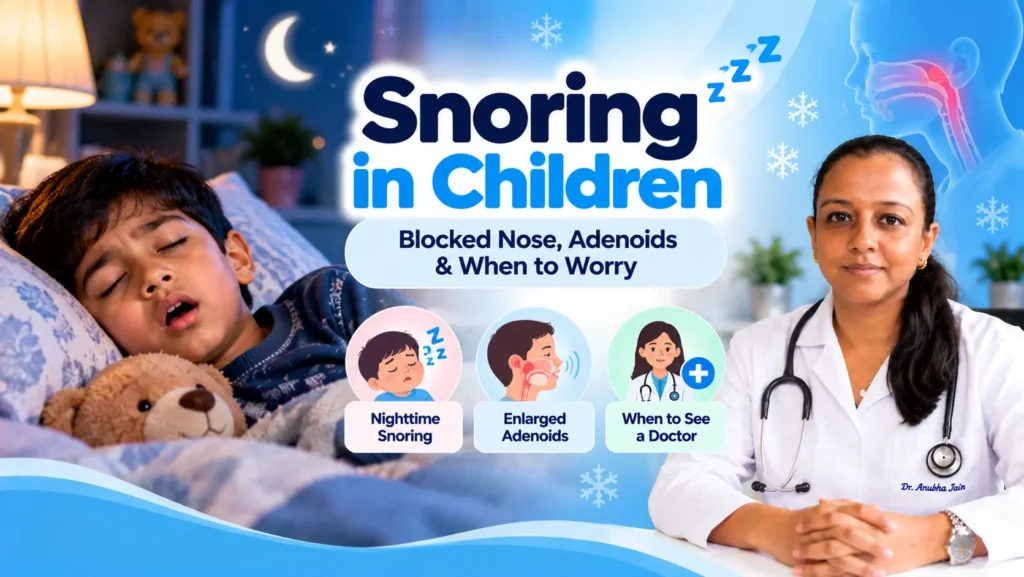
Snoring in Children can worry parents, especially when a child begins making loud breathing sounds during sleep after a cold or during changing weather. Some children snore only for a few nights when their nose is blocked, while others have noisy breathing almost every night.
Although occasional snoring during nasal congestion may improve as the illness resolves, frequent or loud snoring should not automatically be considered harmless. Enlarged tonsils, adenoids, allergic rhinitis and obstructive sleep apnea are among the possible causes of disturbed nighttime breathing.
This guide explains why children snore, how to recognize possible sleep-related breathing problems, which steps parents can take safely and when pediatric evaluation is necessary.
Quick Answer for Parents
A child may snore because of a blocked nose, allergies, enlarged tonsils or adenoids. Temporary snoring during a cold may settle after nasal congestion improves.
However, frequent loud snoring, pauses in breathing, gasping during sleep or persistent daytime tiredness can indicate a sleep-related breathing problem.
Parents should arrange pediatric evaluation when snoring occurs regularly or interferes with sleep. Severe breathing difficulty or blue or grey skin discoloration requires emergency medical attention.
What Is Snoring in Children?
Snoring is a breathing sound produced when air passes through a partly narrowed upper airway during sleep. The surrounding tissues vibrate and create a rattling or snoring noise.
The sound may become more noticeable when a child has nasal congestion, throat inflammation or enlarged tissues around the airway.
Snoring is different from wheezing, which is usually associated with airflow through narrowed lower airways. Parents should not assume that all noisy breathing sounds have the same cause.
Why Does Snoring in Children Become More Noticeable During Winter?
Cooler months may coincide with viral colds, changes in indoor exposure and periods of nasal congestion. When a child’s nose becomes blocked, breathing through the nose may become more difficult during sleep.
Some children respond by breathing through their mouths. This can increase upper-airway noise and make snoring more noticeable.
However, cold weather itself does not cause enlarged adenoids or sleep apnea. If snoring continues after a cold improves, another underlying issue should be considered.
What Are the Common Causes of Snoring in Children?
Blocked Nose During a Common Cold
Viral respiratory infections can cause temporary swelling inside the nose and increased mucus production. This may make it harder to breathe comfortably through the nose at night and contribute to snoring.
Symptoms often improve as the infection resolves. Persistent snoring after recovery needs further attention.
Enlarged Adenoids
Adenoids are lymphatic tissues located behind the nose. When enlarged, they may partly obstruct the upper airway and contribute to mouth breathing, nasal blockage, snoring and disturbed sleep.
Adenoids are not usually visible when parents look inside a child’s mouth. A clinician may recommend further examination when necessary.
Enlarged Tonsils
Tonsils are located at the back of the throat. Enlarged tonsils may narrow the airway during sleep and contribute to persistent snoring in some children.
However, large tonsils do not automatically mean a child has obstructive sleep apnea.
Nasal Allergies
Allergic rhinitis may cause frequent sneezing, nasal itching, congestion and mouth breathing. These symptoms can worsen nighttime airflow in some children.
Allergy evaluation may be useful when snoring occurs alongside repeated nasal symptoms.
Obstructive Sleep Apnea
Obstructive sleep apnea occurs when the upper airway repeatedly narrows or becomes blocked during sleep. The child may snore loudly, gasp, experience pauses in breathing or wake frequently.
This condition requires medical assessment because it can affect sleep quality and overall health.
Can a Blocked Nose Make a Child Snore at Night?
Yes. Nasal congestion can contribute to temporary snoring, especially during a cold or allergic episode.
Parents may notice that snoring begins at the same time as a runny nose, sneezing or a sore throat. When congestion improves, the nighttime noise may reduce as well.
However, repeated nasal blockage or snoring that continues between illnesses should be discussed with a pediatrician.
What Are Enlarged Adenoids in Children?
Adenoids are part of the immune system and sit in the upper throat behind the nose. They are commonly larger in younger children and may gradually become smaller as children grow.
When adenoids contribute to upper-airway obstruction, a child may experience persistent mouth breathing, a blocked-nose sensation, snoring or restless sleep.
Possible Symptoms of Enlarged Adenoids
- Habitual snoring
- Persistent mouth breathing
- Blocked nasal breathing
- Restless or disturbed sleep
- Recurring nasal symptoms
- Possible associated ear problems
These symptoms can have several causes. A pediatrician or ENT specialist can assess whether adenoids are contributing.
What Is Obstructive Sleep Apnea in Children?
Obstructive sleep apnea, often shortened to OSA, is a sleep-related breathing disorder in which the upper airway repeatedly becomes partly or fully blocked during sleep.
Some children snore loudly and then appear to pause their breathing before gasping or changing position. Others have restless sleep, unusual sleeping postures or frequent nighttime waking.
Sleep apnea may affect a child’s ability to obtain restorative sleep. Untreated cases can contribute to behavioral, learning and other health concerns.
A sleep study may be recommended when the history and examination suggest obstructive sleep apnea.
Ordinary Snoring vs Possible Sleep Apnea in Children
Snoring alone cannot establish a diagnosis, but certain patterns increase concern about sleep-disordered breathing.
| Feature | Occasional Snoring | Possible Sleep Apnea |
|---|---|---|
| Frequency | May happen during a cold | Often frequent or persistent |
| Breathing pauses | Not typically observed | May be present |
| Gasping or choking | Not typical | May occur during sleep |
| Sleep quality | May remain otherwise normal | May be restless or interrupted |
| Daytime symptoms | Often absent | May include tiredness or attention difficulties |
These differences are only general clues. Some children with sleep apnea do not have obvious symptoms in every category, and formal evaluation may still be necessary.
Why Does My Child Sleep With Their Mouth Open?
Mouth breathing during sleep may happen when nasal airflow is reduced because of congestion, allergies or enlarged adenoids.
Parents may notice that the child sleeps with the lips apart, wakes with a dry mouth or frequently sounds congested.
Persistent mouth breathing should not be ignored, particularly when accompanied by loud snoring, restless sleep or suspected breathing pauses.
Related Pediatric Service: If your child has recurring nasal congestion, sneezing or suspected allergies, explore Allergy in Children.
Can Snoring Affect a Child’s School Performance?
Children who experience disturbed sleep may have difficulty concentrating, feel tired during the day or show changes in behavior.
Unlike adults, children with sleep-disordered breathing may sometimes appear hyperactive or irritable rather than obviously sleepy.
Academic difficulties alone do not establish sleep apnea. However, when behavioral or attention changes occur alongside habitual snoring, parents should discuss the connection with a pediatrician.
Can Snoring Cause Morning Headaches?
Some children with sleep-related breathing disorders experience headaches after waking. Poor sleep can also contribute to daytime fatigue and reduced comfort.
Morning headaches have many possible causes, so they should not automatically be attributed to snoring.
Persistent headaches, severe headache symptoms or neurological concerns deserve medical evaluation.
Is Snoring Connected to Bedwetting in Children?
Bedwetting may occur in some children with obstructive sleep apnea, although many other factors can contribute to nighttime wetting.
A child with persistent bedwetting and regular loud snoring may benefit from evaluation for sleep-related breathing problems.
Parents should not assume that snoring is responsible for every episode of bedwetting.
How Can Parents Help a Child With Mild Snoring During a Cold?
If a child has temporary nasal congestion but is otherwise comfortable, breathing normally and showing no warning signs, simple supportive measures may help.
Safe Parent Care Checklist
- Encourage adequate age-appropriate hydration.
- Use age-appropriate saline nasal drops or spray when suitable.
- Keep the bedroom free from tobacco smoke.
- Reduce exposure to identified allergens and irritants.
- Maintain a consistent sleep schedule.
- Use a clean, comfortable sleeping environment.
- Observe whether snoring improves as the cold resolves.
- Seek evaluation if snoring is loud, frequent or persistent.
Do not use adult decongestant sprays, sedating medicines or unprescribed sleep aids to treat a child’s snoring. Medication should be selected with age-appropriate medical advice.
Do Anti-Snoring Devices Work for Children?
Products marketed for adult snoring are not automatically suitable for children. Mouthpieces, nasal devices and other treatments may be ineffective or inappropriate without understanding the underlying cause.
A child with enlarged tonsils, adenoids or suspected sleep apnea needs medical assessment rather than an unverified over-the-counter anti-snoring device.
Treatment should be directed at the diagnosed condition and the child’s individual needs.
Does Every Child Who Snores Need Surgery?
No. The treatment of snoring depends on the cause, severity and whether obstructive sleep apnea is present.
Some children benefit from appropriate management of nasal allergies or temporary congestion. Others with clinically significant airway obstruction may require specialist assessment.
When obstructive sleep apnea is related to enlarged tonsils and adenoids, an ENT specialist may discuss surgery as one treatment option. However, surgery is not required for every child who snores, and follow-up remains important.
When Should Parents Consult a Pediatrician?
Regular loud snoring deserves medical review, especially when it continues after respiratory symptoms improve or affects daytime wellbeing.
Reasons to Schedule a Pediatric Visit
- Snoring on most nights
- Loud snoring that continues between colds
- Observed pauses in breathing during sleep
- Gasping, choking or frequent nighttime waking
- Persistent mouth breathing or nasal blockage
- Difficulty concentrating or unusual daytime tiredness
- Recurring morning headaches
- Snoring associated with growth or behavioral concerns
Pediatric Consultation in Varanasi
For initial evaluation of persistent snoring and childhood sleep-related breathing concerns, visit Pediatrician in Varanasi.
When Is Snoring or Noisy Breathing an Emergency?
Seek Emergency Medical Care If Your Child Has:
- Breathing that stops and does not promptly resume
- Severe difficulty breathing or struggling for air
- Blue, grey or unusually pale lips or face
- Reduced responsiveness or difficulty waking
- Marked chest retractions or severe breathing effort
- Sudden airway symptoms after choking
These signs require immediate emergency assistance. Do not wait for an ordinary appointment or attempt to manage severe breathing problems with home remedies.
How Does a Pediatrician Evaluate a Snoring Child?
A pediatrician may ask how frequently the child snores, whether breathing pauses occur and whether the child experiences mouth breathing, sleep disruption or daytime behavior changes.
An examination may include the nose, throat, tonsils, growth and general respiratory health.
Depending on the findings, the child may be referred to an ENT specialist or sleep specialist. An overnight sleep study, called polysomnography, can help diagnose obstructive sleep apnea and assess its severity.
A normal-looking throat examination alone does not always exclude sleep apnea.
What Should Parents Record Before the Appointment?
Child Snoring Observation Checklist
- How many nights per week the child snores
- Whether snoring is loud or persistent
- Any breathing pauses, gasping or choking sounds
- Whether the child sleeps with the mouth open
- Recent colds or persistent allergy symptoms
- Restless sleep, sweating or frequent waking
- Daytime tiredness, irritability or school difficulties
- Any existing medical conditions or medicines
A short recording of nighttime breathing may help the clinician understand the symptoms. However, never delay emergency care to make a video.
Consult Dr. Anubha Jain in Varanasi
Dr. Anubha Jain, MBBS, MD (Pediatrics), provides pediatric consultations at Samaria Multi-Speciality & Chest Centre, Kabir Nagar, Durgakund, Varanasi.
Parents concerned about persistent snoring, mouth breathing, enlarged tonsils or sleep-related symptoms may seek initial pediatric evaluation. Further testing, treatment or ENT referral depends on the child’s examination and clinical history.
Clinic Information
Doctor: Dr. Anubha Jain
Qualifications: MBBS, MD (Pediatrics)
Location: Samaria Multi-Speciality & Chest Centre
Address: Plot 36A, Kabir Nagar, Durgakund, Varanasi – 221005
Contact: +91 9454643742
Appointments: Contact Dr. Anubha Jain
Frequently Asked Questions About Snoring in Children
Is snoring normal in children?
Occasional snoring during a cold can occur. Frequent or loud snoring should be evaluated because it may indicate upper-airway obstruction or sleep-related breathing problems.
Can a blocked nose cause snoring?
Yes. Nasal congestion from a cold or allergies can contribute to nighttime mouth breathing and snoring.
Do enlarged adenoids cause snoring?
Enlarged adenoids can partially obstruct nasal airflow and may contribute to mouth breathing, snoring and disturbed sleep.
Does every snoring child have sleep apnea?
No. Snoring has several causes. However, loud habitual snoring with breathing pauses or daytime symptoms raises concern about obstructive sleep apnea.
Can snoring affect school performance?
Disturbed sleep may contribute to attention, learning and behavioral difficulties in some children. These concerns deserve assessment when snoring is persistent.
Can allergies make a child snore?
Yes. Allergic nasal congestion may reduce airflow through the nose and contribute to snoring in susceptible children.
Does snoring always require tonsil surgery?
No. Treatment depends on the underlying cause and severity. Surgery may be considered for selected children with clinically significant obstruction or sleep apnea.
Which doctor should examine a child who snores?
A pediatrician can provide initial evaluation and recommend pediatric ENT or sleep-specialist assessment when necessary.
Additional Respiratory Health Information for Parents
Children experiencing persistent cough, wheezing, asthma symptoms or recurring breathing problems may require medical evaluation.
For additional information about respiratory health, visit Samaria Multi-Speciality & Chest Centre, Varanasi.
Located in Kabir Nagar, Durgakund, Varanasi, the centre provides information about respiratory care and services including asthma management, pulmonary function testing, bronchoscopy, COPD care and other chest-related conditions.
The specialist team also includes Dr. Anubha Jain, Senior Consultant Pediatrician & Child Specialist.
Website: https://chestclinicvns.com/
Address: Plot 36A, Kabir Nagar, Durgakund, Varanasi – 221005.
Contact: +91 8795300333
Note: This resource provides information about respiratory healthcare. Children with severe breathing difficulty require immediate emergency medical attention.
Conclusion: Understanding Snoring in Children
Snoring in children may occur temporarily during a common cold, but persistent loud snoring can be associated with enlarged tonsils, adenoids, nasal allergies or obstructive sleep apnea.
Parents should observe the frequency of snoring, breathing patterns during sleep and any daytime symptoms. Medical evaluation can help identify the cause and determine whether further testing or specialist care is appropriate.
For general pediatric consultation information in Varanasi, visit Pediatrician in Varanasi.
Request Pediatric Consultation
Medical Disclaimer: This article is for general educational purposes and does not replace professional medical diagnosis, sleep evaluation, specialist assessment or emergency care.