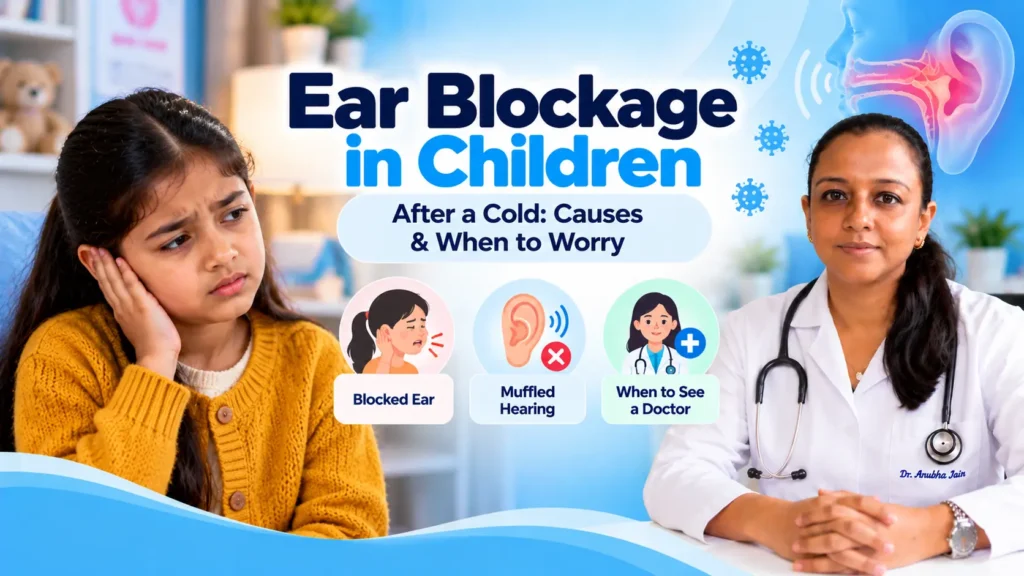
Ear Blockage in Children can occur after a common cold, leaving a child feeling as though one or both ears are plugged. Some children complain of pressure inside the ear, while others notice popping sounds or say that people seem to be speaking more quietly than usual.
A blocked feeling after a cold may develop when swelling around the Eustachian tube affects pressure regulation in the middle ear. Fluid can sometimes remain behind the eardrum even after the respiratory infection improves. However, earwax, infection and other ear conditions can cause similar symptoms.
This guide explains why ears may feel blocked after a cold, how to recognize muffled hearing, the meaning of glue ear, safe care steps and when a pediatrician should examine your child.
Quick Answer for Parents
Ear blockage after a cold is often related to temporary Eustachian tube dysfunction or fluid behind the eardrum. The child may experience fullness, popping or muffled hearing.
Do not insert cotton buds, oil or unprescribed ear drops into the child’s ear. A new hearing change, persistent blockage, ear pain or discharge should be medically assessed.
Severe symptoms such as swelling behind the ear, serious illness, facial weakness or sudden significant hearing loss need urgent medical attention.
Why Does Ear Blockage in Children Happen After a Cold?
The middle ear is a small air-filled space behind the eardrum. A passage called the Eustachian tube connects this space to the back of the nose and helps maintain normal ear pressure.
During a cold, swelling and mucus around the nose and throat can affect how this tube works. Air pressure may not equalize normally, which can create a blocked or full sensation inside the ear.
Some children also develop fluid behind the eardrum. This may cause temporary hearing changes without the severe pain usually associated with an acute ear infection.
What Are the Common Symptoms of a Blocked Ear?
Feeling of Fullness or Pressure
A child may describe the ear as stuffed, heavy or clogged. The sensation may be more noticeable after a cold or while the nose remains blocked.
Muffled Hearing
Sounds may seem quieter or less clear. The child may ask parents to repeat words, turn the television volume up or have difficulty hearing the teacher in class.
Popping or Crackling Sounds
Some children hear popping or crackling when swallowing or yawning. This can occur when pressure changes in the middle ear or when fluid is present.
Mild Ear Discomfort
A child may experience mild pressure or discomfort. Significant pain, high fever or discharge can suggest another problem and warrants prompt examination.
What Is the Eustachian Tube?
The Eustachian tube helps equalize air pressure between the middle ear and the surrounding environment. It also contributes to normal drainage from the middle ear.
In children, this tube has anatomical characteristics that make middle-ear problems more common than in adults. A cold or nasal inflammation can temporarily interfere with its function.
Eustachian tube dysfunction is one possible cause of blocked-ear symptoms, but it should not be assumed without considering other conditions.
What Is Glue Ear in Children?
Glue ear, also called otitis media with effusion, occurs when fluid remains in the middle ear without the typical signs of an acute ear infection.
It may follow a cold or an earlier ear infection. The child may not complain of pain but may have trouble hearing clearly, experience popping sensations or seem distracted during conversation.
Many cases improve naturally, often within about three months. However, a child with hearing difficulties should be medically evaluated rather than waiting for several months without assessment.
Signs That May Suggest Glue Ear
- Reduced hearing after a recent cold
- Frequently asking people to repeat themselves
- Increasing television or device volume
- Difficulty following spoken instructions
- Ear fullness or occasional popping sounds
- Changes in attention or classroom participation
Ear Blockage vs Ear Infection: What Is the Difference?
A child can have ear pressure or fluid without an acute bacterial infection. The presence of ear pain, fever and examination findings helps a clinician distinguish possible causes.
| Feature | Ear Blockage / Middle-Ear Fluid | Possible Acute Ear Infection |
|---|---|---|
| Main complaint | Fullness or muffled hearing | Often ear pain |
| Fever | Not usually present from fluid alone | May be present |
| Hearing | May be temporarily reduced | May also be reduced |
| Examination | Fluid may be visible behind eardrum | Signs of acute inflammation may be present |
| Management | Observation and hearing follow-up when appropriate | Depends on age, severity and diagnosis |
These are general differences, not a home diagnostic test. An ear infection may occur without obvious fever, and a blocked feeling may have causes other than middle-ear fluid.
Can Nasal Allergies Cause Ear Blockage?
Yes. Allergic rhinitis can contribute to nasal inflammation and congestion around the Eustachian tube. Some children notice blocked ears alongside frequent sneezing, an itchy nose or watery eyes.
However, allergies are not responsible for every episode of ear blockage. Earwax, infections and pressure-related problems may cause similar symptoms.
Related Pediatric Service: Read about Allergy in Children when blocked ears occur alongside repeated nasal allergy symptoms.
Why Is My Child Hearing Less After a Cold?
Fluid behind the eardrum can interfere with how sound travels through the middle ear. This may create temporary conductive hearing loss, meaning sound is not conducted normally through the outer or middle ear.
Parents may notice that a child becomes less responsive when called from another room or needs louder instructions. The child may not realize their hearing has changed.
Because hearing affects learning and communication, parents should arrange medical assessment for a noticeable hearing change rather than assuming it will always disappear without follow-up.
Can Ear Blockage Affect School Performance?
When sounds become muffled, a child may miss parts of classroom instructions or struggle to follow conversations in a noisy environment.
This can look like inattention, especially when hearing problems are not obvious to teachers or parents. Persistent hearing difficulties may affect learning and communication.
Tell the child’s teacher if hearing seems reduced and seek appropriate medical evaluation. Temporary classroom accommodations may help while hearing is being assessed.
Can Earwax Cause Similar Symptoms?
Yes. Earwax buildup can sometimes cause a blocked sensation or reduced hearing. However, the treatment for earwax is not the same as treatment for fluid behind the eardrum.
Parents should avoid using cotton buds, sharp objects, household oils or ear candles to remove wax. These methods may push wax deeper or damage the ear canal.
A clinician can examine the ear and recommend safe management if wax is actually responsible.
What Can Parents Safely Do at Home?
If the child is otherwise comfortable, has no significant pain and is waiting for medical assessment, simple supportive measures may help with associated cold symptoms.
Safe Parent Care Checklist
- Encourage normal hydration and rest during the cold.
- Use age-appropriate saline nasal drops or spray if suitable for nasal congestion.
- Avoid exposing the child to tobacco smoke.
- Encourage gentle nose blowing rather than forceful blowing.
- Do not insert objects or liquids into the ear.
- Observe whether hearing seems reduced at home or school.
- Seek medical advice if the ear remains blocked or hearing changes.
Do not attempt forceful pressure-equalization maneuvers or use decongestant medicines without professional advice. In selected cases of confirmed glue ear, a clinician may recommend supervised autoinflation for a child who can use the technique correctly.
Should Parents Use Ear Drops for Blocked Ears?
Not without knowing the cause. Ear drops intended for wax do not remove fluid trapped behind the eardrum, and some products may be unsuitable if the eardrum is damaged.
A clinician should examine the ear before treatment when the cause is uncertain, especially if a child has pain, discharge or hearing loss.
Antibiotic drops and other medicated products should only be used when medically indicated.
Do Antibiotics Help With Glue Ear?
Routine antibiotics are not generally recommended for uncomplicated glue ear. Fluid behind the eardrum often resolves over time, and medication is not routinely effective at making it disappear.
Antibiotics may be considered for certain diagnosed infections, but those decisions depend on symptoms and examination findings.
Do not use leftover antibiotics simply because a child feels that their ear is blocked.
How Long Can Ear Blockage Last After a Cold?
Temporary pressure-related symptoms may settle as nasal congestion improves. Middle-ear fluid can persist longer, sometimes for weeks or months.
The NHS notes that many cases of glue ear resolve within about three months. However, noticeable hearing loss should be evaluated earlier, and ongoing hearing problems may require hearing tests or ENT assessment.
Children with developmental, speech, learning or pre-existing hearing concerns may require closer monitoring rather than routine observation alone.
When Should Parents Consult a Pediatrician?
A blocked-ear sensation can have several causes, so a medical examination is useful when symptoms are persistent or hearing appears affected.
Reasons to Schedule a Pediatric Visit
- Ear blockage continuing beyond a couple of days
- Noticeable muffled hearing
- Repeated ear pressure after colds
- Ear pain or fever
- Popping sounds with persistent hearing problems
- Difficulty hearing at school
- Ear discharge or recurring ear infections
- Concerns about speech, balance or communication
Pediatric Consultation in Varanasi
For assessment of blocked ears, cold-related symptoms and childhood hearing concerns, visit Pediatrician in Varanasi.
When Is Ear Blockage an Emergency?
Seek Urgent or Emergency Care If Your Child Has:
- Sudden major hearing loss, especially in one ear
- Severe pain with high fever or marked illness
- Swelling, redness or severe tenderness behind the ear
- New facial weakness or severe dizziness
- Severe headache, stiff neck or reduced responsiveness
- Significant ear injury or suspected foreign object with concerning symptoms
These symptoms should not be managed with home remedies or routine observation. Seek prompt medical care, and use emergency services for severe neurological symptoms or serious illness.
How Does a Pediatrician Check Ear Blockage?
The pediatrician may ask when symptoms began, whether the child recently had a cold and whether hearing, balance or school participation has changed.
An otoscope can be used to examine the ear canal and eardrum. The clinician may look for wax, signs of infection or possible middle-ear fluid.
Depending on the findings, tympanometry or a hearing test may be recommended. Persistent or complicated cases may need evaluation by an ear, nose and throat specialist.
Does Every Child With Glue Ear Need Surgery?
No. Many cases resolve without surgery. When hearing difficulties persist or significantly affect learning and communication, specialists may discuss appropriate treatment options.
These options can include continued monitoring, hearing support or procedures such as ventilation tubes in selected children. Treatment depends on the child’s age, hearing assessment and overall medical circumstances.
Parents should not assume that an isolated blocked-ear sensation means an operation is necessary.
What Should Parents Observe Before the Appointment?
Ear Symptom Checklist
- Which ear feels blocked or whether both are affected
- When the symptom started
- Recent cold, fever or nasal congestion
- Any ear pain, discharge or ringing
- Whether the child asks people to repeat themselves
- Any change in television volume or school hearing
- Balance problems or dizziness
- Ear drops or medicines already used
Consult Dr. Anubha Jain in Varanasi
Dr. Anubha Jain, MBBS, MD (Pediatrics), provides pediatric consultations at Samaria Multi-Speciality & Chest Centre in Kabir Nagar, Durgakund, Varanasi.
Parents concerned about blocked ears after a cold, recurring nasal congestion or changes in hearing can seek an initial pediatric assessment. Further investigations or ENT referral depend on the individual child’s examination and symptoms.
Clinic Information
Doctor: Dr. Anubha Jain
Qualifications: MBBS, MD (Pediatrics)
Location: Samaria Multi-Speciality & Chest Centre
Address: Plot 36A, Kabir Nagar, Durgakund, Varanasi – 221005
Contact: +91 9454643742
Appointments: Contact Dr. Anubha Jain
Frequently Asked Questions About Ear Blockage in Children
Why does my child’s ear feel blocked after a cold?
Nasal inflammation can temporarily affect the Eustachian tube, causing pressure changes or fluid buildup behind the eardrum.
Can a child have a blocked ear without pain?
Yes. Middle-ear fluid or Eustachian tube dysfunction may cause fullness and muffled hearing without significant pain.
What is glue ear?
Glue ear is fluid buildup behind the eardrum without the typical signs of an acute ear infection. It can cause temporary hearing difficulties.
Can blocked ears affect hearing at school?
Yes. Muffled hearing may make it harder to follow classroom instructions or conversations. A noticeable hearing problem needs assessment.
Should I clean my child’s ear with cotton buds?
No. Cotton buds can push wax deeper or injure the ear. Do not insert objects into the ear canal.
Do antibiotics clear fluid behind the eardrum?
Routine antibiotics are not recommended for uncomplicated glue ear. Treatment depends on the underlying diagnosis.
How long does glue ear last in children?
Many cases improve within about three months, but children with hearing changes should be assessed and may need follow-up or hearing tests.
Which doctor should check persistent ear blockage?
A pediatrician can provide initial evaluation and refer the child to an ENT specialist or audiologist when necessary.
Additional Respiratory Health Information for Parents
Children experiencing persistent cough, wheezing, asthma symptoms or recurring breathing problems may require medical evaluation.
For additional information about respiratory health, visit Samaria Multi-Speciality & Chest Centre, Varanasi.
Located in Kabir Nagar, Durgakund, Varanasi, the centre provides information about respiratory care and services including asthma management, pulmonary function testing, bronchoscopy, COPD care and other chest-related conditions.
The specialist team also includes Dr. Anubha Jain, Senior Consultant Pediatrician & Child Specialist.
Website: https://chestclinicvns.com/
Address: Plot 36A, Kabir Nagar, Durgakund, Varanasi – 221005.
Contact: +91 8795300333
Note: This resource provides information about respiratory healthcare. Children with severe breathing difficulty require immediate emergency medical attention.
Conclusion: Understanding Ear Blockage in Children
Ear blockage in children after a cold may be related to Eustachian tube dysfunction or middle-ear fluid. While some symptoms improve as congestion settles, persistent fullness or muffled hearing deserves medical assessment.
Parents should avoid inserting objects into the ear, observe changes in hearing and seek timely care for pain, discharge or other concerning symptoms. Hearing difficulties may require follow-up even when the child otherwise feels well.
For pediatric consultation in Varanasi, visit Pediatrician in Varanasi.
Request Pediatric Consultation
Call the Clinic
Medical Disclaimer: This article is for general educational purposes and does not replace professional medical examination, hearing testing, specialist assessment or emergency care.